

“I honestly didn’t think the league would survive."
The challenges and continued emphasis on community that have shaped the San Francisco Gay Basketball Association’s Castro League over its 40 years.
This is the second instalment of a two-part feature on the San Francisco Gay Basketball Association’s Castro League. You can read Part I here.
A Well-Planned Basketball Community
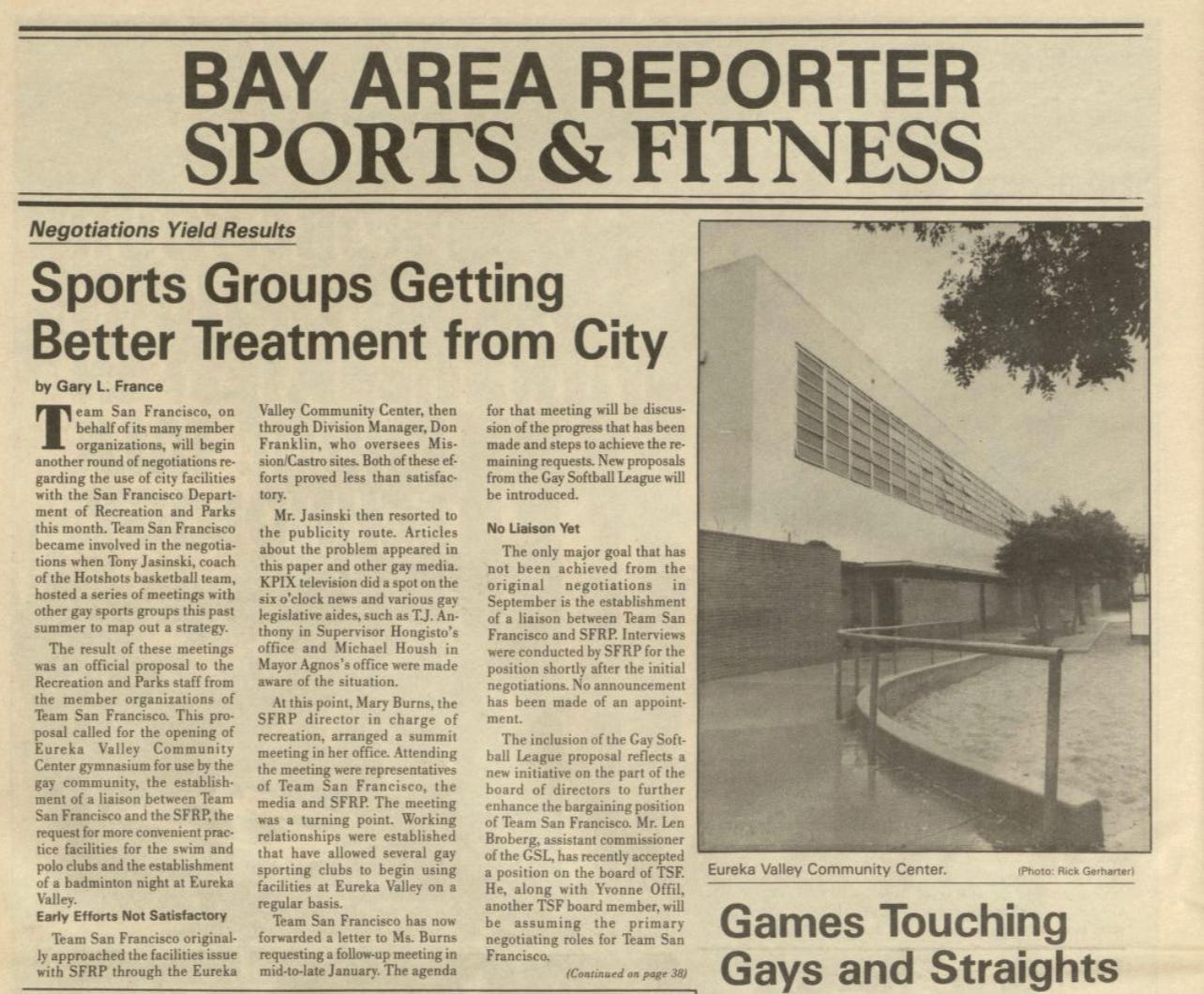
When speaking with league organizers, it’s clear that there is no shortcut to building a community with the level of continuity and closeness that the San Francisco Gay Basketball Association now enjoys. What it comes down to is people like Tony Jasinski, Chris Johnson, JJ Suddreth and countless others that choose to dedicate their time to keeping the league on course.
The willingness to repeatedly perform the annoying or mundane tasks of organizing — making sure referees are paid, dry mopping the court between games, creating schedules, sending reminders and planning fundraising events — is a bedrock of the league’s success. To convince people to routinely dedicate a portion of their free time to an organization, especially the over-worked, screen-addled and socially isolated contemporary American adult, you need to make it worth their while. To this end, creating a smoothly running, reliable operation, with all the requisite legwork it entails from league organizers, is nearly as important as the SFGBA’s uniting principles of diversity and inclusion.
For a majority of the league’s existence, Jasinski was its sole officer and commissioner, with an informal but dedicated cast of helpers who assisted with everything from recruiting to gameday operations. This arrangement eventually met its expiration date, with Jasinski passing on commissioner duties to Pete Myers in 2007. In the period between Jasinski’s resignation and the onset of the COVID-19, the league’s leadership structure slightly shifted, adding a treasurer to assist the commissioner with administrative and fundraising duties.
This setup, too, had its shortcomings, as the league cycled through eight different commissioners in a little over 14 years. Of this time, Jasinski recalls, “I was trying to find someone to take charge, and what you find in our community, especially in the sporting community, is people are there to play basketball, they’re not there to organize and volunteer and do other things.”
For a team of two, the burden of handling organizing, recruiting, administering and fundraising duties was simply not sustainable — a testament to both Jasinski’s unique capabilities as an organizer and the increasingly harried nature of contemporary life. When the league returned to action in late 2021, it adopted a 10-person leadership board with responsibilities ranging from gameday operations to community engagement. All SFGBA teams now have captains, who meet monthly with the executive board and act as liaisons between players and the executive board.
The task of administering the league, and crucially, ensuring that it runs at the level that participants have come to expect, is now divided into more manageably-sized chunks.
“Operations-wise, we set up the scorer’s table and the basketballs and all that, but we also update the league’s mailing list and website. We talk to the gym to get time reservations,” Newman says. “It’s not a ton [of work] day-to-day, but there are tasks like publishing stats and things that keep us busy and doing stuff on Wednesdays and Thursdays during the season.”
The league’s new decentralized approach to administration seems more befitting and of the frantically-paced, over-worked and stressed-out tenor of contemporary American life. The aforementioned 2024 Harvard School of Education Study cites feelings of over-work, work-related exhaustion and general busyness as major drivers of social isolation and loneliness. In 2025, very few people may be able to singlehandedly run the league like Jasinski managed to do for so many years, but when the requisite tasks of doing so are divided into many different parts, the job becomes more palatable within the strictures of modern life.
The Connector
Raised in South Bend, Indiana, Chris Johnson was one of the youngest in a large family filled with high-level basketball players, coaches and trainers. Though he had no shortage of potential basketball role models in his midst as a child, he cites his grandmother as having a uniquely strong impact on him during these formative years. Compared to the other adults in Johnson’s family, his grandmother “gave back to the community in a way that was different,” he recalls. She spent most of her career working at the Logan Center, a South Bend-based and University of Notre Dame-affiliated organization that serves adults and children with intellectual and developmental disabilities.
At age 11, a life-altering tragedy would ultimately bring him closer to his family and to the game of basketball. In the summer of 1991, when Johnson was about to enter the 7th grade, his mother suddenly and unexpectedly died. Far younger than the rest of his immediate family, he recalls feeling trapped at home in the wake of this tragedy, confused and distraught.
“I didn’t have anything because I couldn’t really go out. Like, my older brothers were out doing what they wanted to do, in the streets, with girls, they were having fun,” Johnson says of that summer. “So all I could do was play basketball, and that’s all I did.”
He describes how he would “zone out and play basketball sun up to sun down,” occupying his mind and his time by repeating drills and moves he’d seen on TV. Perhaps without even knowing it at the time, he was turning to basketball as what he describes as “my therapy… my remedy for depression and suicidal ideation.”
Johnson’s family, noticing both his need for guidance in the wake of his mother’s passing as well as his growing aptitude for the game of basketball, stepped in to take more active roles in his personal and athletic development. His grandmother worked to provide him with access to the gyms, leagues and gear he’d need to take his game to the next level, while some of his older cousins, themselves standout basketball players, began training him.
This outpouring of support both on and off the court both spurred Johnson’s’ development as a basketball player as well as his interest in building community through the sport. In 2000, immediately after moving to California, he began working at a community center in the South Bay city of San Carlos, where he led youth sports programs and organized a weeknight adult basketball league. It was around this time when, in hopes of finding an even deeper level of community through basketball, he found out about the SFGBA.
One night after a shift at the community center, Johnson recalls typing the words “gay” and “basketball” into a Yahoo! search, which produced the SFGBA’s website as the top result. Shortly thereafter, he attended his first Sunday open gym at the Eureka Valley Recreation Center. Now, nearly 25 years after that fateful Yahoo! search, he remains a fixture in the city’s Gay Basketball community.
Aside from his current day job as a healthcare professional and his role as SFGBA’s vice president, Johnson dedicates a portion of his free time to providing free-of-charge, one-on-one basketball training to friends and community members. He attributes this inclination toward community service to his grandmother, and the example she set through her life’s work stewarding inclusive education and community building through her work at the Logan Center. He also wants to get the SFGBA more involved in community service, citing plans to eventually sponsor basketball clinics for local youth and neighborhood cleanup events.
Such involvement wouldn’t necessarily be new for the SFGBA. Throughout the late 1980s, Jasinski organized a number of exhibition games and events to raise money for the AIDS Emergency Fund, once even teaming up with legendary queer and drag nun troupe the Sisters of Perpetual Indulgence.
When asked about his inspiration to continue teaching and building community through basketball, Johnson points to the example set by his family members.
“That’s why I really got into basketball training, because I knew what it did for me, so I want to give that back to the community now,” Johnson says. “I come from a family that gives back, from my grandmother giving back to the community and watching other people in my family give back. I also want to give back in any way shape or form.”
(Barely) Staying Connected
Like countless other groups reliant on regular in-person gatherings, the SFGBA’s operations ground to a screeching halt in March 2020, as COVID-19 shelter-in-place ordinances came into effect.
“I honestly didn’t think the league would survive,” Jasinski recalls. “We saw so many other leagues not make it through that year.”
JJ Suddreth, the league’s commissioner at the time, estimates that about 65% of regular players either left the league or moved out of San Francisco altogether during this period, along with nearly the entirety of his executive board. With playing games or gathering in any meaningful way completely out of the question, the SFGBA leaned on one of its own longtime players and board members for guidance.
In his role as a nurse with the San Francisco Department of Public Health, Johnson was dispatched to work in the City’s COVID-19 Command and Response Center.
“I was working on a team doing contract tracing logs and sharing information with the public, and it just so happened that Eureka Valley fell inside my jurisdiction,” Johnson says. “It was serendipitous and pretty beautiful. But, to be honest, the first thing I thought about after I was dispatched was how we were going to re-open the gym.”
Though the league’s home base in Eureka Valley would remain shuttered for the better part of the next year and a half, Johnson and his fellow board members helped keep the league afloat through a regular stream of reliable, clear updates on county COVID protocols and honest insights into when returning to the court would be feasible.
With their usual meeting place closed and other opportunities for in-person socialization limited by safety concerns, county ordinances or general inconvenience, the SFGBA, like countless other communities, increasingly relied on technology to stay connected in those isolating, confounding times. Most of these updates came via the SFGBA’s Facebook Messenger group, which quickly became the league’s de facto online meeting, socializing and organizing space in the height of the pandemic.
The SFGBA had long utilized the internet and social media as a means of record-keeping, promotion and communication (Jasinski was a particularly shrewd, early adopter of the internet, securing rights to the URL “www.gaybasketball.com” in the late 1990s) but the COVID-19 pandemic marked a new era of deeper, more direct reliance on technology to keep the community connected. They also created a server on Discord, a social networking platform that skyrocketed in popularity during the pandemic’s initial phase due to its capacity for customization and facilitating multiple forms of communication including instant text messaging, voice calls, video calls and media sharing.
Since 2017, SFGBA has used Instagram as its main outlet for promoting and chronicling its week-to-week happenings. Scrolling through the league’s posts, one can find “Player of the Week” awards with top performers’ full stat lines, league standings updates and reminders about registration and other administrative deadlines. Every Wednesday night during the season, the account provides real-time video highlights of each game, from the first game’s opening tipoff at 7 p.m. to the third game’s final buzzer shortly after 10 p.m. This level of detail and coverage week after week is, again, the product of league administrators’ consistent effort and attention, all in the name of keeping the community feeling engaged, included and celebrated.
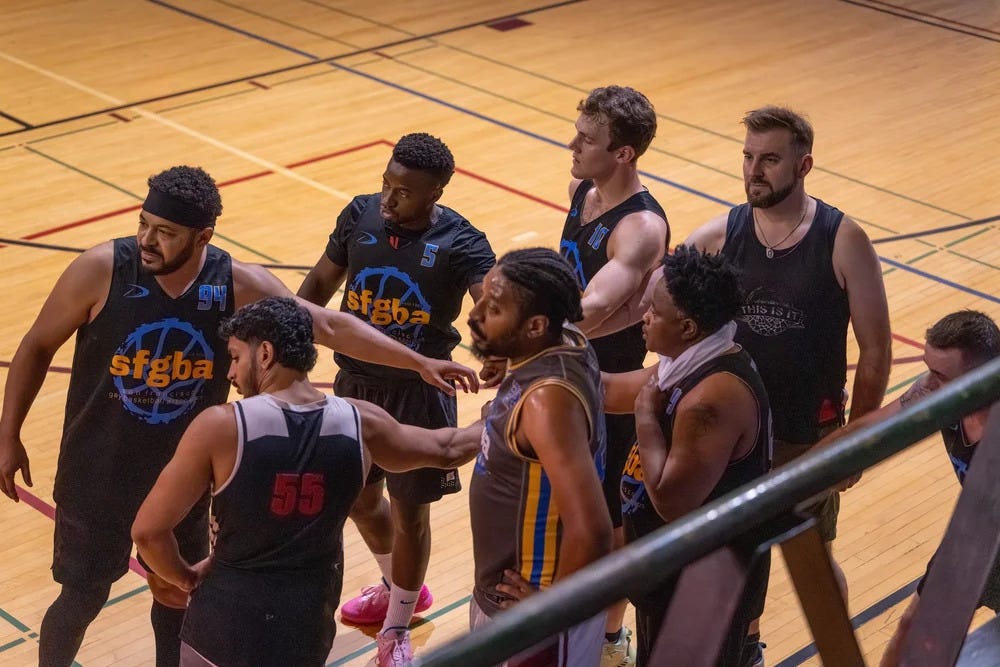
These communication channels, indispensable at the time, are still regularly used by league administrators and players, although in a much more utilitarian way. Now, they keep league members informed about upcoming events, administrative deadlines, social engagements and opportunities to play in tournaments.
Crucially, all of these outlets are only useful to the SFGBA insofar as they amplify and supplement what goes on at the Eureka Valley Rec Center on Wednesdays and Sundays. They were temporarily utilized to bridge the social gaps that COVID created, rather than replacing the in-person connections that the community was built upon. In the years since the league was able to resume regular operations, its recovery and re-establishment as a social hub has come from two familiar, time-tested sources: dedication to inclusion and a meticulous, thoughtful approach to administration.
A Lasting Legacy
As the final buzzer sounded on the first game of the night on October 8th, the environment inside Eureka Valley Recreation Center was its typical mix of excitement, exhaustion, elation and some frustration — “Every Last Drop” had just lost a tight contest against “Sake Slam” in the game’s final minutes. A few moments into this intermission, Johnson and Communications Chair Justin Seiter silently walked to center court. Johnson kindly but authoritatively called the room to his attention, and the crowd immediately hushed. He had an important announcement to make — JJ Suddreth just played his final league game ever and was leaving San Francisco within the week.
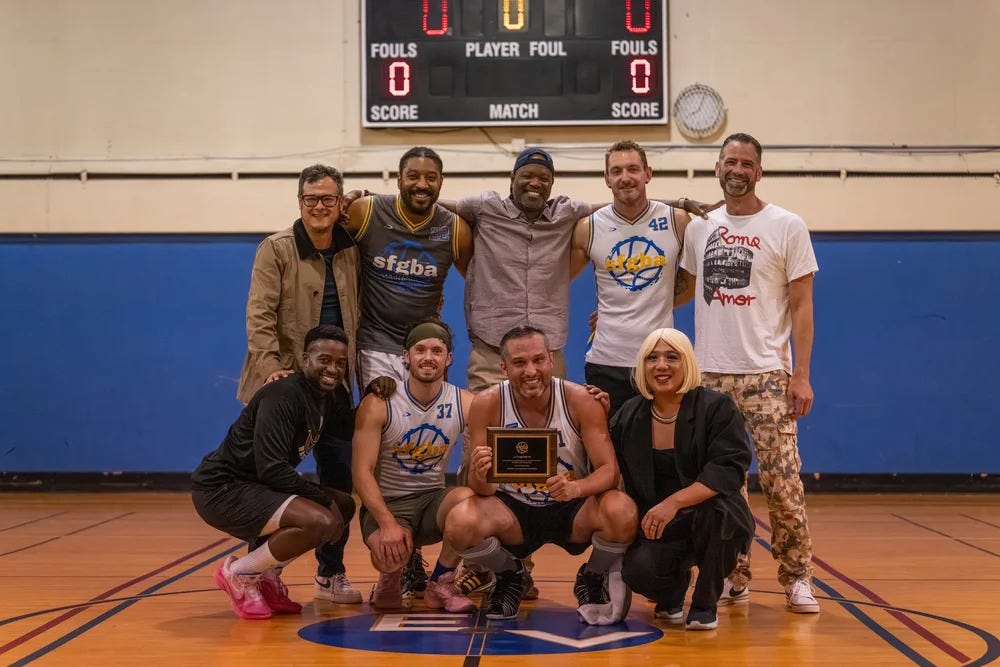
News of this league fixture and former commissioner’s imminent departure sent shockwaves through the gym, and it immediately became clear that this was brand new information for nearly everyone in attendance. Just minutes earlier, Suddreth had almost singlehandedly brought his team to the verge of its first victory of the season, tallying 18 points and 6 rebounds in a gutsy effort. Seiter, standing next to Johnson with a canvas bag in his hand, motions for Suddreth to join them at center court, presenting him with a commemorative plaque recognizing his dedication to the league.
“People who are just getting into the city that are just coming out, you know, they’re young, maybe they’ve lost family, lost community, the league was something, for me, that gave me community right off the bat,” Suddreth said while sitting on a ledge in the Eureka Valley Rec Center’s brightly-lit lobby on the night of his final game.
“[The league] has helped me really be successful in San Francisco, coming from a small town. I always wanted to cultivate that and help as many people as I could through the years. That’s what has kept me driven to do this.”
 | A guest post by
|