

The oldest gay basketball league in the world turns 40
A two-part feature on the history, heart, and social impact of the San Francisco Gay Basketball Association's Castro League.
Tucked away on a quiet, one-way stretch of Collingwood Street, just a block from the heart of San Francisco’s Castro District, sits the Eureka Valley Recreation Center. Its central building is unassuming — a squat, two-story example of municipal mid-century modern architecture — and surrounded by softball fields, old playgrounds, an expansive dog park and two tennis courts. On Wednesday evenings a cacophony of squeaks, thuds, chatter, and cheers can be heard from outside — the tell-tale signs of a basketball game.
Inside, players stretch, shoot and strategize in preparation for tip-off; referees, huddled in a corner of the gym in folding chairs, lace up pitch black patent leather athletic shoes and slide braces over their knees; a team of two operates the scoreboard from a folding table along the sideline.
Those scoreboard operators are flanked by two statkeepers, feverishly logging the games’ every development on a laptop. There’s a professional photographer roaming the court’s perimeter, documenting jump shots, steals and rebounds. A few dozen onlookers, ranging from friends and family to former players and fans, sit among the three rows of bleachers. Instead of exchanging half-hearted handshakes and pleasantries as the final buzzer sounds, players and observers descend upon center court, chatting, laughing and hugging. They ask about each other’s families, pets and significant others; they make plans for postgame drinks and weekend get-togethers. It’s all part of a little known but quintessentially San Francisco institution, the oldest gay basketball program in the world: the San Francisco Gay Basketball Association’s (SFGBA) Castro League.
When SFGBA founder Tony Jasinski first had the idea to organize an open-gym pickup basketball program for gay San Franciscans in 1986, all he wanted was a safe, casual and welcoming place to play.
“I was frustrated,” Jasinski recalls, sitting on a bench outside the Eureka Valley Rec Center on a windy evening this past October. “I wanted to play some basketball, and I’m not a really great player, and [public] gyms like this are often OK, but relatively hostile. You get a hothead or two and it’s no longer fun.”
What started as a casual weekly pickup game has grown and formalized into an inclusive, multi-generational basketball community. It draws dozens of players from throughout the Bay Area every week, is operated by a 10-person board and remains deeply embedded in the Castro community, all while running solely on volunteer labor. In 2026, getting dozens of people to show up anywhere on a weeknight is a feat. The SFGBA’s ability to do so for 40-plus years through its culture of inclusivity and operational dependability, and despite the inevitable waves of personal, logistical, financial and societal struggle, warrants a closer examination. It may even impart some lessons on how to deal with a societal landscape that is rapidly drifting toward isolation, loneliness and technological mediation.
Since the COVID-19 pandemic, there has been a growing cottage industry of work discussing and reckoning with the rise of loneliness and social isolation in contemporary society, with writers and researchers analyzing the issue along generational, gender, racial and class lines. The pandemic may have gotten people talking about these issues and, in some ways, exacerbated them, but their origins stretch much further back than 2020.
A comprehensive study by University of Rochester Professors Viji Diane Kannan and Peter J. Veazie in 2023 found that over the past three decades, the amount of time American adults spend alone has increased by 24 hours per month, while time spent socializing in person with friends decreased by 20 hours per month. According to the American Enterprise Institute’s Survey Center on American Life, we also have fewer friends than we used to — a staggering 49% of those surveyed in 2021 claim to have three or fewer friends, a 22% jump from those surveyed in 1990. These seismic social shifts became known, and, in 2023, officially recognized by the Surgeon General of the United States as the Loneliness Epidemic.
A 2024 study sheds more light on what exactly is causing all of this loneliness and disconnection. It identifies a wide variety of sources, ranging from technology’s tightening grasp on our collective attention spans to the rise of telecommuting and a general societal shift toward individualism. These factors are closely tied to the COVID pandemic, which temporarily turned social isolation into a public health requirement. At COVID’s onset, telecommuting became the norm for many white collar workers essentially overnight. Hundreds of millions of Americans holed up in their homes, avoiding all unnecessary social contact in order to ride out this novel and incredibly deadly virus.
In its own way, the SFGBA has proven rather successful at combatting these socially deleterious trends. It’s a carefully planned, smoothly run, unflinchingly inclusive and decidedly offline community that, with a bit of buy-in, can become home for just about anyone.
“You’d be amazed at how many people throughout the world have put those two words ‘gay’ and ‘basketball’ together and have found community,” says SFGBA Vice President Chris Johnson. “If we have it, we’re going to give you the shirt off our back. There’s so many people [in the league] like that.”
A Place to Play
In 1982, Jasinski travelled from his home in Boston to San Francisco to participate in the inaugural Gay Games, where his team earned a silver medal in basketball. Little more than two weeks later, he moved to San Francisco to take a job at Wells Fargo. Having participated in some gay men’s pickup basketball runs in Boston, he decided to get involved in his new city’s rapidly growing and formalizing gay sports community. By the time the second Gay Games rolled around in 1986, Jasinski recounts that the competition in the basketball tournament had reached “near collegiate level,” casting casual players like himself aside in the process.
In search of a safe and welcoming environment for gay men to play basketball, Jasinski approached recreation centers and church gymnasiums throughout the city, ultimately agreeing to a weekly rental of a basement court at the Earl Poltenghi Youth Center at 1525 Waller Street.
“I put up my own cash, put up some signs in the Castro and an ad in one of the local papers at the time,” Jasinski says. “That first week 10 people showed up, and some of them stuck forever.”
The Friday night pickup games lasted on Waller Street for about a year, until the youth center was remodeled into the city’s first family homeless shelter. Jasinski moved his group — still very much a DIY operation at the time — to the Eureka Valley Recreation Center, a city-run facility in the Castro District. But the nascent gay basketball outfit received a surprisingly cold reception in the Castro, which, by that time, was firmly established as the epicenter of the city’s LGBTQ+ community.
According to Jasinski, the Eureka Valley Recreation Center, which he chides as the “last bastion of straighthood in the neighborhood” at the time, initially denied the group’s venue rental application without cause or justification.
“So, I went on the Channel 2 news, because they’d heard that I was being denied access to the gym, and I was filmed on the court and was basically saying discrimination, discrimination, discrimination,” Jasinski recalls, a slight glint in his eye. “And the very next day the head of Parks and Rec called me up and said, We’ll fix it.”
Though they did eventually reach a weekly rental agreement for the Eureka Valley Rec Center’s gymnasium, the relationship between the San Francisco Recreation and Parks Department and the gay basketball program would prove to be consistently rocky through much of the 1980s.
Differences came to a head in August 1989 when, during one of the weekly runs, a group of teenagers entered the gym and rushed the court mid-game, forcing the action to an awkward, contentious pause. As reported at the time to longtime local LGBTQ+ newspaper the Bay Area Reporter, the incident did not turn violent, as the basketball players were able to usher the young intruders back outside, subsequently locking the gym doors behind them.
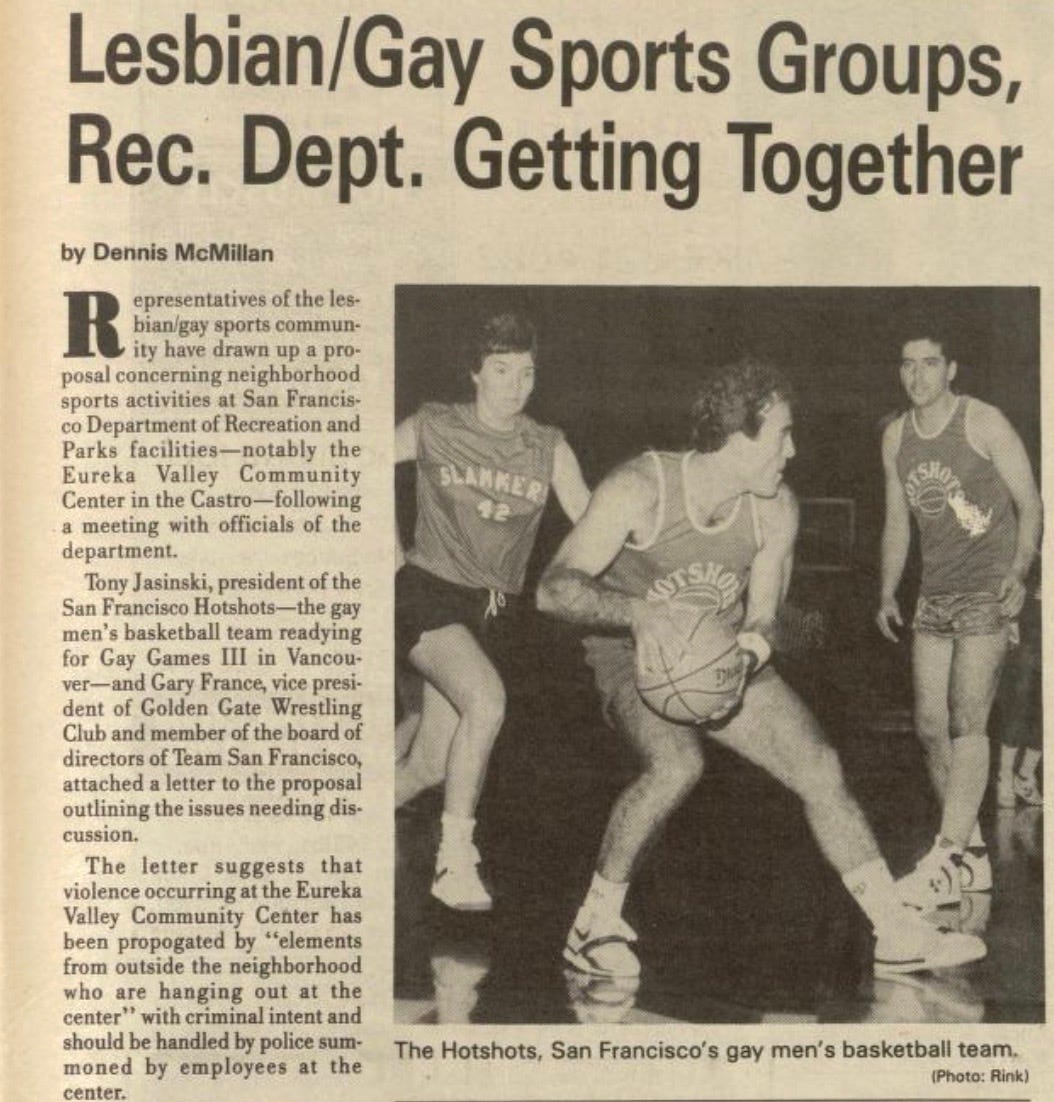
It’s unclear whether this specific incident was a targeted anti-LGBTQ+ act, but the Eureka Valley Recreation Center was known among local LGBTQ+ advocacy groups, like Community United Against Violence, as a hotspot for anti-LGBTQ+ activity and even hate crimes, pointing to a larger-scale issue at hand. In the wake of this nearly-violent encounter, the rec center’s superintendent, Joel Robinson, wanted Jasinski’s group to pay for additional security presence at the facility on nights they played, which would’ve raised the weekly rental rate from $64 to $104.
Faced with this untenable price hike, a looming threat of discriminatory violence and an uncooperative local administrator, Jasinski turned to his strongest talent: organizing. Not only did he circumvent the Recreation and Parks Department’s security fees by deputizing two of his own players for the job, he turned the situation into a referendum on gay sports in the Castro writ large.
Jasinski rallied his fellow gay sports league administrators around the cause of creating a more welcoming environment at the Eureka Valley Rec Center, leading a series of strategy meetings throughout the summer of 1989. At the time, Jasinski alleged that the center held only two gay sports events per week - his basketball group and the Golden Gate Wrestling Club — a disproportionally low number given the neighborhood’s demographics and reputation. The group drafted a multi-pronged proposal aimed at better integrating gay sports leagues into the Recreation and Parks Department’s programming and operations. Gary France, a member of this coalition and head of the Golden Gate Wrestling Club, described the proposal to the Bay Area Reporter as “a first step in involving the gay sporting community in the use of the facility at Eureka Valley and in establishing a successful and meaningful working relationship with Recreation and Parks.”
When the group’s calls for reform and acceptance were initially disregarded, Jasinski again sought out the local media to amplify his group’s message, securing coverage on local television station KPIX. The television spot caught the eyes of a few City Hall power players, including Parks and Recreation Commissioner Connie O’Connor, who proved to be a strong advocate for the group’s cause. With Commissioner O’Connor’s assistance, Jasinski and his counterparts were able to schedule a series of meetings with the City that established a more open and collaborative posture from the Parks and Recreation department toward the gay sports community. Jasinski’s basketball group, in all its permutations both casual and formal, has called the Eureka Valley Rec Center home ever since.
Jasinski’s advocacy for equality and acceptance translated to his on-the-court philosophy as well. Early newspaper advertisements for his Friday evening runs often included the blunt line: “There are only two rules: no hostility is allowed and everyone must try their best!” He echoed this sentiment when asked about the group, stating that its focus “was always drop-in ball,” recounting the early years.
“Whoever shows up, plays. We’d divide up teams and I was always trying to make them even and make sure everybody got as much time as everybody else, whether they were good or not.”
In 1996, SFGBA started its Wednesday night Castro League, adding a second event to its weekly calendar.
The Castro League
To watch the SFGBA’s contemporary iteration is to witness Jasinski’s philosophy applied to a new generation playing a decidedly modern style of basketball. The league currently hovers around a half dozen teams per season, with annual spring and fall sessions. This regular, consistent schedule — games are always at 7 p.m. and 8 p.m. on Wednesdays, seasons occur over the same time spans each year, all events take place at Eureka Valley — affords the league a crucial level of continuity on the court as well as the development of strong relationships off of it.
The SFGBA, like any other large, raucous and fun-loving extended family, takes advantage of every possible opportunity to break bread together. Sometimes that comes in the form of postgame drinks at The Mix, a local watering hole just across Castro on 18th Street. On the weekends, there’s Jock Sundays at famed Market Street bar The Lookout, where a portion of sales go toward various LGBTQ+ sports leagues. Every June, volunteers from the league run a beer booth at the city’s world-famous Pride festival, itself in its fifth decade of existence. Between these recurring events are dozens of informal get-togethers, from gatherings at Jasinski’s home around the corner from the Eureka Valley Rec Center to impromptu nights out in the Castro.
These connections shine through on gamedays, as each team has a distinct style of play based upon their players’ blend of skillsets. Some teams, like To Be Continued, are led by fleet-footed, ball-dominant guards who push the pace of the game to tire out their opponents, pestering offenses as they cross half court for all 40 minutes of game time. The team’s ball-hawking backcourt consistently forces turnovers, turning hard-nosed defense into easy fastbreak opportunities on offense.
Teams like Every Last Drop, on the other hand, base their gameplan on their height advantage, focusing on getting the ball into the paint with crisp interior passing between the team’s many talented forwards.
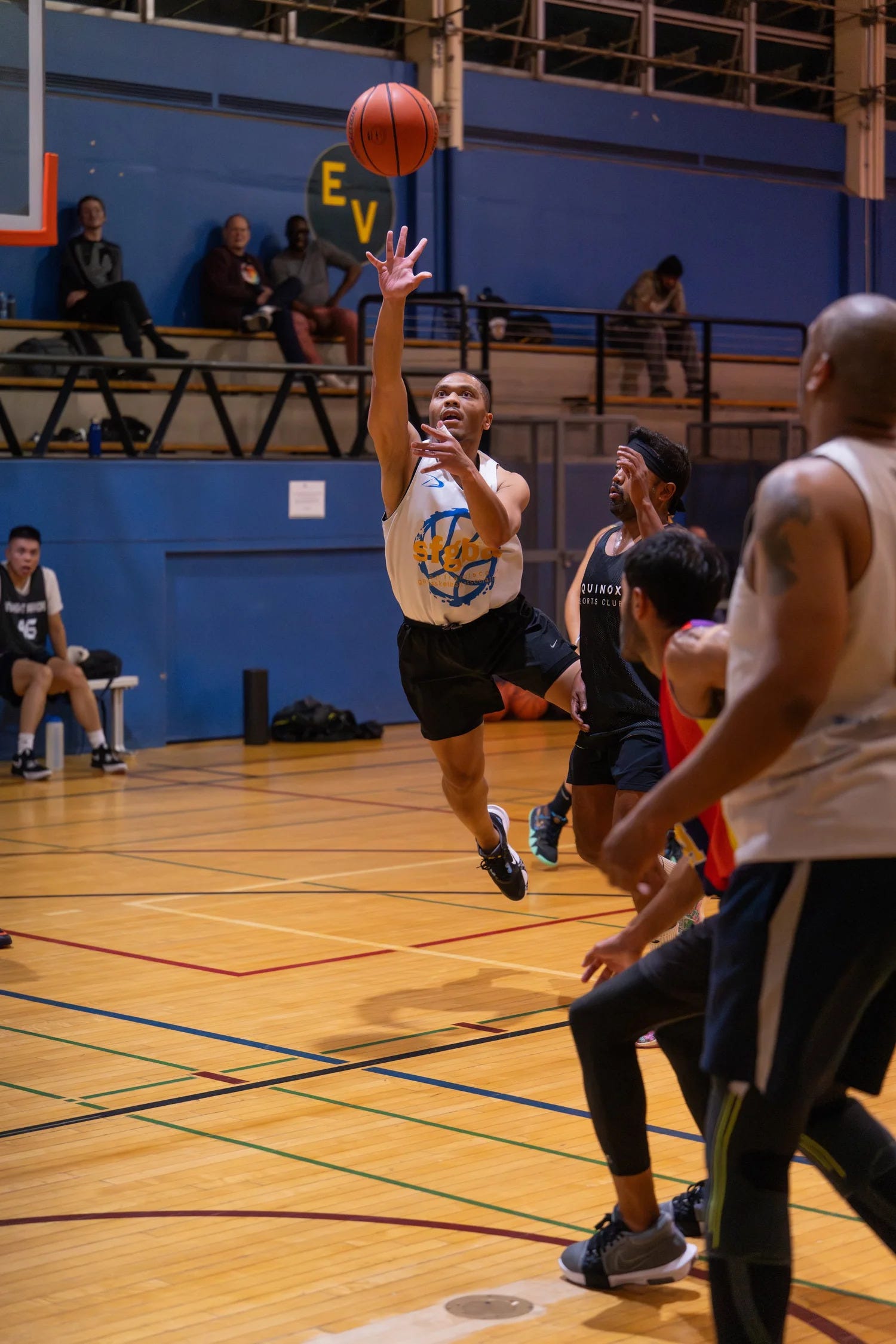
Generally, players seem comfortable with and even relish the opportunity to slot into whichever role is best suited to help their team to victory. Long-range specialists linger around the three-point arc, awaiting a kick-out pass from a driving teammate or a long rebound to come bouncing their way. Larger players repeatedly crash the boards, jostling for position and possession. Hierarchies do seem to emerge on each team, and the best players spend the most time with the ball in their hands, as is common among longer-standing and more organized leagues.
This isn’t to say, however, that the SFGBA is a fleet of perfectly-oiled machines. Knees creak, players double over in exhaustion toward the end of games, balls careen off dribblers’ feet, wide-open layups are missed. These kinds of miscues, which are all common sights in gyms the world over, seem less important than what happens immediately after one of them occurs during a SFGBA game.
Take, for example, the first half of an early November matchup between To Be Continued and Nooners. To counter the size advantage and post scoring ability of To Be Continued big man Ryan Briggs, Nooners defenders began double-teaming Briggs whenever he’d get the ball. Instead of responding to this defensive tactic by attacking the open space left by the second defender and cutting toward the basket, Briggs’ teammates hovered around the three-point arc, waiting for their big man to pass the ball back out to the perimeter, a response that defied both Briggs’ on-court pleas and conventional basketball wisdom. This misalignment between Briggs and his teammates caused the team’s offense to stagnate and the early lead that To Be Continued had built to quickly evaporate.
During a subsequent, much-needed timeout, tension didn’t boil over, nor were any fingers pointed. Instead, Briggs and his teammate Tristan Davis used the time more constructively, explaining offensive counter-strategy to some of their less experienced teammates.
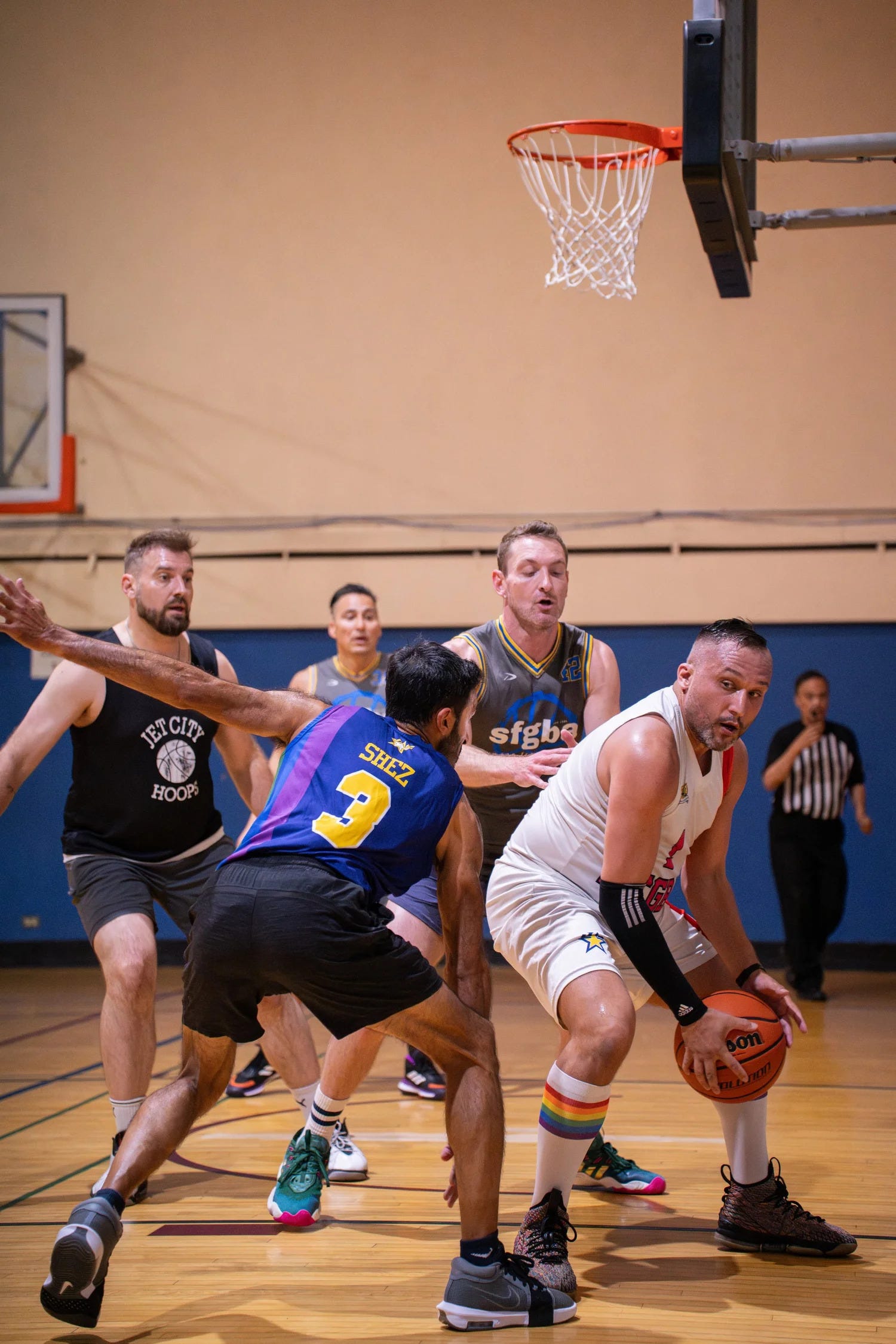
Uncommon among rec leagues, SFGBA includes players with a wide variety of skill and experience levels. Every week, players with obvious high school- or college-level experience suit up alongside relative newcomers to the game, and remarkably little tension results. This is no coincidence or magical confluence of incredibly understanding individuals (although everyone in the league that I’ve come across has been delightfully kind); this consistently inclusive and supportive environment is by design.
Sitting at a tiny two-person table tucked in the corner of a cafe on a particularly noisy part of Geary Boulevard, current league Vice President Chris Johnson speaks frankly about the league’s approach of being stern and upfront with those who cross lines and jeopardize this carefully-crafted environment.
“We want to honor every person, as well as to honor the game,” Johnson explains. “People are not coming here to get hurt, to be abused. We’re coming here to really kinda gel, build chemistry, have fun, get a workout, release endorphins of course, and build community.”
Key to the league’s sustained success, it seems, is a commitment to inclusivity along all lines, not just to players of different skill levels.
Jasinski and his fellow league administrators did, however, have to contend with teams circumventing a well-meaning but unpopular rule that they established at the league’s founding. To assure a worthwhile, inclusive experience for all involved, Jasinski instituted a 10-minute-per-game minimum of playing time for every player in the league. Some teams voluntarily abided by this rule, while some worked to find loopholes around it. Others openly defied the rule, forcing Jasinski to either punish the team or let their indiscretion slide. Eventually, Jasinski recalls abandoning the rule, as he has found it easier and more productive to promote a general environment of inclusion and acceptance than to engineer inclusion via hard-and-fast rules about playing time.
Connecting the Bay
Despite what its name implies, SFGBA’s community spans far beyond just gay, cisgender men. It has long welcomed players of all gender expressions and sexualities, and its mission statement names diversity and inclusion as its two primary guiding principles. Amidst the Trump Administration’s (and the American right wing writ large’s) ongoing efforts to discredit, vilify and defund all civil organizations that hold these exact same principles, particularly those serving marginalized groups like the LGTBQ+ community, the SFGBA’s continued embrace of diversity and inclusion is itself a community-affirming and community-building act.
“The league is more about helping people versus shaming people,” Johnson explains. “I mean, we can get that just by stepping off the Muni wearing rainbow, so why would we ever discriminate within our own family?”
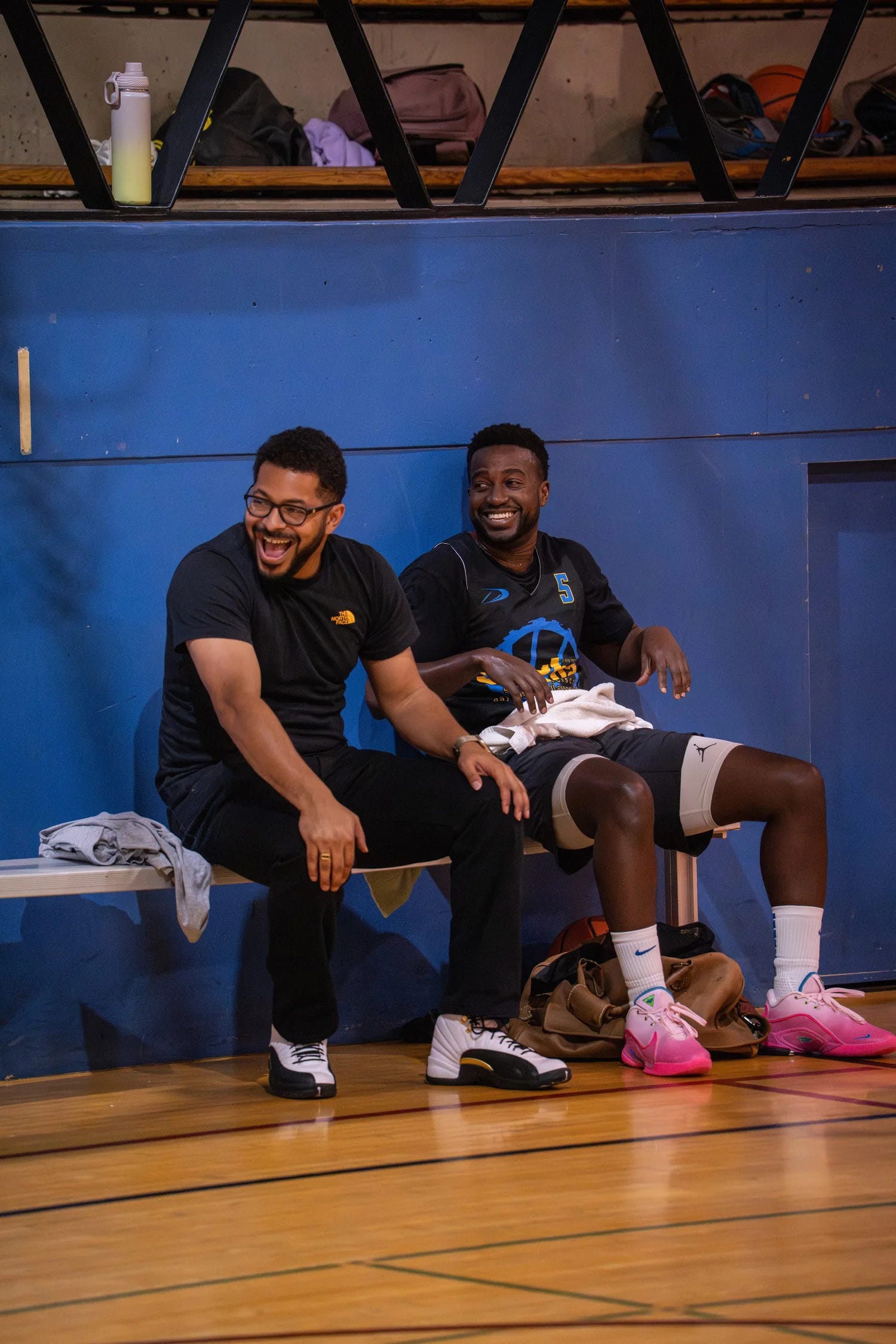
The league is a collection of longtime San Franciscans and newcomers, of commuters from the East Bay, Marin County and San Jose, of those firmly planted in the Castro District and those who have moved in and out of San Francisco multiple times. There are also relatively recent San Francisco transplants like Tim Newman, a league member since moving from the East Coast in 2022, who turned to SFGBA as a way to integrate himself and find community in a new, unfamiliar city.
“When I first moved to San Francisco, the first night I was in the city, I decided to go to a local gay bar because I wanted to meet some people and make some friends,” Newman says. “And it just so happened that the first person I met was JJ [Suddreth], who at the time was the commissioner of the SFGBA. He and I became really good friends and he invited me to join the league and I said, ‘Absolutely, that sounds like a great idea.’”
Though he had never played organized basketball before then, Newman recalls going to his first SFGBA Sunday open gym shortly thereafter, “I met Ryan Briggs and Justin Seiter there [at the open gym] and they taught me a lot about how to play, how to move, all that kind of stuff. And they were super nice to me. So then I signed up for that next [SFGBA] season and kinda went from there.”
“I’ve played in a lot of different sports leagues — some gay, some straight, some basketball, some not — and I have not really found a social scene that matches what SFGBA does,” Newman says. “I’ve met a ton of my closest friends at games, and even people that don’t play in the league anymore still come back pretty often to watch games or just say hi. I’m also doing a Volo [basketball] league right now and there’s, like, no one around in the stands. It’s a different environment.”
Some players become close friends, some date for a while, some find lifelong partners through the league, but the overarching relationship between all who’re involved with the league is one of mutual care, acceptance and, when necessary, aid.
“The different generations and people who actually give a fuck about you, and care, we go the extra mile,” Johnson says. “But it’s not even an extra mile, it’s just normal, like breathing.”
Johnson recalls a specific experience during COVID that exemplifies profound bonds that exist within the SFGBA community. At the height of the pandemic, one of Johnson’s fellow league administrators was temporarily experiencing homelessness. Remarkably, few within the league knew of this person’s circumstances at first because he continued to perform his usual league duties, both on and off the court, without incident. When Johnson eventually caught wind of this, he immediately offered to house his fellow league member until he could find a more permanent arrangement.
Through the work of people like Johnson, Newman, Suddreth, Jasinski and countless others, the SFGBA has become an exemplar of “social infrastructure”, defined in the Office of the Surgeon General’s 2023 advisory on the Loneliness Epidemic as “programs, policies and physical pieces of infrastructure that promote social cohesion and gathering.”
The SFGBA combines all three of these defined elements: it utilizes a physical piece of infrastructure (the Eureka Valley Recreation Center) to operate its program (the Wednesday night Castro League and Sunday open runs) and implement its stated policies (inclusion, diversity and acceptance), all in the name of creating a space for positive social interaction and community building. The Surgeon General’s advisory also includes “strengthening social infrastructure” as the first of its “six pillars to advance social cohesion.”
Social cohesion and community are examples of “social determinants of health,” or external conditions and circumstances of a person’s life that impact their physical and psychological health. According to a 2022 study by the United States Centers for Disease Control (CDC), social isolation and prolonged stretches of loneliness can cause a variety of severe health effects including increased risk for heart disease, stroke, dementia, type 2 diabetes, depression, anxiety, and premature mortality.
Loneliness and social isolation are experienced at different rates among different demographic groups, and as the Loneliness Epidemic becomes more pronounced and widely discussed, the amount of available research about these differences also grows. The abovementioned CDC study contributes to this body of research, with its survey finding that feelings of loneliness were “significantly higher among [surveyed] adults who identified as gay (41.2%), lesbian (44.8%), bisexual (56.7%), or something other than gay, lesbian, bisexual, or straight (50.7%), than among those who identified as straight (30.3%).”
But constructing a piece of social infrastructure that’s sturdy enough to withstand the test of time and all of its requisite challenges requires more than just a strong unifying ethos.
Part II publishes next week.
 | A guest post by
|
This is wonderful! I didn't know about the SFGBA's Castro League, but it was great learning about it (and its history) here. I'm excited for Part II! Great article, Ben!
So rad! Looking forward to reading more