

Repost: Relentless revving
The NBA's trade machine churns on, and what's been knocked loose in Giannis Antetokounmpo?
In light of yesterday’s news that Giannis Antetokounmpo was traded to the Miami Heat (for, roughly, a third of the Miami Heat) I thought I’d unlock and repost this piece I wrote about him in January.
That was when the trade machinations around Antetokounmpo, though they’ve been grinding away for seasons, reached a new frequency in their strain. It was also the thick of winter. If you’re averse to either — the endless discussion around trading Antetokounmpo, the winter — my apologies, but there’s a catharsis to both being over.
For days there’s been one persistent sound. It starts guttural; low, nagging complaint from the belly of a beast. From there it moves into churning grumbles, tapering to silence or else climbs, pitch gaining tonal strain. If the strain gets too frantic, too tight, there’s an easing off, seconds later it begins again. Cars, many of them, struggling in the snow that’s been dumped on the city. Spinning wheels, stuck.
Toronto gets snow and most drivers are used to it. Still, there is a muscle memory that must be coaxed back to life for drivers in the city and it usually comes with the first big snowfall. The sound of that reawakening is revving.
Relentless revving.
All the windows in my apartment face onto one of the city’s main roads where it begins to climb steadily uphill, and where another of the city’s big streets intersects it, dead-ending and spilling its traffic. One morning this week, after a night of straight snowfall, I made coffee and idled at the window while it brewed, watching the early morning traffic creep cautiously along.
There’d been no overnight plough, the road was the same colour as the sidewalks, as the boulevards, as the thick blanket weighing on the trees: white, all white. Most every driver kept it cool — after all there is no rush to get to work with the baked-in excuse of a snow day — but sure enough, pouring my coffee, I heard my first rev of the morning. Back over at the window to watch a small silver sedan make a swaying fishtail forward a dozen feet before sliding backward and punching the gas. The wheels spun but the car didn’t go anywhere. That churn, that strain, somehow extra futile in an extra muffled world.
Eventually, if you’ve got a situation like mine, you learn to tune the sound out. Either that or you leave the house. I suppose the same goes for the NBA Trade Deadline.
The revving of the NBA’s trade machine, its strain this time of year, I try my best to shift my attention which only works so long as I’m not asked about it and that only lasts as long as between podcasts, shows and idle conversations at games. Not a winning strategy, but the best I can do.
I don’t like trades for their own sake. The monetary machinations of front offices, the win/lose dichotomy of trades, pretty dull to me. The proprietary language placed on athletes, assigning people a wholly arbitrary going rate (X for X player, future picks, or worst of all — cash considerations) or that shuttling people’s lives around is such a gleeful prospect to some, that part has always felt gross. Trades centred on individual experience, that part I enjoy and when I’ve spoken with athletes about it, yield the most interesting takeaways. Careers that suddenly blossomed or rekindled, new perspectives for athletes, more recognition and appreciation for them from new fanbases, those things feel great. To some degree, I can admit that is me finding the silver lining of trades in order to exist in the same ecosystem that demands them.
Huge stars, the people fans and media alike most want to be traded at deadline time, are the least likely to be moved. When and if they do it’s in the summer, and then, they tend to move themselves. So it’s been unusual to witness the rev and churn of this trade season centre around big stars — Giannis Antetokounmpo, Ja Morant, Anthony Davis — to the extent that I wonder if last winter’s Luka Doncic-Anthony Davis swap warped everybody’s brains to a degree we haven’t recovered from yet.
It’s possible players haven’t either.
A kind of steady phenomena in the NBA has been the correspondence between perceived stardom and safety. That athletes who achieve a certain level of star power are removed from the steady, banal churn of trade talk and its related stresses. That it’s possible to become too big to be traded.
When Doncic was traded to the Lakers the two-way mirror gained with that tier of stardom shattered. Players at that level suddenly and wholly exposed.
“If he can get traded then anybody's up for grabs,” Kevin Durant said.
“I'm scared,” Anthony Edwards chuckled. “Tim [Connelly], if you're gonna trade me let me know dawg. When Luka got traded anybody is able to get traded at that point.”
“I think nobody is safe in the league, it seems like,” Nikola Jokic said.
“Luka being a guy that everybody has claimed is untouchable, and untradeable, and the NBA shows you again. You just can't predict it, you know, it's a business. They're always having a conversation about you, so don't think you're safe at any point,” that was Devin Booker.
It was Antetokounmpo who gave one of the longest answers when asked for his reaction to the trade. An answer that ranged from shock to rattling off, by heart, Doncic’s career-best stats and accolades then circled back to himself, his own efforts, and finally, to what rang like a future-proofing appeal:
But at the same time, it goes both ways. You cannot have a double standard here… When a player believes that he can go to a different team and he believes he can have a chance to win a championship, we cannot crucify the person and say that he's not loyal and he didn't do the right thing and he let everybody down. Because history has shown you, you have to do what is best for you and your family. You have to do what's best/most important to win.
That was nearly a year ago and the rev around Antetokounmpo, the entire NBA ecosystem spinning its wheels to smoke, hasn’t let up. As if his public-facing realisation — that effort didn’t guarantee infallibility, that dedication didn’t mean a fan base wouldn’t turn on you — corresponded with our own.
Since then, he’s veered from cryptic to rebuffing, has said demanding a trade is not in his nature while reserving the caveat that human nature (“Now, if in six, seven months, I change my mind, I think that’s human too, you’re allowed to make any decision you want”) is sometimes about changing your mind.
Not to draw too stark a comparison, but the other stars who’ve had their names swirling in trade discussions have been mum or miserable when asked about the prospect.
Morant gave short, strained answers in Berlin this week to questions of his future with the Grizzlies. Hunched over, arms crossed, eyes faraway, his body language — compared to an upright and direct Jaren Jackson Jr. who followed him on the podium — said everything he didn’t. Trae Young said some subdued goodbyes as the game he was traded in the middle of wound down and left the floor, quietly as he could, before the final buzzer. Davis has been out, injured, perhaps generously spared from interrogation, but if past behaviour is the best predictor of future action then if asked, I’m sure he’d make a light joke while still looking a little bit hurt.
There is of course no good or normal way to discuss your own trade. The most rote response to lean on is “It’s a business” and that’s because framing it that way, saying those words as a murmured prayer, takes the sting out. How else to comprehend and translate, in the moment, on a podium or in a locker room, that your future plans will abruptly and knowingly to those you’ve entrusted with them, evaporate? How else to explain the feeling of having no control?
I think we’re accustomed to the quiet of an athlete’s response to the prospect of being traded. To a person being clipped, short, and subdued in the face of that uncertainty. Telling us, It’s a business, so we can all — them and us — move on.
Not so Antetokounmpo, who since the Doncic trade has been spinning his wheels.
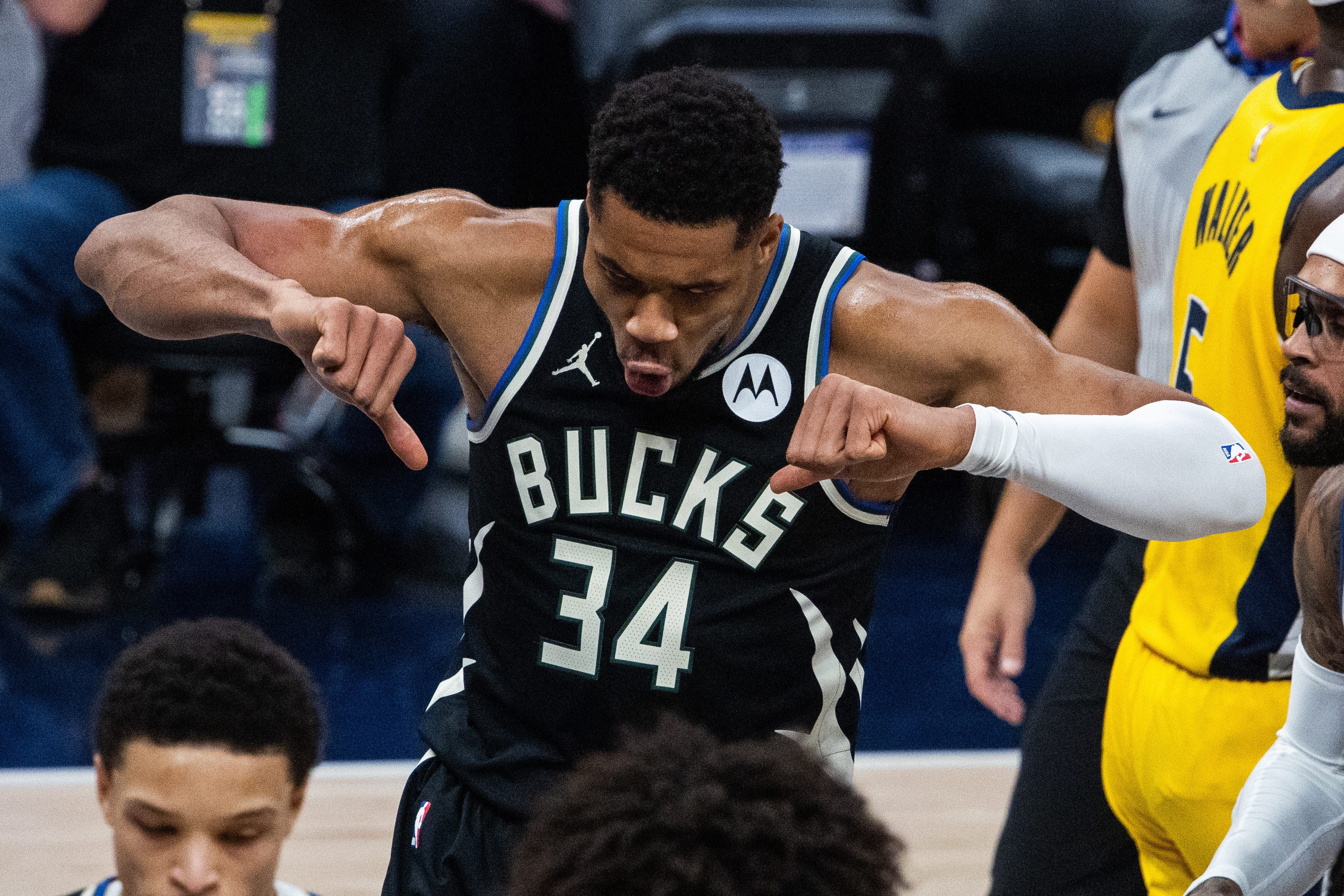
It’s not that what he’s saying is so unfamiliar (loyalty and effort are recurring themes in the NBA) or radical (people do have the right to change their minds; that people are changeable is pretty much the only sure thing in our world, geopolitical and beyond, right now) it’s that he keeps saying it that marks him as querulous. It’s also why he keeps getting asked. His open-endedness a recurring invitation, his truisms a chicken-or-egg for the NBA trade set: What comes first, his agent asking for a trade or Antetokounmpo saying he would never ask for one, himself, outright?
Still, it does seem like the Doncic trade knocked something loose in Antetokounmpo.
Maybe he’s aware of all the fodder he’s shovelling into the trade machine, has seen there is no safety in stardom but some measure of power to feeding the insatiable hunger for information about his rarified class. There is also Antetokounmpo’s duality, a trait that’s flashed unguarded and often for us throughout his career, a trait that tends to trained, coaxed or forced out of athletes at this level. A trait without which we wouldn’t be walking so many circles around this question.
Can trades live in the body, like muscle memory? If so, is Antetokounmpo’s fixation preemptive, borne out of the fear of not having felt that particular quality of hurt yet? Is that a fear we’d even allow our stars — to get out ahead of rejection, to worry it and work it; lead us in the opposite direction for an elaborate emotional pump fake?
It could just be a new sense of urgency, that the league is moving on without him. If it’s a new recognition of susceptibility, that his stature and gravity as a star will, in some trade situation or as an eventuality, wane, then that’s a mortal wrench we all face — whether in world-lapsing pause or heavy duty instrument wielded, on desperate occasion, to jam up the machinery.
It’s snowing again.
Coming home in it I go slow, careful through the deep tracts cut by the sidewalk ploughs that only sort of shift the snow around rather than clear it away. I make it into my lobby with a neighbour I haven’t met yet, both of us busy with the process of recalibrating after coming in from weather. We step into the elevator and let out simultaneous big sighs, look at each other and laugh for how blanketed in snow we are. Her glasses fogging.
It’s like déjà vu, I say.
I thought we were past it, she smiles.
Well, what can you do? I offer, reflexively.
She laughs, a big friendly burst. Absolutely nothing, my dear!
This is the other option, I’m quickly and kindly reminded of. Resignation, acceptance. How often this goes against the core rhetoric of what we tell athletes it takes. Not only to be great but to exist at all, to secure their very continuity.
The biggest fear, in bad weather or situation, is always the false one — that you’ll be stuck forever. That’s when we get frantic, panic. Make bargains and bets. Anything for a stay to the endless spinning of wheels.