

Best shot, worst case
The NBA's hierarchy of betrayal, and disintegrating in the orbit of someone else's star power.
Standing on the Raptors baseline with Dan, watching LeBron James warmup.
When James is in town — any town — fans crowd the gates well before they normally would so they can watch him do the same. The arena thrums with excitement, with James’ name. James knows.
He doesn’t do anything different, doesn’t rush himself or bend his routine. Steph Curry, by contrast, will happily showboat, joke around with his coaches and flash grins at the crowd. James moves precisely through the circuit, ticks every hour on the semi-circle clock of the half court with a series of shots, occasionally towelling his face with his shirt. He doesn’t avoid the crowd, he’ll glance, but nothing about the spectacle of it registers since the spectacle is him.
James reaches the end of his warmup, lines up at the top of the key to shoot free throws. A crowd of media has gathered around Dan and I in anticipation. Every single person has their phone out, trained on James. Typically, if a player can dunk this is where they’ll do it to punctuate the end of their routine.
Are you going to dunk? Dan asks James, motioning to the rim above our heads and just one step forward.
James smirks, the high shine of the court catching on his brow, his teeth. He shakes his head ruefully at Dan as if to say, not unkindly, You motherfucker.
I’m tired, he mouths.
Ephialtes showed the Persian army a narrow mountain goat track to ambush the Spartans during the Greco-Persian war. Mir Jafar expedited Britain’s colonial conquest of the Indian subcontinent, bringing about the fall of the Mughal Empire. Benedict Arnold sold out the Americans to the British in their War of Independence.
For Ephialtes, a local, the path between Trachis and neighbouring Malis was one he took often. His insight less military intelligence than giving directions to the large army at his door.
Jafar got a seat of power in the newly fractured Bengal, a puppet for the British East India Company for the rest of his life. He’d be called “A stigma on humanity, on religion, and the country” by Muhammad Iqbal, one of the great Urdu poets of the 20th century and the intellectual founder of Pakistan.
Arnold felt he was being passed over for promotions and not given credit for his tactical prowess. He was also up to his neck in debt. He fled to the (can’t make this up) HMS Vulture for safe passage north and eventually, to England. Arnold’s name is still slang for treachery, so in the end he did get the notoriety he was after.
After defecting, Arnold wrote an open letter to the American people in an attempt to explain himself. Its conclusion reads an awful lot like the lament of the unhappy NBA superstar who has forced a trade:
Some may think I continued in the struggle of those unhappy days too long, and others that I quitted it too soon.
Betrayal is, at its base, a breach of subjective expectation. At its linguistic base, from the Latin tradere, “to hand over.”
At an emotional level, much harder to parse. In a study that interviewed 900 people about their own examples of betrayal, the central theme, if there even is one, is that betrayal is felt by the person who perceives themselves to hold less power than the person inflicting the betrayal. A partner cheats on the other, a boss throws an employee under the bus, a friend discloses sensitive information without consent. Because betrayal is so subjective — what constitutes it for one person won’t be the case for another — the action may be even less important than the decision to act. The sense of betrayal lingers and festers because the person betrayed interrogates the decision: when it was made, why, how long did it hover there half-formed, that it was made at all.
This hierarchical power structure exists in sports and informs its own betrayals. For fans, it jumps up to the athlete, from athlete up to front office, from from office to ownership. Betrayal laid at the feet of the person deemed one notch above the other.
What about the tiers within these tiers? The team, for example, with its athlete hierarchy. Typically this order can be straightforward to parse: least experienced to most (which also tends to translate into money and who makes the most, a human symbol for power and its consolidation so long as we’ve had and hoarded it). With journeymen and role players scattered between and subject to jockeying qualifiers like minutes played, titles won, most relevant skillset to the present season, etc.
What about the even more interstitial tiers, where hierarchies aren’t clear at a glance? Like the relationship between two stars on the same team, or the demotion of a superstar given the gravity of another?
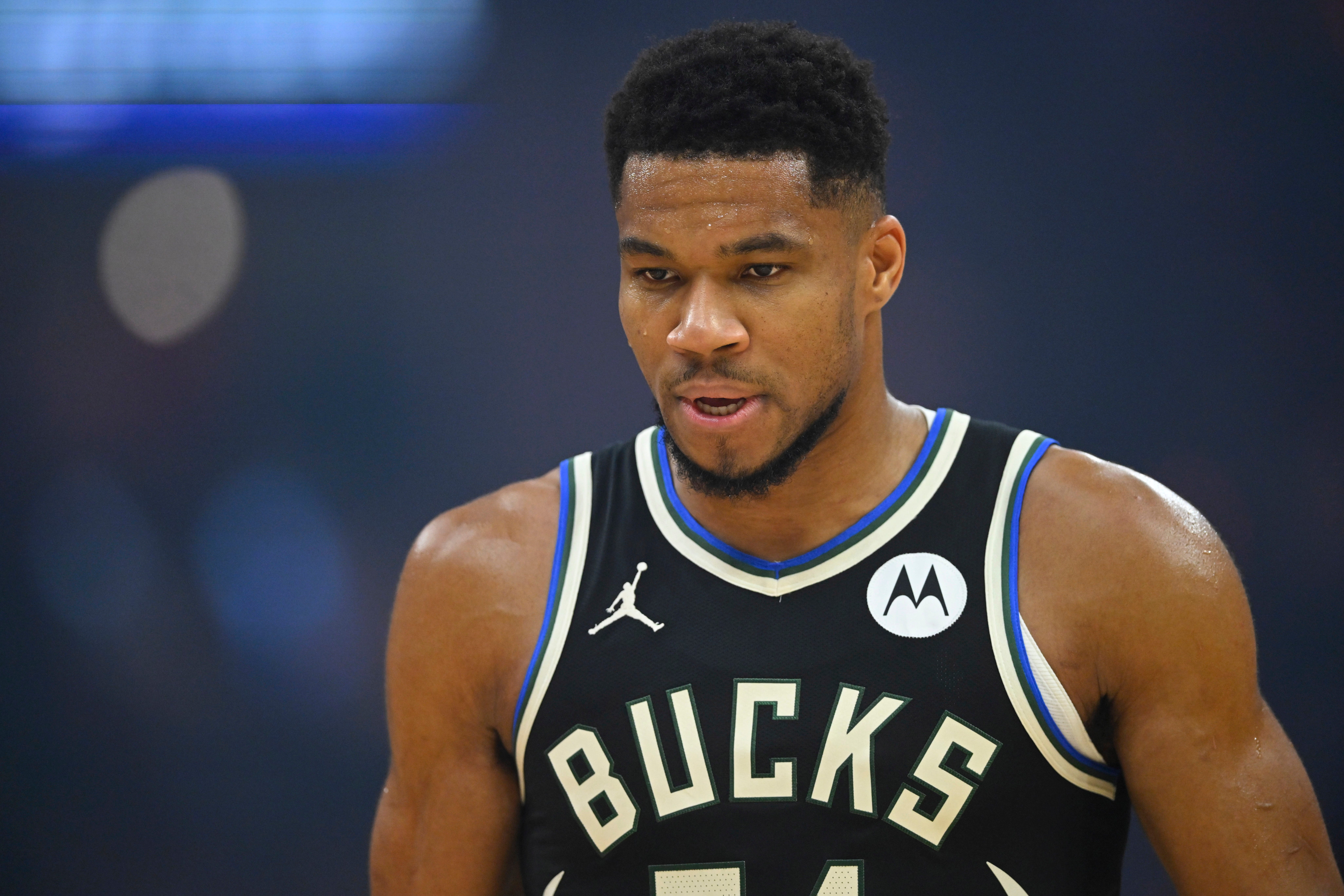
It wasn’t Giannis Antetokounmpo I thought about when the star and his camp likely leaked this week that Antetokounmpo was, again, seeking a trade out of Milwaukee — it was Damian Lillard. From Lillard it skipped to Myles Turner (loathe as I am to admit, but to be transparent and prove that even when idle hierarchies exist, that skipping felt like a slight mental movement down). Two people, two stars, who are in different stages of being caught in a greater power’s slipstream. For Lillard, the toll to wrench himself out was two wholly failed seasons and an Achilles tendon, for Turner it’s too early to tell.
Both Lillard and Turner were active parties in their pairing with Antetokounmpo. They knew what they were signing up for. That doesn’t mean that both signed up for the same reasons. Turner’s “abrupt” departure from Indianapolis came after seasons of signalling a need for assurance from the Pacers that he wouldn’t be traded (though his name was permanently raised in rumours) and because he wanted a big contract that never came. Lillard’s arrival in Milwaukee was psychically circuitous. He’d been signalling a desire for change for seasons but didn’t want it to be through the Trail Blazers bringing in young talent. He wanted proven quantities — stars like him — to win with. But then, he also wanted to go to Miami. The Bucks were a consolation, even if he and Antetokounmpo tried in vain to impress the opposite. Lillard winding up back in Portland only underscores it.
But here’s a hierarchy again — in Milwaukee, Lillard was never going to be the primary star, the one for whom the franchise turned. In Portland, he was the quality of rare star exceptions and mistakes could be made for. Turner on the other hand has nothing but the green assurance of the Bucks front office, in itself a fickle thing so long as Antetokounmpo revs and revives his quarterly game of hot and cold.
Is it betrayal, Antetokounmpo stringing Milwaukee along, even if he’s been telegraphing his receptiveness to a move for seasons? No, because betrayal, like grief, can’t be preempted. Imagining it, mentally going down all its painful streets of possibility, won’t soften the eventual blow.
So what’s the appeal for a star to tie themselves to another, bigger star? To return to betrayal’s Latin roots and hand themselves over.
In this current iteration of the NBA, teams on the rise have handed over clear hierarchies in exchange for equitable depth. There isn’t one gravity siphoning superstar and instead, if a standout’s present, they distribute: their skill, their IQ, their shine, their luck with the whistle, even their minutes. What’s the draw of diminishing oneself, or the persistence of belief that the best shot — for a sizeable contract, for recognition, for a championship — is still in the hands of someone else? Especially if it’s been made clear, season after calamitous season, that the best shot often turns into the worst case.
Beyond Antetokounmpo, back to sunny Miami in 2014, when a 29-year-old LeBron James left Dwyane Wade and Chris Bosh after falling 1-4 in the Finals to the Spurs. James returned home, to Cleveland, and the Heat missed the postseason the next year. One more season and Wade and Bosh were both gone. To get so close to winning three in a row, does the consolation come in having won two?
James took the Cavs to the Finals four seasons in a row, won once, left again. His right but there’s a big difference leaving Miami for Cleveland, and Cleveland for Los Angeles. The production value, the glitz, a gaudy knife in the side. No Cavs fans burned his jersey that time, so maybe a title blunts betrayal between fan and athlete, but the sting stuck around for Kyrie Irving over a long few seasons.
There was the complete dismantling of the Brooklyn Nets to bring in the disastrous trio of Kevin Durant, James Harden, and Irving. A cratered ecosystem that hasn’t functioned the same way since. Hard to know who betrayed who, out of the three, when Harden bounced to Philly on Daryl Morey’s own jet, Durant got an expedited trade to Phoenix, and Irving a ticket to Dallas.
In Philly, Harden had two of the worst seasons of his career (up to then) and was not the antidote to Joel Embiid’s unremitting drudgery; in Phoenix Durant could at least retreat behind basketball again, but the team became heavy, too dark for the Sun Belt. When he’s been healthy, Irving has not had a bad time in Dallas, but he’s adopted what feels like forced quietude — but maybe that’s just growth.
For all the betrayals between superstars it strikes that those three, whether in their unwieldiness, total self-immersion, or having gone through it all a few times, are immune to the usual fragmentation that befalls the star lower on the magnitude scale (worth nothing that in apparent magnitude, the measure used to classify the brightness of a star or celestial object, the brighter the object the lower its number on the magnitude scale). The outward impression of their power has dimmed, but it doesn’t seem to have registered with them.
Nor did it with the Los Angeles Clippers, a team that has for seasons now continued to stubbornly stack aging stars, undeterred by the scorches and gauging they rent into the very fabric of a franchise. Kawhi Leonard, Paul George, Bradley Beal, Chris Paul, Harden — the list feels so charged as to be hazardous, like being in an arena with no volume limit, every light thrown throbbingly on.
The Clippers are reaping, just not in the way they wanted. A roster that cannot stay healthy and even if they did, does not seem to work. Booting Chris Paul from the team (but not, as it’s been reported, releasing him from the roster) in the middle of the night, in the middle of a road trip, at the beginning of an already disastrous season. Embroiled in scandal.
A gift that could come from the Clippers going through this very public, embarrassing, and competitively painful massive star death: perhaps this is how the long-held belief that the league’s biggest stars must subsume its lesser ones for a team to be viable finally dies.
There are quieter betrayals in basketball. One in particular we’re still not comfortable with, nor all that equipped to process — fallibility of the body.
Bosh and the blood clots that first sidelined him, then forced him into a retirement he did not want. Bosh tried hard to launch his own comeback into the league, no matter how clear the Heat made it that they would not roster or re-sign him. Hard to fathom what all those doors closing in quick succession would have felt like; cold gusts of air down the desolate hallway of self Bosh found himself in, each slam reverberating into the body he must have felt betrayed him.
Most recently, Antetokounmpo, out for at least a month with a calf strain. The injury coming hours after the news that his future with the Bucks was once again up for discussion. Any injury is bad, but that timing feels particularly snide.
Unless an injury is particularly dramatic, gruesome, or both, we tend not to categorize it as a betrayal to the athlete it happened to, but to our own experience and perception. The season suddenly disrupted, predictions dashed.
There was a real depth of sympathy for Klay Thompson when he tore his ACL and Achilles in succession and was out for over two seasons. Perhaps because of the stage (the Finals) and the length of his absence (941 days), or because the second injury happened while rehabbing. There is not the same sympathy extended to athletes pegged as “injury prone” though the term, when you give it more than a minute’s thought, is an oxymoron. Beyond degenerative conditions (of which there’s even less sympathy for in stars), injuries are random. Yes, conditioning, ramping up performance and its associated physical load, recovery practices — all play a part. But the injury itself, that one split-second of a rolled ankle, of landing badly on somebody else’s foot, a knee blowing out mid-stride, these are indiscriminate, and intimate betrayals all.
I’m tired, James says with a laugh.
He could’ve meant just then, or that day, from travel or a bad sleep. He could’ve meant from residual pain from the sciatica that kept him out of training camp and the start of the season (and out in Boston the next night). He could’ve meant a combination of everything, or from being asked if he would dunk for the thousandth some-odd time.
There is no spectrum on which LeBron James gets to be tired. Even at 41-years-old, in his 23rd season. To be tired is to betray the enduring contract between him and fans on the belief of his infallibility. He is very aware of it both because he wrote it, and because he’s done everything in a human person’s power to uphold it. It’s the human part that will, eventually, underwrite him.
He dunks.
James bounces the ball, kind of badly and low and a few inches too wide. He seems to consider the bounce, hesitating not because he can’t make do but because he knows he can do better. He realizes before we do that it doesn’t matter. Not to him. He takes a single step toward the ball in its descent, gathers it softly in his left hand. Another step and he’s back at the basket, seems to hardly lift to leave the floor as he trades the ball to his right hand. His arm swings up, fingers grazing the rim. The arena explodes.
I was still thinking about him laughing about being tired. It was the most relatable thing I’ve ever heard him say.
High school Latin coming into play for the...first time ever?
Giannis may request a "trade", same root as "betrayal", having "given over" (definition) everything he could to Milwaukee?
Great piece, Katie! I didn't think about betrayal from so many angles before. From the body betraying oneself as it gets older to perceptions of betrayal when a beloved player leaves or wants to go somewhere else to betrayal in no longer seeming ahead of father time, I didn't think about how deep this could go.
It's so easy to put athletes and other stars on a pedestal, but they are human just like the rest of us. Fallible and everyone has to think about their needs too (which clashes with hopes that a beloved player doesn't leave and brings up the conflict that often occurs in sports (and in life too) between one's own needs and direction and their organization's needs and direction).
And you're right, there are so many different levels and a lot of subjectivity involved too. Great, nuanced article.
I hope you have a great week, Katie!