

Having fun, losing
The generosity of space created by the Tempo, Sophie Cunningham's anti-trans fans joyriding the W's momentum, and knowing when to eye-roll hate or shout it down.
Twice during the game I swapped the score. Glanced up at the giant, glowing cube of the scoreboard hovering over centre court, the unmissable numbers tied to their corresponding team, and put the Tempo ahead. It felt like they were ahead.
With about 20 seconds left in the 4th quarter and Toronto down 30 I blurted, Anything could happen! Part of it was to make Jerome laugh, but another part was the electricity coursing through the arena. Fans were on their feet, the whole place hanging on what the next half a minute would bring. Not a win, but something more lasting. Another play, shot, or sequence to catalogue in this impressionistic first season for the team; another first, another anything (another loss, it turned out) — but more most of all.
Jerome and I stayed in our seats after the buzzer, watching the hubbub on court that we don’t get to see when covering games and the final buzzer starts a mental clock counting down for how long you have to get to postgame pressers.
Athletes being wrangled for interviews, idle chit-chat between players, celebrities in attendance angling for introductions to an athlete and trying to act cool about it. Olivia Miles of the Lynx walked into the crowd, determined to sign something for each of the 40+ fans who’d gathered in one of the corner sections to wait for her. A row ahead of us, Kayla McBride’s mom and dad graciously accepted praise about their daughter from lingering fans who’d been too shy to say so during the game. A couple at the end of our row asked if we could take their picture holding the first game certificates the Tempo issues to people attending their inaugural game.
When we were asked politely by an usher if we could start making our way to the concourse, we obliged. It was just as packed as it had been before the game, fans lingering, taking photos, random cheers going up. That same buzzing energy spiking through the crowd.
I really thought we were going to win, I lamented to Jerome.
You did? He laughed, lightly incredulous.
I did. Despite Toronto’s shooting going ice cold coming out of the half and gifting the Lynx a one-way offensive quarter. Despite the struggle to rebound. Despite the sequences of miscommunication or none at all, a little too reminiscent of the first games of the season. Despite Minnesota’s cool control even in Toronto’s early offensive blitz, how unfazed Miles, Courtney Williams and Napheesa Collier look as they are doubled, tripled, how lightly they manage to lose whoever’s guarding them with a pivot, a step-back.
It was the feeling.
An arena leaping to its feet with every made shot, every nailed pass. The energy never dipping, even when Toronto began to trail by 10, then 20, then 30. A crowd thrilled to be seeing what they were, and to be seen by fans seeing the same. That wide-eyed proof usually reserved for buzzer beaters, when you need to turn to the person next to you to confirm what just happened.
On the radio a couple days after the game I tried my best to crystallise the feeling. We had just finished talking about the ongoing Kawhi Leonard saga, the was-he-or-wasn’t-he going to be in a Raptors uniform this season. Shifting to the Tempo I was asked whether it was surprising that the team’s found such a strong and immediate foothold in the city, the country. It’s not. There was so much thoughtful outreach done in the two-plus year process of creating the team, so much focus on ensuring fans of women’s basketball knew that from day one this would be a franchise that saw and welcomed them — and would do the same for fans of basketball who hadn’t had the chance to watch a women’s professional game, or who felt priced out of watching a Raptors game in person, or who just wanted more basketball.
It was the appetite for a WNBA team, for the space and spectacle and community it would create, that didn’t need much stoking in the city. It had been there, ravenous before the Tempo seemed a distant possibility, and sustained its hunger even when the likely investors in bringing a team to Toronto, the same people who owned the Raptors, made a bone-headed error of judgement not pursuing WNBA expansion.
It was that appetite rumbling in the arena as the Tempo and Lynx took their borrowed court for the night, the game moved to Scotiabank Arena — where the Raptors play — to accommodate more fans for the marquee match. It was that appetite that clouded out the regular doldrums that come in a loss.
You know the feeling when you’re at a particularly rough game, like when the Raptors or Jays are losing very badly, and you’ve never been so aware of time in your life? I asked over the phone to the comforting, tinny connection of live radio. Time stretches, the entire game slows down, every blown play or missed shot feels preemptive, like the team is not just in the hole but liminally behind. Catching up, if not impossible, feels like it’s going to take manipulation and acceleration of time so it feels easier to write the whole thing off?
There’s no such existential dread, watching the Tempo. Not for lack of stakes, the fanbase is ebullient as they are serious in their want for the win. But the awareness of time is overwhelmingly of the moment. The losing doesn’t feel nearly as bad when it’s still secondary to the the existence of the team, even the team getting blown out right in front of you.
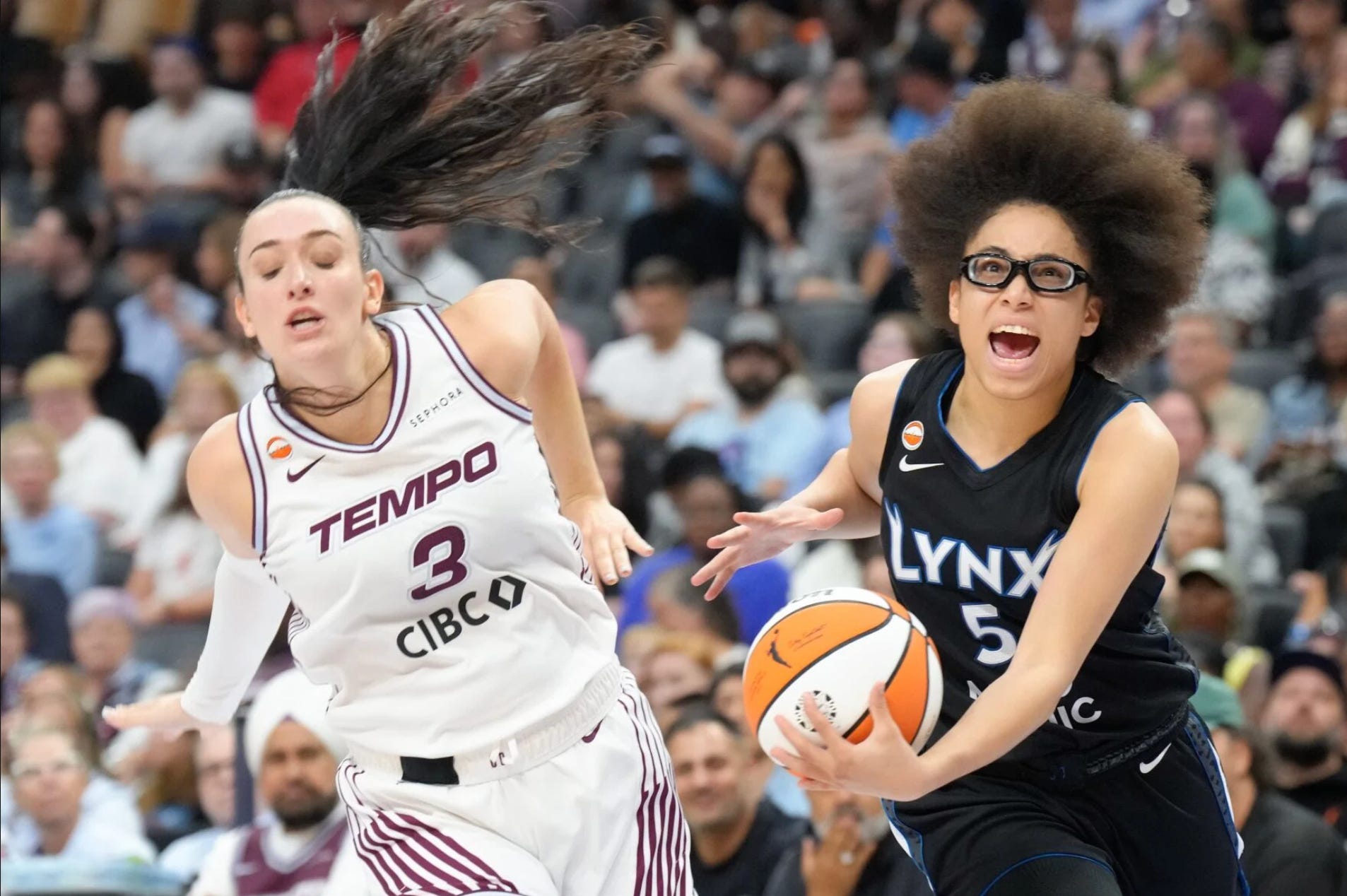
It isn’t as simple as novelty. Any of that wore off within the first handful of home games. It’s visibility — in the immediate present and the promise of it stretching into the future. It’s why seeing so many people in their Tempo jerseys and t-shirts downtown before the game, lined up an hour early to get into the arena, and flooding the concourse feels different than it does on a Raptors game day. I have a hard time explaining why beyond it just does, but it’s in large part to the fact that Tempo fans, women’s basketball fans, aren’t transplant NBA fans. Some are, but the majority not. There are queer fans, trans fans, there are entire generations of women — grandmothers, daughters, granddaughters — there together. There are entire youth basketball teams, giddy and dressed in their own uniforms. There are moms with sons, dads with sons — I know this is starting to sound like the little labels above birthday cards at the drug store (“For anyone funny”) — parents with both, parents to-be. There are, plainly, more women than I’ve ever seen at a men’s pro sports game.
There is, at least right now in the team’s developmental trajectory, such a generosity of ceding and holding space. For everybody, but certainly for people who the men’s game doesn’t reject, but also doesn’t make particular accommodation for.
Of course, there are blips. Taking a lap of the concourse, Jerome and I saw an extremely well-groomed, as in prepared for the camera, teenage boy in a Sophie Cunningham jersey arm-in-arm with a woman in a Jalen Brunson jersey (ostensibly, because Brunson liked this post by Cunningham, where she doubled down on her more calculated-by-the-day comments about protecting “young girls in sport who shouldn't have to go against biological men”) (a lot has been written and argued about that ESPN profile of Cunningham and her anti-trans rhetoric, a good catch up, and the smartest summation thus far, came form Katie Nolan on her podcast Casuals) but the display, so clearly for optics, was laughed off or eye-rolled by everyone I saw also see the pair.
Perhaps it’s unfair to paint that couple as a blip. Tokenising the W as some utopia for equality undercuts the very real work and struggle its athletes have undergone to get it where it is. The doubt, jokes, and harmful vitriol the league’s fans have also encountered and pushed back against for decades. In a league of predominantly Black and queer women, Cunningham may be an outlier, but she’s by no means an outlier for the current American sociopolitical moment. Or, clearly, the way it’s insidiously crept in and begun to flourish in Canada. If anything, the tension those two injected — along with the ongoing, bizarre courtside protests by young women at W games with anti-trans signs funded by mysterious donors — is a sort of critical, sharpening point.
Lynx coach Cheryl Reeves touched on it yesterday when speaking to reporters:
The [transgender] issue isn’t as big as the issues that we have in women’s sports. Whether it’s cisgender men that have held us down for years in spaces like being able to have access to facilities and uniforms and locker rooms, all the things that these young girls that are sitting at games with anti-trans signs, do they understand actually what the real problems are and how they’re being marginalized? We’re still not in a space where we have equality. We don’t even have the Equal Rights Amendment in all 50 states, right? So there’s real issues. This is an issue that I think that we can thoughtfully work through, and that’s my hope.
There was no way, as the W grew, that its detractors weren’t going to find a way in. People who arguably and actively hate women, would prefer to see women marginalised with their rights stripped away, weaselling in to take advantage of the league’s momentum and profile, using gender panic as a convenient Trojan Horse to do so. Wholly joyless joyriders.
Growth is pretty much always uncomfortable. Pressure builds, tensions abound, lines must be redrawn. It’s going back to square one without the naiveté that made square one bearable the first time around. What was hopeful and fun to me about watching the Tempo lose this week was not just the rallying push of the team — Marina Mabrey’s nerve, Nyara Sabally’s full-bodied conviction (worryingly, at times) — but the atmosphere, the energy. All of it of course generated by fans.
Another word for that: community. Another: conviction.
The belief in something when it stops being so light, when it starts getting difficult. The ability to trust that the people around you are seeing the same thing, sometimes giving it a long hard eye-roll, and other times, knowing when to speak up and shout it down because someone in a more vulnerable position can’t. That losses sting less when you aren’t alone.