Women as mirrors, men as absolutes
There isn't more drama in the WNBA, there is just more scrutiny of and for women.
How many things can be true at once? Two, four, 20? If truth is in the eye of the beholder, then it’s more like 8.3 billion, roughly the current population of earth. And then, can truths change? Better still, how good are we at giving them room to?
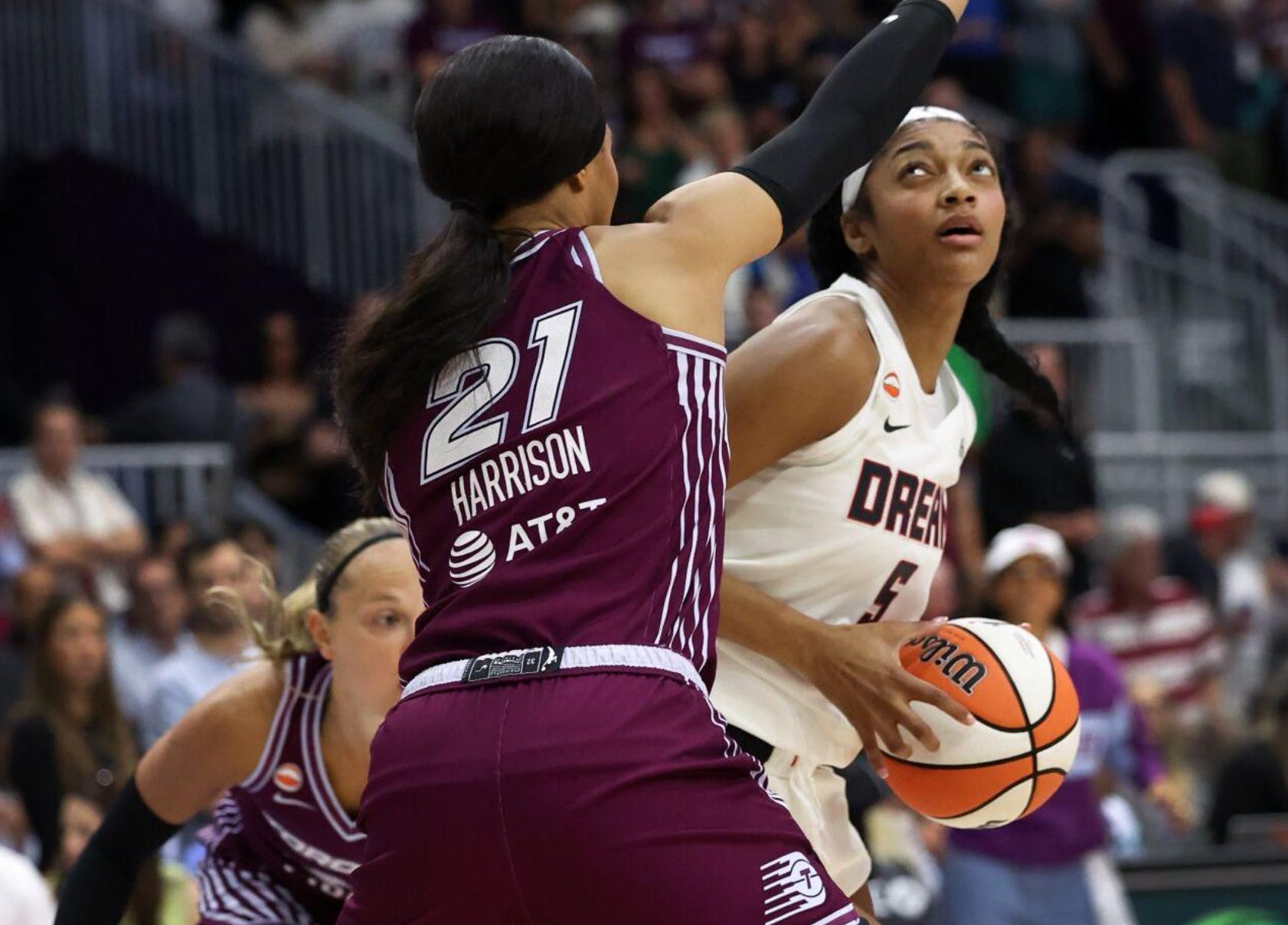
During the Tempo-Dream game last Friday, Tempo head coach Sandy Brondello was caught on an official’s mic complaining that Angel Reese, who plays for the Dream, was a “protected species.” The comment came after Reese elbowed Nyara Sabally in the ribs, and as Sabally was being checked for injury by Tempo medical staff.
Reese was upset, Brondello issued an apology the next morning, and the WNBA announced it was suspending Brondello for one game. All things are true.
The term is, as Brondello explained, an Australian euphemism for an athlete handled with extra care who tends to get a favourable whistle. I’d never heard it before but the conceit is a through-line in pro sports, think about the “foul merchant” moniker applied to Shai Gilgeous-Alexander and the recent theatrics in the World Cup, of grown men writhing around on the pitch after slight contact. Think of LeBron James, in most games.
Was it heavy-handed of the league to suspend Brondello a game versus fining her? Perhaps, but it was also an easy way to set a standard going forward on how the WNBA actively protects its players. It could also be a ripple effect of recent racist messages sent to the Aces Chelsea Gray via DM. A case where the person sending the messages did end up getting fired, but where the W had no overt oversight. More truths.
Brondello, who played in the league and has a track record with the athletes in it now as an advocate and ally, doesn’t need to be a bigot for a comment she made to be interpreted as harmful by Reese. Intent versus impact, as has been pointed out astutely by The Athletic’s ‘No Offseason’ podcast, is paramount in many public-facing spaces and certainly this situation. Black women have historically borne the brunt of racial prejudice where anti-Black racism and sexism intersect, and misogynoir has unfortunately found many new ignorant footholds in the WNBA. Most recently by rightwing identity politics practitioners adopting Caitlin Clark as a paternalistic pet cause, and seemingly having no understanding that basketball is a physical sport.
All: true.
With myriad truths in play from the beginning the situation is less about which one is paramount than it is about our capacity to hold onto each truth in turn. To process and, perhaps crucially, not react. To digest. The WNBA is often criticised for its “drama”, that every issue or situation results in manifold responses, but the truth (another truth) is that the NBA has just as many issues, just as much drama. The difference is that women are treated as mirrors, men as absolutes.
I had this discussion with a friend at Summer League who had a complaint similar to what I outlined above. They wondered why it seemed like the W couldn’t just get on with itself, why the basketball couldn’t exist as-is, a standalone act. But the NBA didn’t do that either, I countered, the most recent example being just days behind us at that point, of Bam Adebayo punching Tyler Herro in the face at an AAU camp in Las Vegas. In-season, the drama was no different, team dynamics make up 70% (my guess) of what analysts talk about on any given major network show or minor pundit podcast. Basketball factors very little into the machinations of the league. Why is it possible to take Adebayo and Herro, or the rift between Jayson Tatum and Jaylen Brown, LeBron James’ falling out with the Lakers, any number of other interpersonal tensions, at face value? Because we still don’t really question men.
Not just interrogate, but existentially press. Male athletes can treat basketball as a job, a vocation they clock in and out of. Women don’t even have the stability of basketball as a workplace — you need only look back to last summer when dildos were thrown onto the court in a move that came to be backed, in extension, by the White House. Beyond that, all of the dynamic factors of the game itself exist in a state of tension, largely impressed on athletes and the WNBA by a subset of their audience.
There’s a discomfort with physicality, of seeing women use their bodies with and for force. There’s discomfort with competitive tension and, humming just below the surface, either the paternalistic desire for protectionism (not for all, but those a particular audience deems worth protecting or “in need of it”) or the sexualisation of women in states of tension and competitive animosity. It is so, so dated that it feels like a resurfaced Bill Simmons blog to write it, but it’s there.
There’s the reality of aesthetics, women fully made up to take the floor but undermined for how these visual cues of attention to the self — lashes and nails done, foundation, eyeliner — signal a lack of dedication to the game, regardless of their efforts taking place before they set foot on the floor. The alternative draws complaints too, that women aren’t as appealing to look at bare-faced and straining, reveling in the exertion of their bodies and the friction of competition.
The mirror women athletes are foisted with is the infinity sort, where looking into it reveals not just one reflection but hundreds spanning back, as far as you can see.
When truth collides with an NBA athlete it tends to stick, stand, or slough off, eventually fade. When the same happens to a WNBA athlete the truth refracts based on what the viewer thinks, wants, or wants to think. The reason the league appears to “perpetuate drama” is because the person watching and holding that opinion has a hard time taking the sport at face value. For them, there will always be something slightly performative about women playing a sport that’s baseline is men. That can change, the very real and rabid viewership and fandom of the WNBA is testament to it, but for the majority of those fans the baseline has always been women. Not who they see the game through, with each movement on or off court an opportunity for interrogation, but who they see the game for.
The growing pains for newcomer fans these past few seasons have been very visible. There are tensions with how many understand a sport and its athletes should, or should want to, interact with the wider world around them. Women’s basketball intersects more readily and naturally — by necessity and by default — with the “outside world”, where men’s has been happily siloed, enforced at the behest of its fans.
The scrutiny isn’t going anywhere unfortunately, given the sociopolitical climate of the U.S., the place where both leagues are rooted. The silver lining is that in the nuance of truths at play between Brondello and Reese, there was relative comfort — even in the tension. The situation evolved, but it also found a fairly balanced outcome, and quickly. In addition to her public apology, Brondello reached out to the Dream and made herself available to Reese, should she want to talk. Reese made a public statement saying she was grateful for the apology, and for the WNBA’s swift ban. From what I saw, it was largely outside, detracting voices attempting to undermine both parties actually getting back to basketball, the thing they were complaining the W and its athletes make it impossible to focus on.
The irony is that the athletes of the WNBA have very little sway in sociologically streamlining their sport, making it the only thing people focus on when they watch a game. For that, women have to be taken at face, considered complete without constant interrogation. That’s on everyone else.


Great article. Australian here and can confirm the euphemism is heard regularly for sports people seemingly favoured by officials, especially in AFL for players who aren't suspended for incidents. I hadn't thought of it as a racial slur but I'm White so that makes sense and I now know better. Agree that impact overrides intent. Seems like this situation was handled well? It's a shame as you say that it gets criticised as drama rather than an example of handling it maturely and restoratively. But not surprising as a reflection of society and gender expectations. Compare how well this was handled to Adelaide Crows handling of a homophobic slur last year (which then played out again this week). Agree with all you've written, thank you