

The space between care and habit
Is care, in NBA basketball, coachable?
Effort and execution. Those were the words Lakers coach JJ Redick emphasised after the Lakers bad loss to the Rockets on Christmas Day, the two qualities the team didn’t have that night. When the Lakers were good, Redick said, they embodied those qualities. When they were terrible, they didn’t. That night they were terrible right from the start.
It was a tidy classification, a neat binary. Prodded very lightly it began to slip.
“As a coach what does that feel like?” Dan asks. In his voice I can hear him thinking back to the beginning of the game he’s just covered, wanting to pick up this fraying thread just before it split. “When you’re on the sidelines, and you’ve keyed in on something and within 48 seconds—”
“It doesn’t matter how I feel,” Redick responds, cutting him off.
Just before Redick speaks, almost imperceptibly (thank goodness, really, for postgame recordings), his eyes narrow and he shakes his head very slightly, seemingly in response to Dan’s use of the word “feel”.
“It doesn’t matter how I feel,” Redick repeats, his right hand holding the postgame mic and his left lightly, repeatedly, tenting against the stats sheet on the table in front of him.
Dan changes the tack of his question — why did Redick think his team was unable to execute the things they were tasked with?
“‘Cause we don’t care enough right now,” Redick said immediately, “that’s the part that bothers you a lot.” His left hand comes off the stats sheet and begins to churn the air for emphasis. “We don’t care enough to do the things that are necessary. We don’t care enough to be a professional. You know, we had it… we don’t have it right now.”
Where Redick ended was far from where he started. He’d strayed from the borders of the binary he set out — effort and execution versus their lack — and waded into the murky territory he seemed initially so wary of: feeling.
To be fair, he framed it as “care”. But care, in its origins, is rife with emotion, with the messy intangibles of feeling. Care can stretch (Old English) anywhere from sorrow, grief, anxiety and concern to (Proto-Germanic) lamenting, overcome with such strong feelings that the body cries out, unbidden.
Care, in sports, is tied to effort. At least that’s how we qualify it. Who cares often boils down in basketball to who is willing to do the “intangibles”, a neat way in itself to describe some tangible actions (diving for loose balls, deflections, drawing charges, boxing out) but mostly to ascribe effort.
Effort (re: caring) in the NBA tends to be hierarchical. Who we praise for “doing the intangibles” are often role players, the sixth man or guys coming off the bench. Their handle on care has to be constant because it’s directly tied to their minutes, basically whether they can right a sloppy bout of play by subbing in or keep things steady when the starters rest their legs. Their handle on care also has to be constant because it’s tied to their personal valuation to a team and in turn, their next contract.
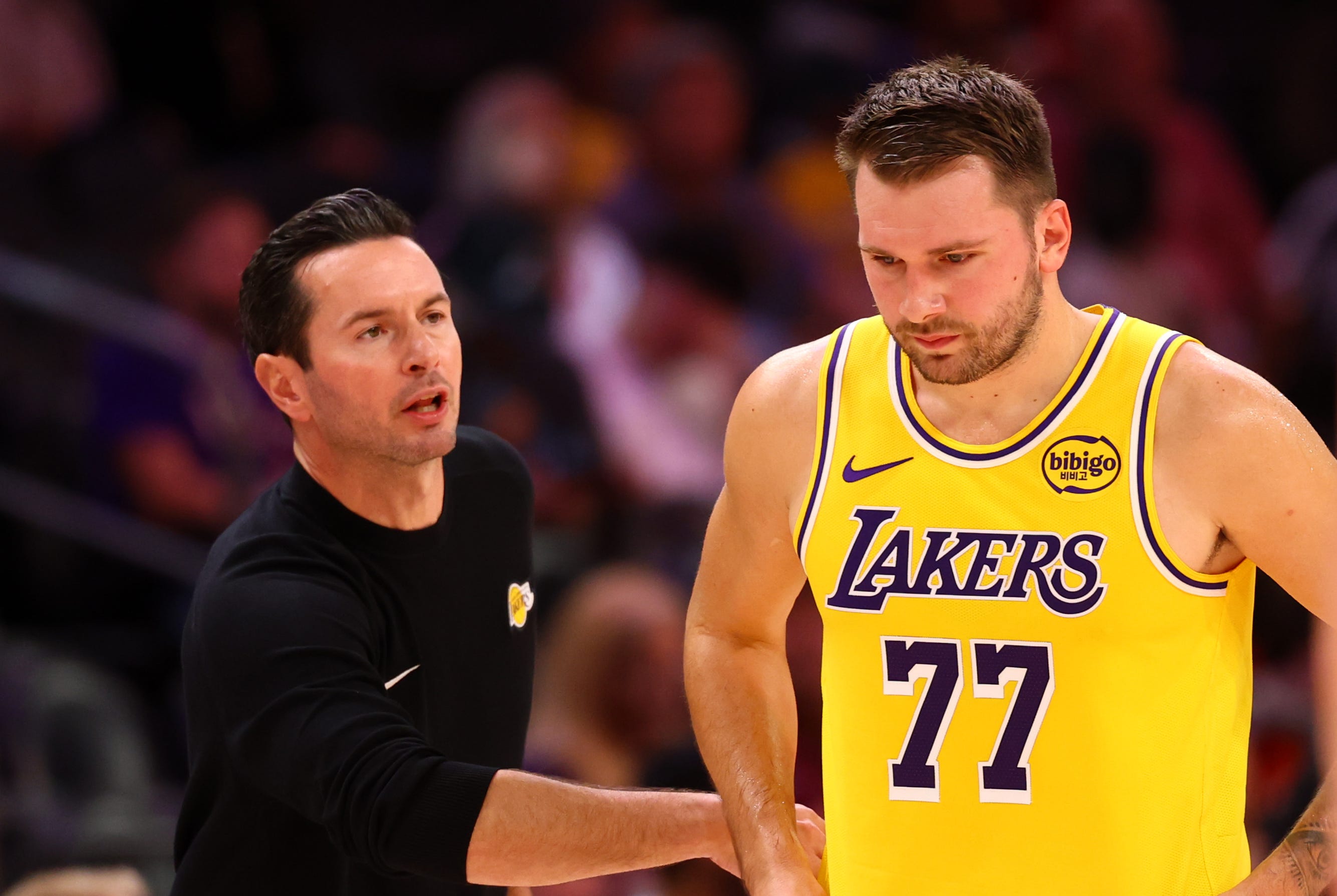
Star players don’t automatically shrug off effort but nor are they expected to maintain it for 40-some-odd minutes per game. Luka Doncic, who Redick was certainly hinting at, has been fielding questions of effort his entire career — whether he cares more about arguing calls out of the refs than getting back on defence. LeBron James, who declined media availability after the Lakers loss to the Rockets and again after practice the next day and who Redick was also likely hinting at, has built a legacy out of caring very much — whether he cared in that particular game, or maintains the same unwavering level of effort in this, his 23rd season, up for debate.
Maybe Redick meant Austin Reeves, star in the making, or Rui Hachimura, flashy in his own right. I texted Dan about it and the consensus was Redick had his sights set on everybody.
The question of sustained effort, of caring consistently, is not unique to the Lakers but it does strike me that the Lakers are the league’s unique team of stardom. That is, every player currently rostered sees themselves as part of a glitzy, flaunting history because it’s inescapable while wearing purple and gold (that purple and gold are shorthand for the Lakers — case in point). To this end, and pointing again to effort’s hierarchy, there are going to be some issues with consistency.
But to care — what a fascinating mess of an intangible Redick set himself up for.
