

The reverberations of other people
Tanking, the prism of context, and America's latest forever war.
My nephew’s current favourite word is kore. It means “this” in Japanese. He wields it deftly, generously, covetously; pointing at his toys and books, at photos of food on menus, at the ubiquitous gachapon capsule vending machines at train stations and the restaurants we visit.
His urgency with the word on point for a toddler, his perception of the world being immediate and largely enthusiastic. But his invocations — kore, kore, kore — how rapid and pressing, each a little slipstream for us to step into and see beyond his wants, glimpse at his impulses and personality.
Kore… to? I ask playfully, moving my finger from where his own small one presses against pictures of french fries or karaage over to anything green. This… and?
Nai! He giggles, gaze shifting between my face and watching for where I’ll point next, the terms of this new game set. The terms a little more changeable for me, knowing there’s a line where fatigue will overtake him and the suggestions I’m making are interpreted as serious instead of playful.
Kore becomes instructive. I say it and point to the parts on his toy excavators and cranes where I want him to show me how they manoeuvre and extend. It also becomes a question while playing songs in the backyard one evening to see which he likes, asking Kore? when he starts to sway or bop his head, or in the Iya Valley at a river we climb down to, crouching and choosing which jade-hued rock on shore he’ll huck into the milky green mountain water.
Kore comes whispered, shrieked, tearfully, and with deep concentration. It becomes punctuative, telling, a place to meet in the middle, a comfort. It won’t be until I get home that I’ll consider completely the way he and the word kept us locked in a steady-state of present. Beyond the way just travel, or being with a young child will, the times we drifted — talking about Japan’s place in current geopolitics with Ryoko as he dozed in his carseat, reviewing logistics with Carl and my mom for the next day as he dumped blocks out to build with — he would soon bring us back with kore. He knows the word’s past-tense partner, sore, for “that”, but preferred to set it aside, opting for the linguistic now. For all those days he freed us up to do the same.
Russell Westbrook used a postgame availability this week to call out a Sacramento Kings reporter. First one, then broadly, vaguely, the room.
Context was central to Westbrook’s umbrage. That the reporter did not have the correct context to make the observations they had in the past. That they did not know him, personally, and were not present in practice or film sessions. For context, media isn’t invited into team film sessions and practice only opens for media as it winds down, when a player or two might linger on court or drift over to gym equipment. For context, to be an objective journalist — an objective observer of anything — personal, intimate knowledge of your subject is not advisable. Founded, intelligent, clear consideration is, and is what it means to contextualize a subject, an athlete.
The contextual takeaways were expansive, and prickled different nerves. Concerns that this was another sign of the erosion of media, that gutting of coverage and beat reporter jobs meant less trust between athlete and writer, or media at large. That Westbrook should have taken that particular media member aside earlier, or after he stepped away from the podium. That expectations for the Kings set by media were unrealistic this season. That Westbrook was protecting young teammates from unwarranted criticism. That this was Westbrook behaving in the context of a career-long pattern. That Westbrook should not be prescriptive about how other people do their jobs. That trust between athlete and media (monolith) needs recalibration.
All of it, to some degree, true. But that’s the many-faced prism of context.
I watched the clip through a haze of jet lag and felt contextually removed. Parachuting back into something I had not clocked my mental distance from until right then. My context also warped by what else I was catching up on — two weeks of a new American forever war, this time with Iran and rapidly expanding throughout the Middle East, underway. With that in mind I only had one thought, that maybe Westbrook hit the same wall I had, that I’ve seen a lot of people reckon with over the last weeks. That it feels impossible, stupid, gross or all three to take the habits, routines, and interests we engage in and try to force the context they exist in to be the same as they were a month ago. That if we’re being honest that steady-state of passive context ceased to exist as far back as — well, take your pick of conflicts: Ukraine, state-sanctioned genocide against Palestinians, Sudan, the United States’ heady, eager rush back into (open) continental and global imperialism.
Is this too much context to offer Westbrook, this exchange? Probably, maybe, but then we do so determinedly, persistently draw that thick line between the context of “NBA basketball” and “rest of the world”, as if the former could covertly exist in the margins for much longer. As if it ever did at all.
There’s a time when the operation of the machine becomes so odious, makes you so sick at heart that you can’t take part. You can’t even passively take part. And you’ve got to put your bodies upon the gears and upon the wheels, upon the levers, upon all the apparatus — and you’ve got to make it stop. And you’ve got to indicate to the people who run it, to the people who own it — that unless you’re free the machine will be prevented from working at all.
— Mario Savio, from his Sproul Hall speech, December 2, 1964
I don’t really care about tanking. It feels radical, taboo, to write that. Or that if I dared say it out loud some Bloody Mary-esque figure, a joyless nerd in a quarter zip, would appear and revoke my status as basketball authority.
Adam Silver talked about the league’s tanking issue this week at MIT’s annual Sloan Sports Analytics Conference. In a conversation led by Sue Bird, Silver floated different solutions: Divorce the Draft and lottery from team records, so all 30 had the same odds regardless of season outcomes? Remove all playoff teams? Just the conference finals teams? Look at the record of a team over two seasons to determine their lottery odds, like the WNBA?
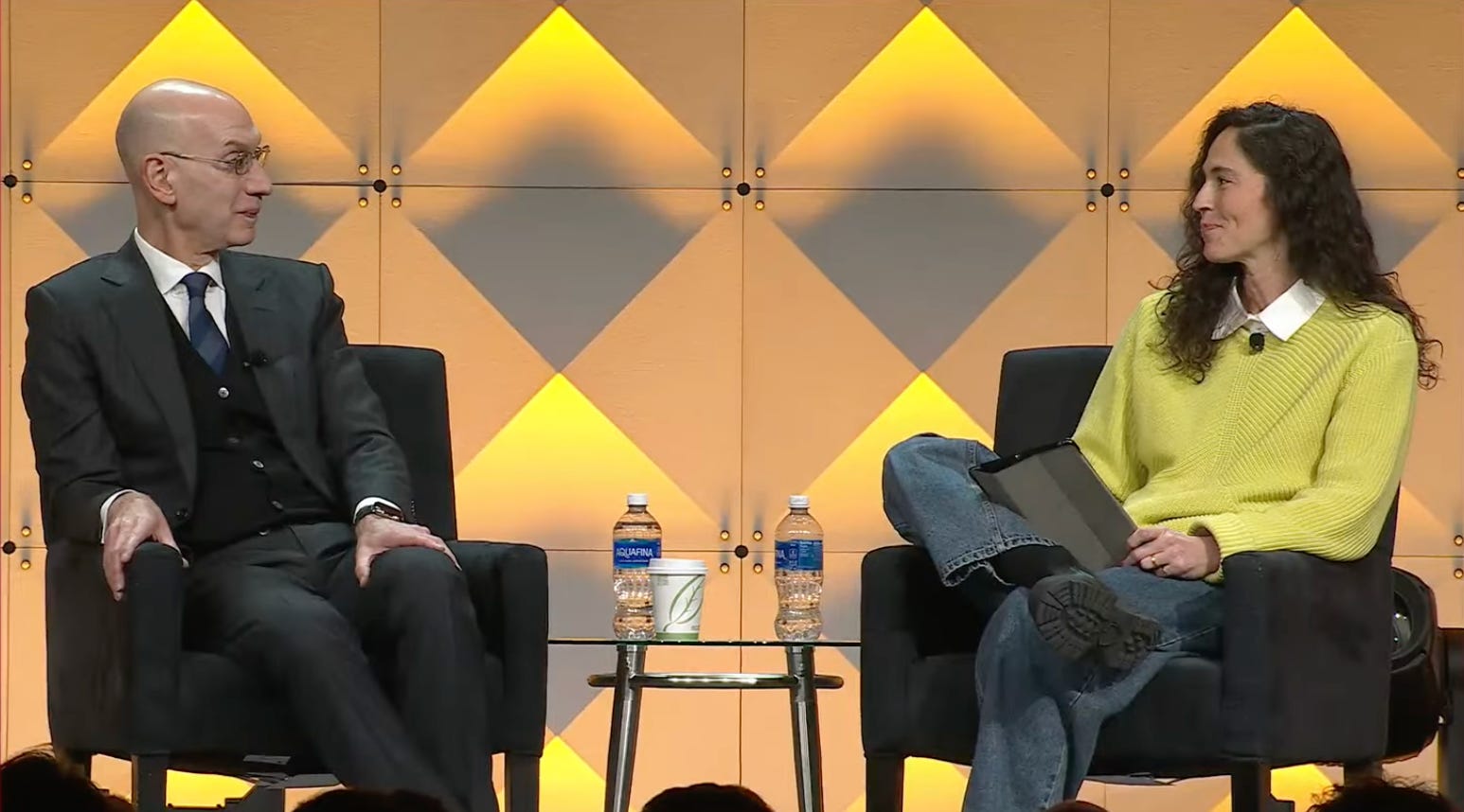
Silver mentioned the “arbitrary lines” drawn over the years, all designed to tweak and more efficiently hone the system in place, which is exactly where my concern wanes. The arbitrariness and forced calamity of what is essentially invented, folding.
I can admit that my reasons are personal in the sense that the largely held context of tanking, its would-be direness and bellwether of what’s wrong with the league, does not hold for me. It does not hold because if I were to present the average fan with the choice of tanking or the league’s response to its athletes who are perpetrators of intimate partner violence and assault, say, or the league’s many ties to Jeffrey Epstein, or its ongoing entrenchment with gambling and the erosion these platforms present not just to the game but our perception of the world around us, and asked which is worse for the NBA, nine times out of 10 the answer would be tanking.
So yes, I can admit what moves the needle for me is personal in that it’s what affects people. That the choice of a team, its billionaire ownership class, is not. Moreover that I’d argue that same class lost its grasp on what’s personal, in the context of what’s affecting for the average person, well before they got their hands on an NBA team.
Not lost on me the impulses of this American administration being in the same range of impulse as a toddler. The difference that where a toddler’s demand of action-reaction, their desirousness of the world around them and the urgency with which they communicate that appetite is out of a hope of expansiveness and understanding, Trump et al. operate from the opposite impulse. Theirs is a fear-driven need for annihilation. Denial or outright destruction of anything other. To reduce the world down to one, funhouse reflective likeness.
What’s clear is the best and easiest way to stay ahead of their rhetoric is to keep your own context current. When everything someone says is revisionist it requires you to exist in the past, which is redrawn by nature. To see the moment clearly and put your whole body in it, dumb molecules vibrating no matter the mundanity of it — impossible to be dragged backwards from that excruciating present.
Something less reported on from Silver’s Sloan appearance was his flag that beyond analytics, beyond any advanced technology like A.I., even beyond athletic feat, the thing that draws people to sports is human connection. That the connection sports offers — in its triumphs and errors — is difficult to find in other aspects of our lives given our growing disconnect, and the deepening individualised moats around us brought on by more screens and less human contact.
He also talked about refs. That while the NBA is using A.I. tools to build out its officiating, there’s no real substitute for the sixth sense referees have. He said it feels as if some of them have “eyes in the back of their head” or that “they’re feeling vibrations on the floor, feeling bodies.”
Aside from how intimate, or poetically tactile — the thrum of reverberations on the court coming up through your legs is a very distinct, grounding feeling — both these thoughts, though offered in different interview tangents, show that while it may be considered by some to be the crudest, or most volatile context of basketball, the human element is inescapable. Should be inescapable, given the fact of the game being played by people (though people are broken down into numbers very quickly), but in these seemingly small, easy to miss or take for granted ways we’re offered the reverberations of other people, of life, and offered them in ways that force us to the present.
The thrum of a thousand some-odd voices buzzing in your ears and vibrating through your chest at a game, turning to a stranger in the seat beside you to confirm some incredible thing you just watched happen, see it in their flushed face clearer than a mirror could show. To watch a game in person, no matter how much you see on screens or in replay, is to remind yourself of how difficult because how human. A voice in your head enthusiastically confirming, synchronously with thousands of others watching around you, This, this, this.
How wonderful to see Mario Savio quoted! It seemed like
we were on the cusp of real freedom then, I will never understand how we ended up here instead *sigh*
I loved the story of your nephew revealing in the kore moment maybe only children understand what freedom means?
The beginning of your article made me smile. :) I'm glad you're having a good time with your nephew.
I also love how you tied the story of your nephew with the other points you made in the article. You do a great job in tying different (and seemingly unrelated) topics together.
"I can admit that my reasons are personal in the sense that the largely held context of tanking, its would-be direness and bellwether of what’s wrong with the league, does not hold for me. It does not hold because if I were to present the average fan with the choice of tanking or the league’s response to its athletes who are perpetrators of intimate partner violence and assault, say, or the league’s many ties to Jeffrey Epstein, or its ongoing entrenchment with gambling and the erosion these platforms present not just to the game but our perception of the world around us, and asked which is worse for the NBA, nine times out of 10 the answer would be tanking."
It's sad that this is the case. :( As you indicate, tanking pales in comparison. And yet, there is so much more focus on it than injustices.
And it's a symptom of a wider issue. Injustices are swept under the rug and attention is heaped upon so many other things, like tanking in this example or smearing critics, and as a distraction. And these distractions often involve scapegoating marginalized groups, like the trans community, immigrants, etc.
That reminds me of what you wrote here: "When everything someone says is revisionist it requires you to exist in the past, which is redrawn by nature. To see the moment clearly and put your whole body in it, dumb molecules vibrating no matter the mundanity of it — impossible to be dragged backwards from that excruciating present."
I might be misinterpreting this, but this reminds me of revisionists calls to revere the past. To ban books. To wipe away mentions of injustices and atrocities. And, as I mentioned before, to scapegoat marginalized communities for systemic problems that continue to today. It's scary and appalling. And yet, there continue to be these calls as well as distractions from the injustices.
"So yes, I can admit what moves the needle for me is personal in that it’s what affects people. That the choice of a team, its billionaire ownership class, is not. Moreover that I’d argue that same class lost its grasp on what’s personal, in the context of what’s affecting for the average person, well before they got their hands on an NBA team."
I feel the same way as you, Katie. What matters to me is the impacts that policies, especially harmful ones, have on people. And yeah, many of the wealthiest and most powerful people don't care. They don't care about people who are struggling to get by and those who can't afford healthcare. They don't care that many of us are just a paycheck away from ruin. And they most certainly don't care about the people, many of whom are the most vulnerable, who are impacted by war. There are so many who have been and continue to be displaced, not to mention how so many people have been injured or killed. The psychological and physical impacts are disregarded. Instead, more funding is given towards the military and the wealthy and there are so many cuts to humanitarian aid, healthcare, social welfare, and the V.A., etc.
It's like what Mike Shinoda rapped in the Linkin Park song, "Hands Held High": "When the rich wage war, it's the poor who die"
"The thrum of a thousand some-odd voices buzzing in your ears and vibrating through your chest at a game, turning to a stranger in the seat beside you to confirm some incredible thing you just watched happen, see it in their flushed face clearer than a mirror could show. To watch a game in person, no matter how much you see on screens or in replay, is to remind yourself of how difficult because how human. A voice in your head enthusiastically confirming, synchronously with thousands of others watching around you, This, this, this. "
This is so beautiful. And it is something that A.I. can never replace. This common humanity that we share. Embracing the present and the moments we share with our fellow human beings. This is something that we, as you beautifully illustrated, experience through sports together.
And it's shown through your nephew's story - to be present-minded and driven by curiosity and hope. This is something we can all learn from and embrace. Indeed, this reminds me of how important it is to be grounded, to never stop learning (and to be curious), and to be loving - all qualities that kids do so well.
Great article, Katie. Wishing you and your family the very best.