

The last derby
Can the NBA's European expansion match the culture of Belgrade basketball, where games are the organizing principal of civic life?
After a EuroLeague game in Paris last November, Valencia’s head coach Pedro Martínez walked into the press conference room. Every chair sat empty. Zero journalists had shown up. He announced the score and left.
The circumstances were specific — November 13th marked the tenth anniversary of the 2015 Paris attacks, memorial events consumed the city, France’s soccer national team played a World Cup qualifier across town. But Panathinaikos’ coach Ergin Ataman saw something structural, “If there’s no interest in basketball in these cities, how can you make a strong league? This is a very dangerous situation for European basketball.”
He was talking about more than one empty press room. He was talking about Paris, London, and all the cities NBA Europe is targeting for expansion. And while the empty chairs in Paris that night had specific explanations, they revealed a structural truth: European basketball is being rebuilt around markets where the sport is optional, manufactured, sustained by investment.
In Belgrade, Partizan and Crvena Zvezda (Red Star) have been playing basketball for eighty years.
When these teams play, the entire city reorganizes. Not metaphorically — literally. Taxi drivers know the schedule. Restaurants adjust hours. The game isn’t one entertainment option among thousands, it’s the organizing principle of civic life for that day.
American players who experience Belgrade games describe noise so overwhelming you can’t hear yourself think. This is acoustic reality produced by 80 years of accumulated passion.
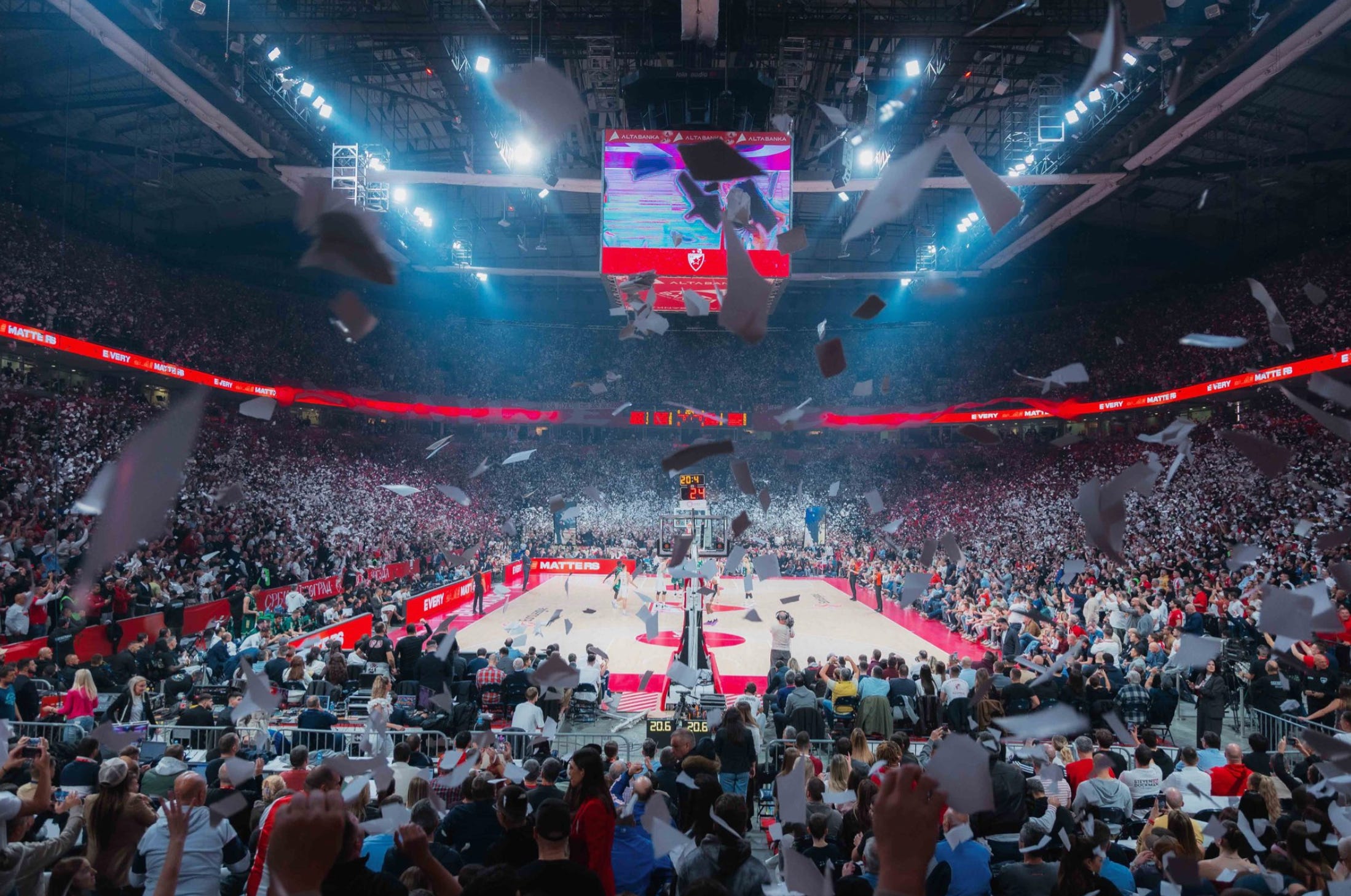
Parents in Belgrade don’t sing nursery rhymes. They sing Partizan or Crvena Zvezda chants depending on familial allegiance. Before kids walk, they’re learning the songs. You don’t choose which team to support. It’s inherited. Non-negotiable.
Eighty years builds specific infrastructure. Media coverage that exists because there’s genuine demand — not zero journalists but too many. Fan knowledge sophisticated enough to recognize defensive rotations in real time. Generational continuity that makes the sport feel less like entertainment and more like identity.
This is what eighty years creates when basketball embeds itself into a city. When it passes from grandparents to parents to children. When it becomes infrastructure rather than product.
This season, Dubai Basketball made its EuroLeague debut. A club founded in 2023. Three years ago.
Dubai has no basketball tradition. No accumulated culture. No parents singing chants. The EuroLeague gave them a five-year wild-card berth anyway, reportedly covering travel expenses for European teams flying seven hours for away games.
The logic was transactional: Dubai has sovereign wealth fund money, petrodollar capital that doesn’t ask questions about whether eighty years of accumulated passion should count for something.
Dubai plays competitive basketball. They try to fill their arena with imported fans, fans who treat it as curiosity rather than identity. By conventional metrics — attendance, revenue, quality of play — the experiment succeeded.
Three years with enough capital and you could skip everything Belgrade spent eighty years creating.
Paris Basketball confirmed it wasn’t aberration. In 2018, American investors bought a bankrupt French second-division team for $50,000. The president they installed: David Kahn, formerly Minnesota Timberwolves GM. In the 2009 draft, Minnesota held two lottery picks and needed a point guard. Kahn selected Ricky Rubio fifth, then Jonny Flynn sixth, passing on a guy named Wardell Stephen Curry II both times.
Steph became the greatest shooter in basketball history. Flynn’s career ended after three seasons.
Now Kahn runs Paris Basketball. Seven people attended the first game. Eight years later, through DJ nights and celebrity signings and social media campaigns, the team climbed to the EuroLeague. They play in a new 9,000-seat arena.
But zero journalists show up to press conferences. In Paris, you can ignore basketball completely. The sport is optional, but the model is clear: build where money exists, hope culture follows.
Two weeks ago, that model took concrete shape. On January 19th, Adam Silver assembled 250 people in a London hotel to discuss what this discovery might mean.
Real Madrid, Barcelona, Panathinaikos, Milan, ASVEL, Bayern Munich, Alba Berlin attended. So did Nike and Amazon Prime. Officials from Saudi Arabia’s Public Investment Fund. Investment firms with stakes in Liverpool and AC Milan. Banks specializing in exactly this kind of opportunity.
NBA Europe lists twelve cities as permanent franchises. Rich markets, global cities, destinations where you can sell expensive tickets. Belgrade isn’t one of them. Nobody asked Partizan or Crvena Zvezda what they think about billion-dollar franchise valuations.
Pau Gasol, Hall of Famer and potential figurehead for a new league, addressed the crowd: “This is a very unique opportunity. It’s all about learning from each other. It’s all about creating this new venture together. Yes, we’re talking about the league, but this goes far beyond. It is about the ecosystem, it’s about the grassroots, it’s about the domestic leagues and it’s about the impact on the children.”
He meant it. That’s what makes it complicated.
In that same room sat officials from sovereign wealth funds whose money had just proven, through Dubai, that you could skip grassroots entirely. Investment capital that had validated, through Paris, that you could build elite basketball where zero journalists cared. People calculating whether eighty years of accumulated passion mattered less than three years of sufficient capital.
Gasol spoke of children while others measured market size. He spoke of ecosystem while others calculated franchise valuations. He spoke of grassroots while Dubai and Paris sat as evidence that grassroots weren’t necessary anymore.
Gasol was advocating for something Dubai and Paris had already proven. That belief, even sincere and well-intentioned, couldn't substitute for soul.
I want to take my oldest son to Belgrade. Partizan versus Crvena Zvezda. The last derby. I’ve never been there. But I have twenty years of listening. Twenty years collecting stories from coaches, journalists, friends. Building understanding from testimony about a place I’d never seen but knew through accumulated narrative.
I need to talk to parents that sang team chants as lullabies. Be overwhelmed by the noise.
Nobody showed up to that Paris press conference because there was nothing that required witnessing. Not just a game but a demonstration: you can build elite European basketball without accumulated culture, inherited allegiance, or generational continuity.
Belgrade still fills arenas. When I go there with my son, I won’t be in the press room. I’ll be in the stands with him, witnessing what eighty years builds while it still matters that it took eighty years to build.
Before witnessing becomes optional too.
 | A guest post by
|
The commodification of everything…