

The tenderest I feel about people in this city is in the rain.
Ducking under dripping trees, slipping awning to awning; leaping over puddles gathering at a curb’s slope down into intersections, toes pointed, suddenly nimble as dancers.
All crowding into the bus, stacking our bags, fastening our umbrellas, extending the orbit of awareness around ourselves to double-wide because we’re dripping wet. There are the winters here, which we get through individually, together. Each of us with our heavy blues, our wavering resolve, our heads bent into the snow and wind; the darkness which at some point begins to seep and seems to go on forever.
In the spring though, in the rain, an opening. No one remembers how to dress so we pick layers to shed, nobody knows how to hold themselves. There’s no bracing, not in the same fierce way as winter. The air is so green, so heady, even in the downpours we want to keep our heads up and eyes open, our lungs hauling deep. Excruciatingly considerate, made aware again, ducking for the lilac bunches heavy with rain and bowing their blooms over the sidewalk, solicitous and soaking. The fogged windows on the bus offer up a blank canvas for fingertips to run, scrawl sloppy hearts and initials. Everyone breathing, everyone steaming, everyone drawing everyone else down into their lungs.
How hopeful, how bourgeoning, how ready to give it all another try as the evenings lengthen in their light and possibility.
There’s always been a disconnect for me to basketball and this time of year. Where it falls in the NBA season. There, it’s supposed to be cumulative, a closing. Where I’m watching from life is taking up its tender loop, once again. Green and absolute. There is nothing of those qualities in playoff basketball.
There is hardness, accumulation, wear — softness perhaps but only in loss, only at the lowest point. Softness in expulsion, softness in a season effectively ended. A closing blow delivered by the more erudite hand.
In NBA basketball, in spring, the bodies are hanging on by a thread. In NBA basketball the resolve is sharpened to a knife’s point. Blunted and honed, worn and whet, over and over in necessary repetition. The goal of playoff basketball is to improve by the round, evolve every game. The best teams do it in ways so obvious even the most discerning eye will widen, watching.
They are more fleet, they shift and shimmy their bodies around the floor as birds do in murmuration. A thrum of recognition going from one player to another, a vibration. Muscles picking up electricity, invisible string pulling from one person to the next. Communication sharpens, new shorthands develop. Teams getting very good don’t need to speak much at all. The intimacy of it — a look, rolled eye, grimace or twinge of lip — like a long marriage, but accomplished in weeks and under the brightest of lights.
At the individual level, if everyone stays healthy, bodies begin to thrum with an ichor of capability. Everything looks easy. Shots made handily but on the way up for the teardrop the person kicks their legs back, mid-air, to also draw the foul. Sluicing through the thick of bodies in the paint, no resistance — but also no softness. The ease comes from intensification. The body has learned what it can withstand.
Last season we saw it with the Thunder. The exuberance and wide eyes went out of them with each trip to the centre line, each time their bodies tensed waiting for the ball to be heaved, the game to begin. This season we’re seeing it with the Spurs. The baby fat of their competitive drive, their exuberance, their wonder at watching themselves beat opponents any which way — whittling down. Growing toned and honed and sharp. Growing up.
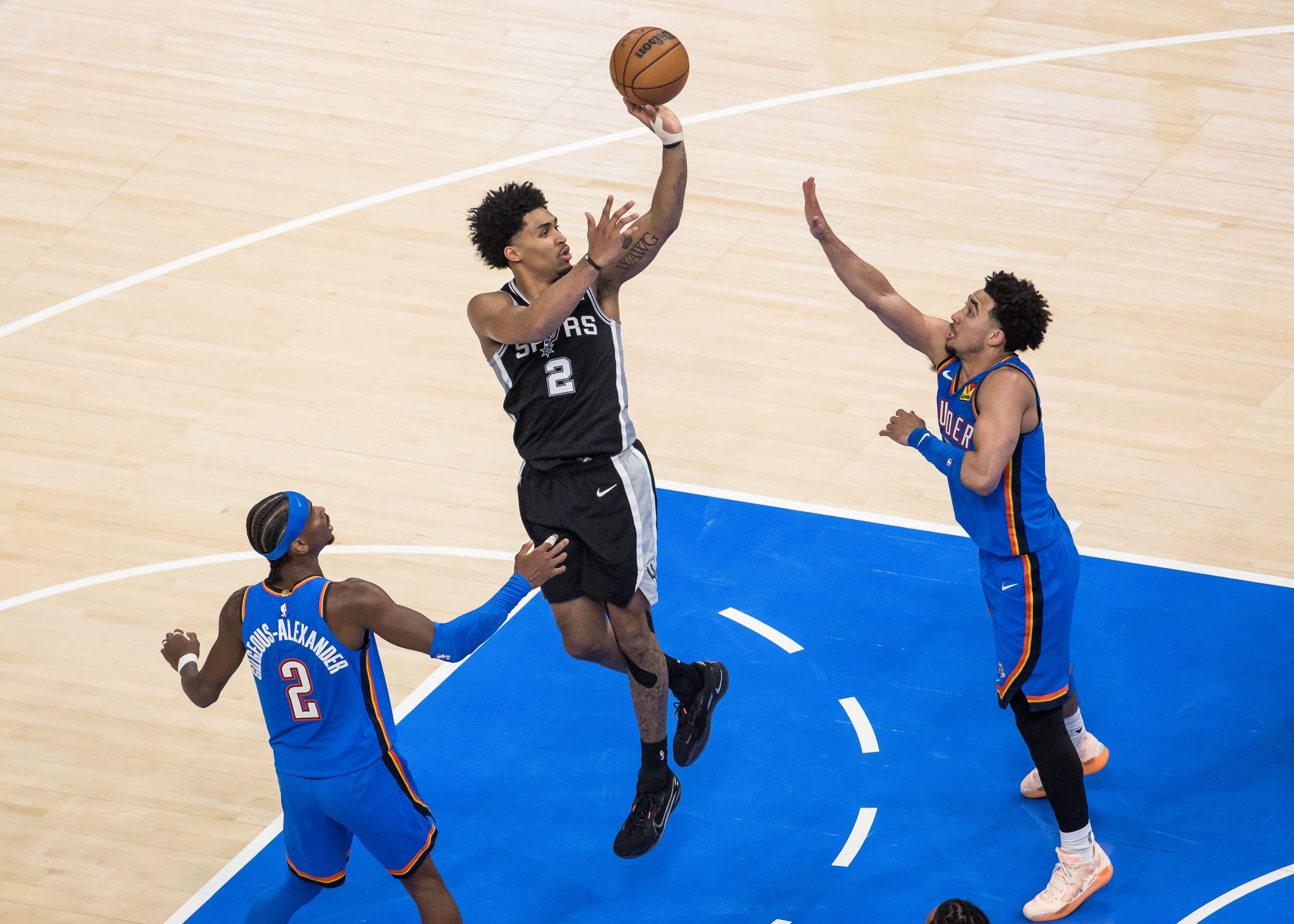
Both teams haven’t lost their greener qualities altogether. In some ways (Shai Gilgeous-Alexander’s cool resolve, Victor Wembanyama’s brash certainty) those traits are the baseline for how each team has formed their respective identities. But this is what playoff basketball demands. At least, what we’re told time and again it does.
Leaving the birthday party I step out into the rain. Monsoon quality. It reminds me of the spring rains in Hong Kong that crash down in waves, sky split open. Water that goes in flapping, visible sheets with the gusts of wind through the streets. Or in Halifax, where we really cut our teeth on rain and weather, experiencing a dozen variants of it on any given day.
I look back. Rachel holds the last third of the sheet cake, its five fat icing balloons cut down to two and a half. Go, go! She shouts. Tell me what you get! She means the bookstore around the corner, where she knows I’m going to make a detour on my way home. How I’ll keep everything dry its own future challenge. Filling my hands with a small stack of books proves to be no problem.
Walking up Strachan toward the park I suddenly remember Meli, whose apartment used to be in the same stretch of brick townhouses. I’ve remembered her here before, maybe exactly the same spot, whether coasting on my bike in summer twilight or cutting up on foot, but always in a soft glitch of memory. Guard down.
The thing about living so long, growing up, in a city that gets as small as Toronto is that memories begin to bump up against each other whether you want them to or not. The thing about growing up anywhere and the privilege of so many memories is you get better at handling them gently, even the errant ones, or the ones you’d rather not revisit, instead of shoving them roughly off. You can look at those past versions of yourself with a degree of empathy you didn’t used to be capable of.
I think of how Meli found me at a house party once we both wound up at, spring bridging into summer over a decade ago. How I’d spilled from the apartment onto the rooftop with a lot of people there, how one rooftop’s worth of people spilled onto the building beside. That section of Queen West is all apartments over storefronts, all the buildings up against one another.
I’d gone looking for people I knew, trailed by a guy I only sort of did. We shared a Venn diagram of social circles, first in Montreal, then in Toronto. He was a west coast transplant who always seemed, if not a bit of a hanger-on, then harmless. A rich kid, he had the sheen of ease, of not having had to bump up against much resistance.
The more I searched, and the longer he followed, the stranger I felt. Heavy, feet dragging, limbs beginning to separate from the circuitry of my body. I remember thinking no, I’ve heard so many accounts of what getting drugged feels like and it wasn’t explicitly this, so it can’t be. But the guy, as if sensing my body beginning to grow clumsy, grew closer. He stopped trailing and began to try and direct, became assertive in a way I hadn’t seen before.
It was then that Meli found me, sitting slumped against a chimney stack. Her eyes darted from me to him. Are you feeling alright? She asked. I feel… tired, I managed. She nodded. Do you want to come to my place and I can call you a cab? She offered, her face telegraphing everything though her words were short, offering no room for debate from him.
Was the air shot with that specific quality of predatory tension, desperate as it slackens? Probably. I only remember the smell of cigarettes, lilacs, beer I had begun to spill. Meli helped me into the apartment from the roof, went slow down the flight of stairs in front of me to the street, unlocked my bike and walked it beside me like a buffer as I weaved over the sidewalk. We laughed a lot, I remember. Relief, recognition, how much a cliche, all of it.
She gave me glasses of water and we sat in her living room, in the half dark and orange splash of streetlights filtering in, talking about it and making fun. The best way then we knew how to armour and forgive ourselves, though there was of course nothing of blame in it. I don’t know how long it was until I felt better but when I did I insisted on biking home. There was a power in it, autonomy, it was how we got around, how we got away; how we met up and bombed along beside each other, howling in the dark.
When I go by that block of townhouses and the memory churns up I don’t feel distress. I don’t think I ever have. I only remember care and tenderness. How in a moment of vulnerability that could have been made to feel considerably worse, or made me feel exposed or stupid or afraid, I was handed my agency like it was something I’d only just dropped. Picked up, dusted off, given back. I remember how assuring that was, and that it made it possible to laugh at what was happening, make it feel like it was already in the past — had happened — and thus easier to push off from.
Biking home I remember smelling the wet grass in Trinity Bellwoods, the deep cool plunge of temperature against my legs coasting by the edge of the dog bowl; climbing up Delaware Ave under the new canopies of green, the good strain of the muscles in my legs working, the flickering strobe of streetlights. I was open to all of it still. Stubbornly soft.
There’s nothing in NBA playoff basketball of shaky expansiveness, like the still translucent blooms of tremulous spring flowers stretching open, expectant and longing for pollination, for completion contingent on another entity. There is nothing left, not in these rounds, of blind hope.
There is hope, of course there’s hope, but it’s hope with a caveat. Hope that hinges on hardness, grit, clenched resolve. Hope that hungers but can’t make clear its appetite. To say too much, to want too much, a jinx. Asking for it.
If there is a difference this season and last, maybe even going all the way back to the Raptors winning in 2019, it’s that expectation has waned enough to allow for impulsiveness. A side effect of competitive parity is that there’s a willingness to name or express bare ambition, spontaneity, capriciousness. I think of Jared McCain’s accessible excitement, Dylan Harper’s ability to amaze himself, how expressive Karl-Anthony Towns is and how that still makes so many people uncomfortable.
“Head down” as a mode is fine, preferred by some, but head up, wild-eyed and huffing the win as it unfurls well before it’s happened, that’s new — and maybe what makes playoff basketball stand out more this time of year is the contrast. The barreling focus, the sharp intention, locked in at the end a season as another unfolds feathery, pliable, gutters flooded with lilac and crabapple blossoms that choke the sewers, wrecking the whole system in their deluge of softness.
Your writing is utterly magical. I’m sorry you had to go through that horror but to describe the way agency was handed back to you was just so tender and warm and made me think of how I hope I can always be there in that way for my friends. I don’t know how you trained to write or think like this but it is beautiful.
Great, vivid, and powerful piece, Katie. Like Varsha, I'm so sorry about the horror you went through, but I'm so glad that Meli was there. She sounds like an amazing person, a gem. Someone our world needs more of.
Your article reminds me of how softness is strength. Compassion and kindness are strengths too and they, along with softness, bring beauty to our world.
I like how you show the contrast between the intensity of playoff basketball and the softness of the season.
"The barreling focus, the sharp intention, locked in at the end a season as another unfolds feathery, pliable, gutters flooded with lilac and crabapple blossoms that choke the sewers, wrecking the whole system in their deluge of softness." This is so beautifully said. I love the imagery. Softness is wonderful and brings so much light.
Sending you my support, Katie. All the very best. Your writing is invaluable and wonderful and you have a good and empathetic heart.