

Portals
The limits and benefits to seeing the world through other people.
I’ve been doing a lot of interviews in the past few weeks.
Talking with athletes in the quiet blue of early morning, or in an arena tunnel in two folding chairs pulled aside, or apologising for the noise of street construction that starts outside my office windows exactly when our call does.
I’ve had calls from athletes at home, where in the beats of silence as they consider a question I hear their weight shift or the deep thrum of a Hmm vibrating down into their chest; from the padded quiet of their car sitting in a parking garage, voice tired but clarified, the controlled clamour of the practice they’ve come from still ringing in their ears and limbs.
A call from an athlete on the other side of the world, their day ending just as mine was beginning to churn. Funny that even in the commonality of this, our modern mainstay of connecting with people wherever you both find yourselves, there’s still a little thrill in confirming the distance. Where am I reaching you?
Each interview, as all interviews are, a brief portal into that person. At the immediate level of the questions I’m asking and their answers but beyond that, the secondary glimpse given by body. If I’m there with them: facial expressions, the hitch of a breath, legs stretching out, relaxed; hands working the air expressively or perhaps kneading a bicep, rubbing their neck. If I’m not: the soft chuckle of recognition, a pause for thought, an intake of air and the speed the next sentence comes with.
Sometimes I find myself reeling my brain quickly back, that I’ve unspooled too far into an answer. I blink hard to snap myself to focus or physically press my feet down against the floor, grounding to the present. Other times questions can feel like pressing on a wall, looking for a notch or groove to get a grip on a person, paired with a rising panic the longer it feels like it takes.
Every time I finish an interview I come away with a rush. Sometimes it’s spent adrenalin and a good, solid feeling of understanding. Maybe there’s been a shift from where we started to where we wound up, a jog of mental recalibration. There’s relief on the other end too. Not like a Thank god that’s over (at least, I hope) but a wash of return, settling back in the moment. It can feel, when it’s going well, like time travel. That a half hour’s passed with no recognition.
And there’s always an awareness of having glimpsed into another life, the sensation of my own coming back into focus.
Spring, with all its false starts and impatient glimpses into what’s coming (the relief of what’s coming), is a good parallel. Every extra minute of evening daylight, the pull of wanting to be outside again, a portal into a dormant version of myself. A cheat, maybe, feeling myself open up in the returned focus of other people. Who’s the flower and who’s the sun. I guess it doesn’t matter.
Except when it’s Mike Conley, then there’s no question of who is bringing the life-affirming warmth.
What was it Geno Auriemma meant to say when he answered, Nothin’. Nothin’.
In the time since his presser following UConn’s loss to South Carolina, since he stalked over to South Carolina coach Dawn Staley as the buzzer sounded and got in her face with words startling and strong enough to cause Staley (no cooler, tougher customer) to jerk her head back, as if struck, Auriemma’s released a statement of apology. But it’s the body language around that first answer — Nothin’. Nothin’. — that gives the most away.
When an AP reporter kicks off the presser asking Auriemma what exactly happened with the postgame handshake between him and Staley, Auriemma is perfectly still until he hears the name Dawn. Then, his eyes shift from the reporter to the right of the room, he begins to shake his head, lips pursed into a caricature frown.
“I said what I had to say,” Auriemma says.
A few questions later and it’s clear Auriemma did not say what he had to say, because he says more. It was about the handshake, that Staley didn’t meet him at half-court for the customary pregame ritual. That he waited there “for like three minutes.” Immediately after the presser several outlets including ESPN shared footage of the two coaches shaking hands before the game.
In the press conference, Auriemma asks the room if they understand what he’s referencing.
“I’ve been in 25 Final Fours,” he says, “and the protocol is before the game you meet at half-court — anybody ever see that before? Two coaches meet at half-court and they shake hands. Correct? You ever see it? They announce it on the loudspeaker.”
His rapid-fire questions are meant to draw support. So is his prefacing with experience, of being there for 25 Final Fours. It’s a hypothetical meant to open a window to what he’s saying did not happen — the handshake — to a real-time marring of tradition. Made up, it would turn out (and as a reporter pointed out mid-presser, only to be dismissed by Auriemma for “missing the point”), but so clear just then in Auriemma’s mind.
There’s a cloying quality to this method of hypothetical questioning I can’t stand. Donald Trump does it a lot. It’s never meant to actually probe the person or people it’s being posed to. The person asking doesn’t care what anyone else thinks, or if they agree, because it isn’t relevant to reality the person thinks they’re in. It’s pure construct; scaffolding around an imagined sleight. It immediately offloads the responsibility for what happens next, at least in the mind of the speaker, because they have outsourced confirmation to whoever’s around. Confirmation and obligation. It’s so boldly petulant that it doesn’t automatically register as such, there’s no whining tone. It can seem almost authoritative, which is the whole point.
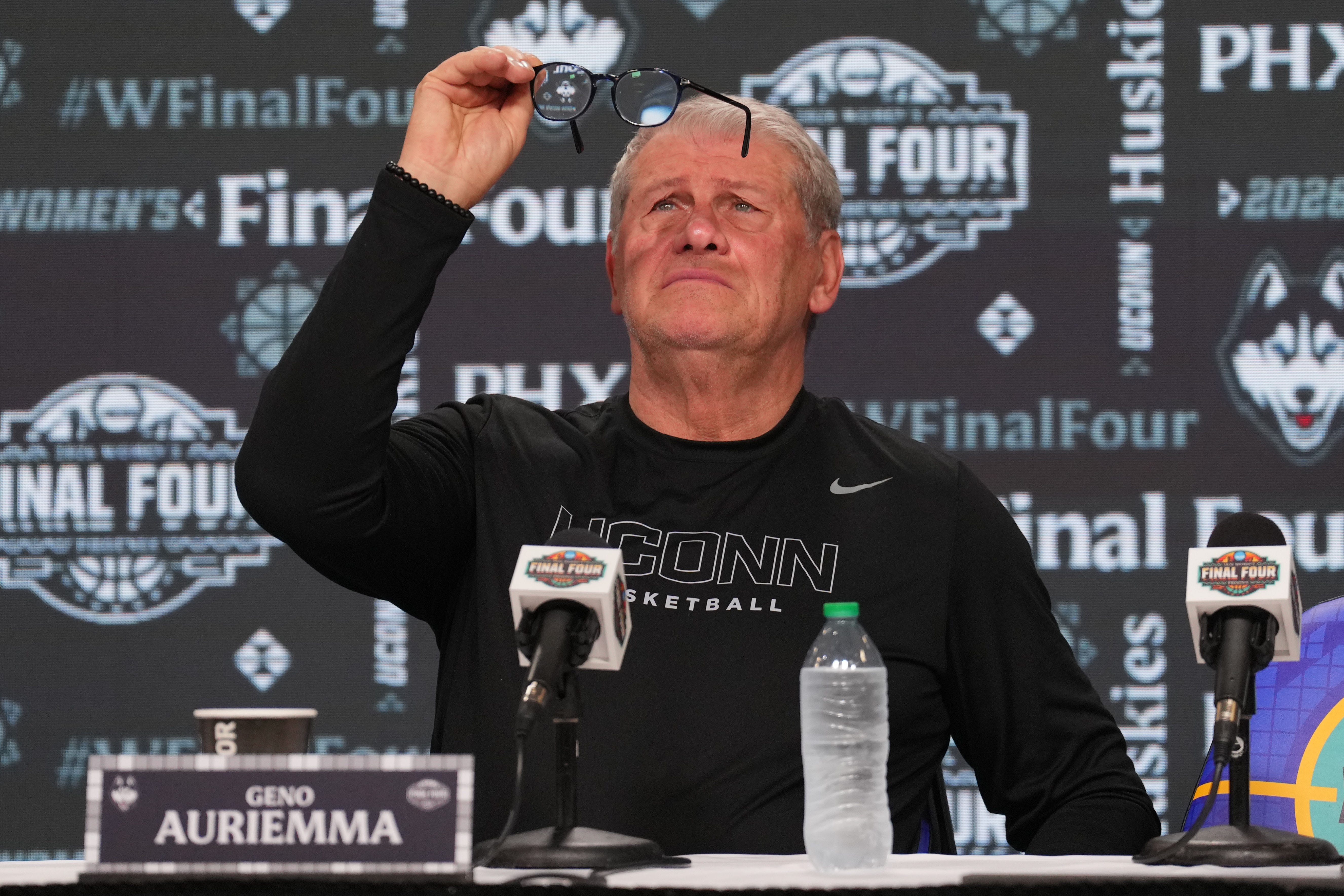
It’s difficult to tell if, with each revisiting Auriemma makes, he believes he’s clarifying his position. He certainly seems to believe he’s drawing people closer, giving them a clear view of what, in his mind, happened.
“The true test is how you handle yourself in this moment,” Auriemma says later, alluding to losing. “No one’s won as much as we have. When you’re part of that, be gracious in your losing. I never wanted to be anything other than that, and treat people with respect.”
A student reporter nervously asks what keeps Auriemma motivated, this being his 25th Final Four. “Well, after tonight I don’t know that I want to continue coaching,” he answers, grinning.
He wasn’t finished.
The question comes of whether Staley’s interactions with the refs — challenging calls, visibly and emphatically disagreeing with officials’ decisions — fuelled Auriemma’s end of game frustrations.
"I just want to make sure there's not a double standard. I'm of the opinion that if I ever talk to an official like that, I would get tossed,” he says, gesturing with a wide open palm like, Hello? “So I just want to make sure there's not a double standard, that some people are allowed to talk to officials like that and other people are not. That's it."
A small aside but one I got stuck on: though Auriemma’s asked several questions about Staley, reporters calling her by full name or first name, he doesn’t respond with either. Once, he rolls his eyes at the mention of her, and her name is not included in his written apology. It made me think about the coaches I hear from most — NBA, admittedly — and that they will refer to fellow coaches by first name when they talk about them. How names bring to the listener an instant mental portal to that person, an empathetic flash.
Auriemma’s strange point of a double standard, referencing the behaviour of a Black woman, the implied notion of Staley having more latitude to assail the refs, is a bizarre lever to pull. For it’s obvious historic inversion, and because Auriemma dishes discord to the refs with the best of them. For that, he and UConn’s men’s coach Dan Hurley are two peas in a particularly volatile pod.
Lindsay Gibbs wrote about the exchange, and enitre night, really well:
This is a man who had his ego bruised, who was personally outcoached during the game and who melted down in a stew of his own self-pity and victimhood because of it. His players played a poor game, there’s no getting around it… But none of that comes close to excusing his behavior. After a season of blowout wins and Big East dominance, Auriemma collapsed at the slightest hint of hardship and challenge.
We’ve not been faced with such public, bold-faced grasping and grifting in our daily lives as we have been in the past decade. It becomes difficult to parse which windows we’re meant to squint through to better understand a person and situation, which are actually worth our trust and time, and which we should quickly turn away from.
Auriemma has coached so many legends — Diana Taurasi, Maya Moore, Sue Bird, Breanna Stewart — that it’s hard not to view them as extensions of him. To view through them. This can be a helpful impulse with hard topics, and has brought many fans clarity or even closer to subjects they were averse to or confused by. I think back to Brittney Griner being detained in Russia and her teammates and WNBA colleagues speaking out, agitating for her release. Or in late-January, when the NBPA released a statement against the ICE shootings in Minneapolis. But there are limits to the way we should parse the world through other people.
Our public figures, in politics, sports, and self-made celebrity, share so much on a daily basis that even for a voyeur, this is a nightmare of observation. Fitting that some of the first results that pop up when googling “people as portals” are warnings of demonic possession.
I’ve only recently become acquainted with your writing but wow am I impressed. You’re so good at capturing the essence of a topic, or person, and uncovering thoughts/feelings that typically go unnoticed. I appreciate the unique approach, the more soulful perspective. Unlike most of the genre, it’s this kind of sports writing that keeps me interested in the game. Well done.
Confirmation and obligation indeed.