

It started with a song. Back in January 2022, when Sandro Mamukelashvili was on the Milwaukee Bucks and putting in big minutes against my Toronto Raptors, I listened to Raps commentator Jack Armstrong trip on a syllable, then stop and abandon any hope in trying to pronounce the emphatically polysyllabic surname of this young player who was born in New York, but has a distinctly Georgian handle.
Luckily, the young Buck already had a highly abridged alias, which Jack gladly embraced: here was “Mamu.”
But, I thought — how hard could it be to get the full name right? Once you have mah-moo, two simple syllables, there are only four more (rather musical) beats in it. Kel. Ash. Vee. Lee. They might be weird siblings in a very large family. Lost Kardashians, perhaps.
Delicious bits of language like this, I tend to repeat in my head. And why not, I thought, for Mamu? Even back on the Bucks, with whom he only logged one season, he brought to the court an undeniable energy and a unique sincerity. So, I started following Mamu’s career, and once I had mastered the syllabic structure and pronunciation of his name, I built a little song around it.
Although this song only exists in theory, I can describe it to you pretty well. It is in brisk 4/4 time, based on a simple electric guitar downstroke pattern played in a vaguely anapestic rhythm, the same you might clap in: one-two, one; one-two, one. The snare drum doubles this. The tune has the crisp, new wave bounce of the The Knack’s “My Sharona.” The only words are “He’s my Mamukelashvili… my Mamu.”
I could go on, but the point is, the song exists in my head, it rips, and I sing it (silently or out loud) whenever Mamu comes onto the court. Or sometimes when I’m cooking or doing dishes. Sometimes just because it’s the kind of thing I do — and not the only song I have.
Alexander “Sandro” Mamukelashvili came into the world on U.S. soil, in New York City, in May 1999, but his Georgian family moved to Tblisi when he was still a baby. He comes from basketball; Wikipedia tells me his grandmother, Ira Gabashvili, was a member of the Soviet women’s national basketball team. It also says he was in Chicago visiting his famous pianist aunt when the Russo-Georgian War broke out in 2008. At 14, he went to Italy to pursue basketball. At 17, he moved to the States, to play for Florida’s Monteverde Academy in high school, and went on to play college ball for Seton Hall.
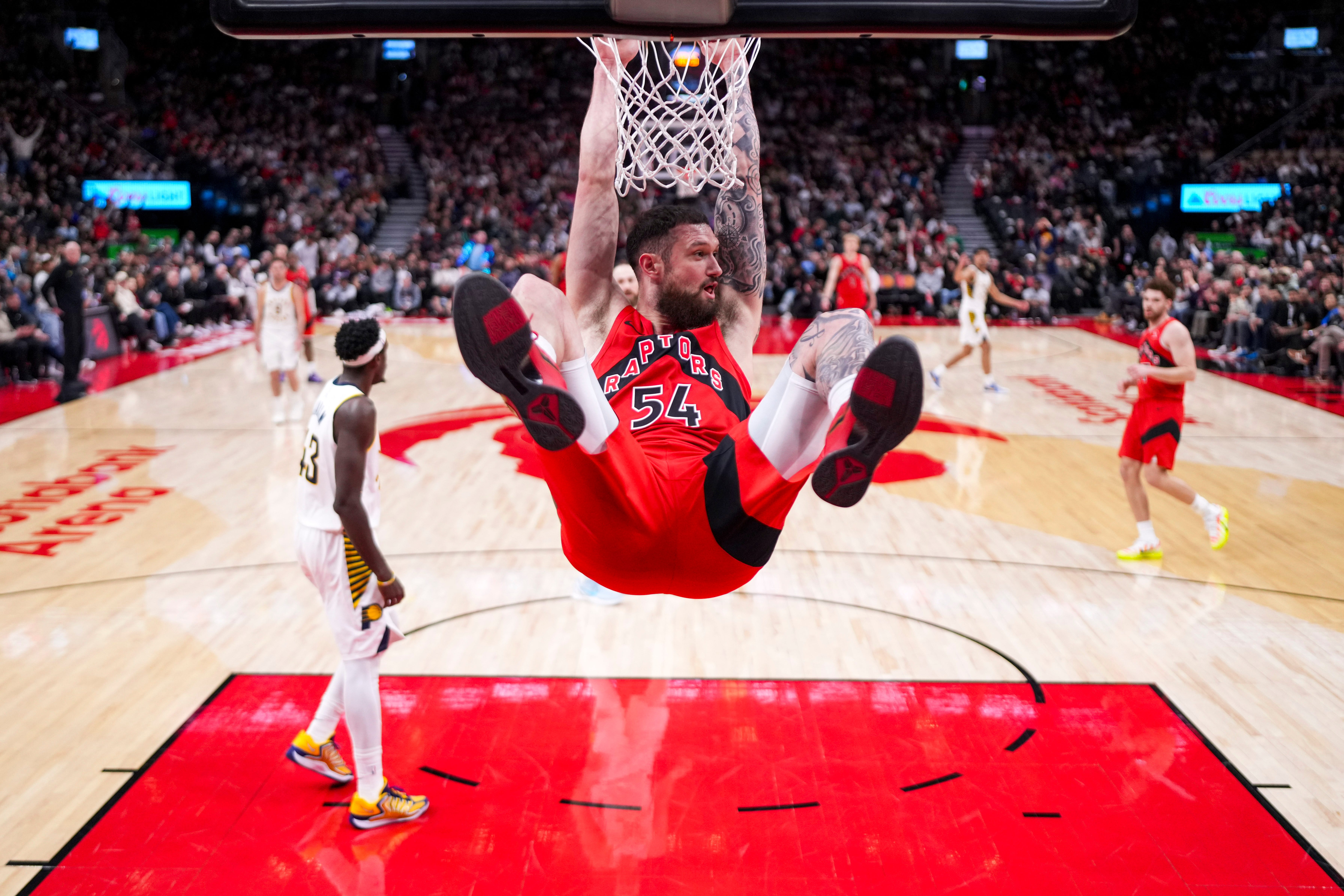
Mamu was selected as the 54th pick in the second round of the 2021 NBA Draft — the same one that got the Raptors NBA All-Star Scottie Barnes, who now plays alongside Mamu, a Raptor since the 2025 offseason.
After thin stints with the Bucks and the Spurs (and their respective G-League teams), this season the Georgian has become one of the Raptors’ two go-to replacements for often-injured centre Jakob Poeltl. He’s averaging around 10 points, 5 rebounds and 2 assists per game, with a field goal percentage of 51.5. On good nights, his three-point shooting can space the floor for the Raps. He’s plucky on defense, big but fluid.
Mamu’s best attribute, however, is his effort. He brings a jolt of energy to the court that comes partly from having had to prove himself as a legitimate and valuable NBA role player (right now, there are only two Georgians in the league: Mamu and the Orlando Magic’s Goga Bitadze).
But some of it just comes from Mamu being, abstractly, a little different. He’s one of the NBA’s few heavily tattooed white guys. His beard is ungainly. He needs a more loving barber. In interviews, he is among the Raptors’ more polite and normal-seeming spokespeople, but he has the tendency to make goofy faces for the camera, which always make him look a little embarrassed by himself.
In the NBA, “different” has a specific context. Players with unfathomable talent are called “different” as the ultimate form of praise. A “difference maker” is someone who can change the tenor of a game. In an NBA context, the phrase “Steph different” would only ever be taken to be a statement about Stephen Curry’s preternatural basketball skills. It would not be interpreted to mean, “Steph Curry is weird because he never stops chewing on his goddamn mouthguard.”
That iffy kind of difference has haunted a handful of NBA players who didn’t quite fit the Be Like Mike mold of the superstar model. Dennis Rodman? Too colourful. Dwight Howard? Too thuggish. You can see the same dynamic at play in the current aura clouding the future of Ja Morant, who, even before the gun thing, was maybe just a bit too flashy for the NBA’s comfort.
Sandro Mamukelashvili isn’t different like Rodman or Morant or Metta “World Peace” Sandiford-Artest. But he has his own kind of difference, an endearing awkwardness nicely encapsulated in his name — which, in Georgian, looks like this: ალექსანდრე მამუკელაშვილი — and, in my head, sound like “My Sharona.”
For years, I never thought much about my little songs, the tendency to fix on phrases and privately vocalize them into easily repeated patterns. I first noticed the habit more pointedly during the COVID-19 lockdowns, when the whole world was in an accelerated state of stress. I built songs using random Korean words, common names and funny animals (horned grebe, etc.).
Then, one day I came across a post on social media, in which the poster “shouted out” those, like them, who listened to particular songs endlessly on repeat, had obsessive compulsive leanings, and — using a term with which I was unfamiliar — did “vocal stimming.” Those, in other words, considered neurodivergent.
I grew up in the 1990s, when depression was a trend. Nobody was neurodivergent except Dustin Hoffman’s character Raymond Babbitt in the Oscar-winning film Rain Main, and we called him autistic. Autism, of course, existed as a complicated experience for anyone managing it in themselves or a loved one. But the larger cultural conversation was much more binary: autism was a kind of disability (unless you were gambling).
I have never been Raymond Babbitt. In high school, I knew my brain worked differently than a lot of people’s — but whose doesn’t? We all live in our private cells of perception and consciousness. True understanding is beyond reach. It took me years to ask my doctor for an anti-depressant prescription, and since it turned out to be a helpful and successful intervention, I figured my tics were just part of being “generally fucked up.”
This new information — that my difference might fall into a recognized category that didn’t really exist in my youth — though admittedly inferred from an anonymous social media post, became more relevant when, not long after, my daughter was similarly assessed.
It also offers a possible explanation for the songs. Vocal stimming is any self-stimulatory behaviour that involves the use of the mouth, lips and vocal cords. It is often triggered in response to stress or excitement. In Rain Man, Raymond Babbitt’s release came out in muttered calculations and misinterpretations of his own name.
For me, the answer comes out, in part, as Sandro Mamukelashvili — my Mamu.
“Difference” is a double-edged sword. On the one hand, it can mean brilliant, or fascinating, or diverse. On the other, it can be a brutal agent of separation.
That matters nominally in the NBA. Most of the athletes who make it to the elite tier of professional basketball are, by definition, successful. Dwight Howard judged this year’s three-point competition. Ja Morant is being given indefinite chances to be better at everything. Mamu, for all his syllables and Sasquatchian grooming and goofy faces, will be fine, even if he spends much of his career coming off the bench, or ends up on the Wizards.
Away from the basketball court, difference matters urgently. The fascist project is to cleave a rift in the public consciousness, creating a gulf between the accepted and the different. Accounts from across the United States say that ICE’s project in Minneapolis was to detain anyone with brown skin. The current assault on Iran is bolstered by endless statements on the basic inhumanity of Iranians. Here is the most sinister use of difference: the racist project of white supremacy. It is rooted in an ugly ideal of conformity and groupthink. The perfect citizenry of the new right looks like a vast army of faces made indistinguishable by blind service. The same spirit fuels the boom of large language models and other generative AI tools that promise to enable the making of anything, but all pump out visual crap coloured by the same giveaway plastic sheen. The geometry of absolute power is a funnel pushing everything toward sameness: a processing machine that turns diversity into bland, nutrient-bereft sausage.
It is, perhaps, a stretch to get from here back to the NBA and Mamu and what it means to be typical in anything at all. But I think I can get there by putting on a few jerseys.
It’s easy to love or hate the superstars. Steph Curry is a generational phenomenon; Steph Curry needs to stop chewing on his goddamn mouthguard. As long as Steph Curry is playing, and longer, his #30 Golden State Warriors jersey will always be a bestseller. Because, as we all know, Steph different. Same goes for LeBron James, Kevin Durant, probably Victor Wembanyama. The big-difference-makers live forever.
Sometime in January, I went searching for Mamu jerseys on the official NBA shop. For the Raptors, the options included the obvious choices: Scottie Barnes, hometown favourite R.J. Barrett, good old #1 (Gradey) Dick. I had the option of ordering the jersey of Mo Bamba, whom the Raptors picked up for maybe seven games this season before waiving.
Mamu’s name was not on the menu.
I think sometimes about when Pascal Siakam left the Raptors, and published a heartfelt essay in the Player’s Tribune. He wrote of the first time he ever saw his number in the stands:
With some rookies, they come into the league, it’s a lot of buzz. But with me, when I got drafted, my agent went to the team store to buy a Siakam jersey…. and they didn’t even have it for sale!!! I definitely wasn’t on fans’ radars, you know?? And I’ll admit something to you now. I would do this thing as a rookie, during the anthems, where I’d look around and try to spot my jersey in the crowd. Obviously you can’t be doing that during a game, you need to be chill. But during the anthems you’re looking at the crowd anyway, so it’s less bad. It’s crazy, though: I’d never see any. I swear, every night I looked. Nothing. Then finally, this random night, I’m doing my usual scan — I SPOT ONE. RAPTORS 43. I’ll never forget that feeling. I’m going, YESSSS!!! on the inside.
Turns out, you can buy a Sandro Mamukelashvili jersey through the Raptors store (of course, you can; assuming otherwise in this psychotically consumerist environment is, in retrospect, very dumb). But I’d wager it’s a relatively small club that has made the leap — a group of fans who are drawn toward something a bit different. At any rate, this is my mission for the rest of the 2026 season: I will acquire and don my Mamu Raptors jersey. I will become part of a club for which I have already written an anthem that, aside from my wife and child, no one will ever hear.
I will wear number 54 with pride, as an expression of my love for a utility guy whose name is a beautiful sound that has given me an anchor. If I, and the Raptors, are lucky, I will wear it to a playoff game. And, during the anthems, I will wonder if Mamu can see up high enough to notice it, and think to himself, YESSSS. That guy? He’s different.

This was a pleasure to read 💜
(Just requested Different Beasts through an interlibrary loan)
Awesome article, JR! I'm neurodivergent and I struggle with anxiety. I've also struggled with identity and conflicting cultural expectations as the child of East Asian immigrants. I struggled with many years with trying to 'fit in', with feeling belonging. And I've felt different, like an outlier. I still do to an extent (and the stigmas, authoritarianism, atrocities by ICE. and more have made it difficult). Your article really resonates with me, and the examples you shared are spot on. I love how witty it is as well as how heartfelt it is as well :).
"I will wear number 54 with pride, as an expression of my love for a utility guy whose name is a beautiful sound that has given me an anchor. If I, and the Raptors, are lucky, I will wear it to a playoff game. And, during the anthems, I will wonder if Mamu can see up high enough to notice it, and think to himself, YESSSS. That guy? He’s different."
Love how you wrapped up the article too :)
Great write!