

Heady as a heartbeat
Russell Westbrook announces his retirement.
At some point it goes on without you.
It’s the people who try and hold on too long who have the worst of it. Who become desperate and clinging, who become lonely, raging kings. The people who don’t realise that it’s the luckiest of us who get to pick our endings. That oblivion will always come like an animal that was only seconds before flat on its side sleeping, then suddenly sprung to all fours with every muscle so taut that its trembling, keen toward you.
There’s a clip — well I’m sure there’s several, several dozen — of Russell Westbrook loping around the paint, veering in and out of the candy-bright vortex of whatever primary colour that particular opponent hails as their own, plucking rebounds out of the air like they were low, lilting June bugs, woozy on the succour of their breeding frenzy and imminent deaths.
The first attempt clanks off the backboard and he’s already split the three defenders crowding in with their eyes up; airborne between them before their hands start to raise a half beat too slow. He scoops a palm around the ball, somehow gets a handle on it even as it moves away from the basket and his hand, to divert it out to a teammate waiting, far away on the three point line. Another shot goes up, rims out, and Westbrook is back in the air, body jagged as a puzzle piece, flipping the ball again to another teammate who takes and makes the third and final shot.
He’s sprinting down the floor before the other team has gathered the ball and taken it out for the inbound. He’s hardly broken a sweat.
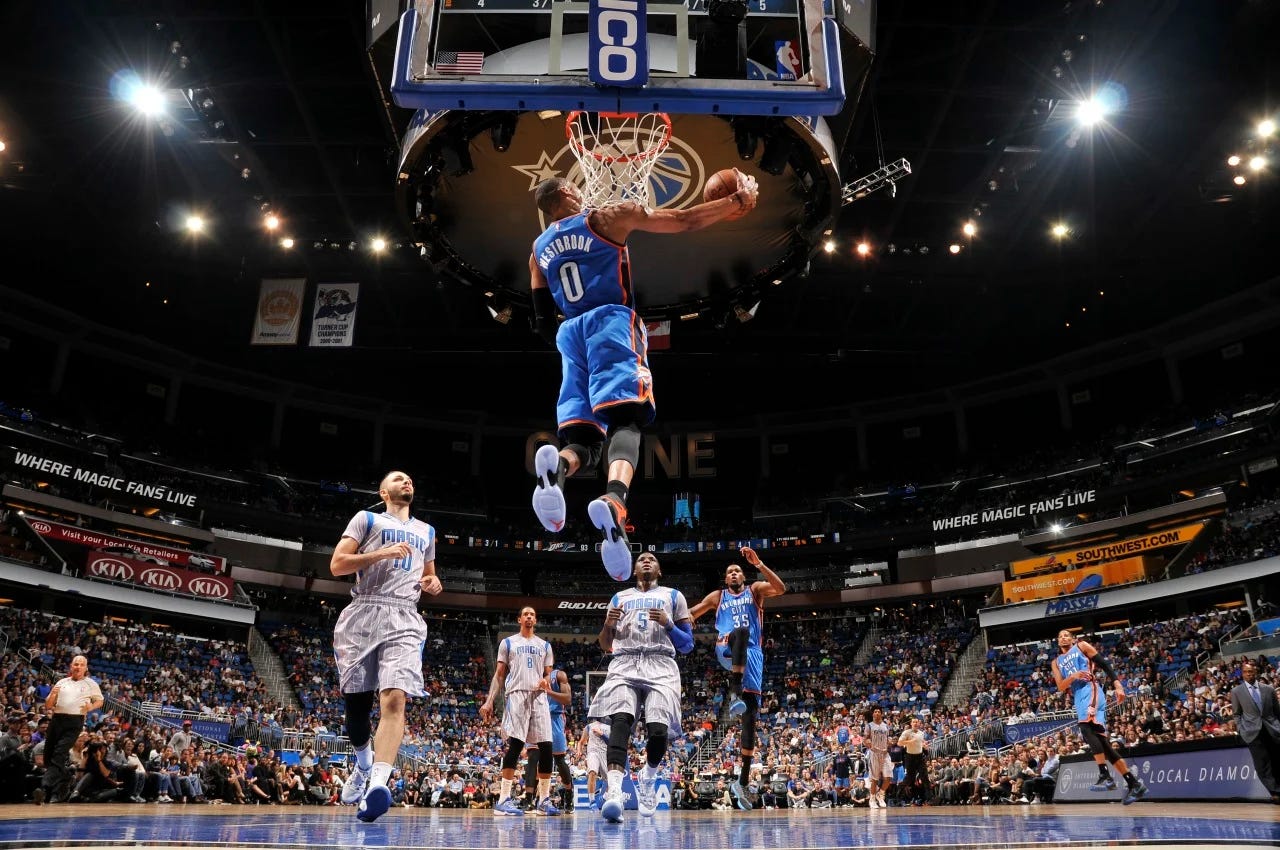
Watching Westbrook, it’s not that you get the sense there’s something else he’d rather be doing — it’s the sense that no one else is playing the same game that he is.
This is the crux. At the heart of what makes Westbrook so polarising, whether he maddens you or vaults your brain to the same plane it gets to standing in front of an artwork that suspends time, it’s the recognition that his version of basketball is different from anyone else’s. It’s why it makes no sense to point out that he’s never adapted or adjusted, tried to modernise or worse, standardise his game. It’s like judging the moon by its shy, pale impression tucked over in the corner of the sky at dawn; like speaking Japanese to learn Italian.
He’s confounding, is I’m sure what you’ve heard if you’ve ever heard about Westbrook. What this means is usually frustrating, and frustrating because he is difficult — to watch, to parse through the numbers.
The smoothest and most direct of Westbrook possessions — a straight arrow down the middle of the floor to the basket for a dunk, say — will still hold within it an aberration. His arm will lever back an extra awkward notch, he will take the last steps with his hand up and stone-still like a statue wielding a torch, he will do a sudden stutter-step and change the direction of his approach in a wide open lane, skitter sideways like a crab before launching his body into the air, as if to feign pursuit or else slow himself down. Each flourish thrown in not for aesthetics, since they snag the eye in ways that feels tricky, glitching, a hitch in the surface-level desire for visual ease, but to make things more difficult.
Why go from A to B when you can toss in some cuneiform, add a few hieroglyphs along the way? Why not?
What a bizarre contrast it’s been to watch the last week’s deluge of highlights and clip tributes to Westbrook, who out of any athlete in basketball or beyond wielded exquisite control of his body and revelled in its ability to be pushed into extremes and chaos, as my own behaved in open revolt.
To watch Westbrook is to watch flight, feat, crashing and burning and springing up from the wreckage without grimace or pause. To watch Westbrook is to live for a few free fleeting seconds outside of the mind — certainly your own mind as it perceives the outlines of your body through its limits and contours of pain — and channel into the physical. Into impulse. Into the bioelectric signals the brain sends down the nerves to trigger each muscle. Nearly into the ions, charged particles of sodium, potassium, calcium.
Out of body. Out of the perception of your body.
When the clips end, when I come back to myself, I can feel everything tighten. What gives me away to myself, I think, is the big grin on my face.
Things Russell Westbrook hates: disparaging variations on his name, gravity’s crude limits, Patrick Beverley, to be made to stop once in motion.
He is confounding, but it’s closer to the word’s origins than its contemporary, exasperated variation.
First from the Latin confundere, to jumble together, especially relating to the senses and the mind. Then into Old French, confondre, to crush, ruin, throw into disorder. In Middle English, confounden, to destroy utterly.
The urgency hemmed into these initial iterations (and what’s lost in how clunkily we wield the word today, like a shield we’re LARPing with) comes from naming not just the process of confounding, or being confounded, but the feeling that came in the process. The fear and furtive thrill of witnessing a thing paired down, by force, to its essence. The unexpected freedom abruptly revealed therein.
Isn’t that what Kevin Durant was getting at, in his tribute to Westbrook this week?
A lot of people looked at the emotions on the court and thought Russ was loud, nah to me, he was quiet and methodical. He lead by example and once the lights were bright, he let everything out and experienced pure freedom.
He laid the game bare, broke its canonical rules and tactile decorum, made it ugly, made it loud, made it arduous and urgent. He confounded. In the process, bit by fevered bit, every vibrating moment primetime bright, he exalted. The ball in his hands, his body in the air — elemental. Pure freedom.
How do you build a legend?
With awe, with grace, with time spent most at the ineffable place where the two meet.
There has to be candor, along with a certain roughness — not all the edges and corners can be smooth. A crashing quality, still. An ability to snag.
Turbulence and constraint, too. Forever chasing tails. We want to watch what’s beautiful but we want to know what’s humming just under the surface, heady as a heartbeat.
Still, the real proof of a legend is how it’s received once that person has packed it in and gone, when all the careful chemistry comes to blow. It works best when they’ve turned and started walking away, their silhouette sharpened in the first radiant burst of memory.