

Atlas was so grateful to Heracles for his kindly deed that he not only gladly gave him such assistance as his Labour called for, but he also instructed him quite freely in the knowledge of astrology. For Atlas had worked out the science of astrology to a degree surpassing others and had ingeniously discovered the spherical nature of the stars, and for that reason was generally believed to be bearing the entire firmament upon his shoulders.
— Diodorus Siculus, Bibliotheca historica, 60-30 BCE
The days of the United States propping up the entire world order like Atlas are over. We count among our many allies and partners dozens of wealthy, sophisticated nations that must assume primary responsibility for their regions and contribute far more to our collective defense.
— National Security Strategy of the United States of America, November 2025
I fell asleep with Wuthering Heights tented open on my stomach. Just ten minutes, I told myself as I set the paperback down and laced my fingers together, let my head loll back against the cushions.
In every collection of people, every family or couple, friend group or collegial pairing, there is the organizer. The person who sorts social commitments, takes hold of the day, makes heads or tails of timing, who holds the logistical world up. The role can shift depending on the group and the need but so long as a person isn’t solo, someone shifts to fill it.
Relinquishing was the word that came to mind as I started to drift there on the couch. Consciousness, evidently, though mostly control. I was thinking of where Dylan and I had to be, when we’d have to leave to get there, but as that word flashed I felt myself let go.
Victor Wembanyama returned last night after a 12 game absence from a calf strain. A knack for the moment, Wembanyama picked the Spurs’ NBA Cup semifinals showdown against the Thunder in Las Vegas for his re-debut. It was the first game all season San Antonio could put its complete lineup of De’Aaron Fox, Stephon Castle, Dylan Harper and Wembanyama on the floor together at once and they drew it out (the last 35 seconds of the 4th quarter took about six minutes), revelling in making OKC do the sort of work the team hasn’t so much had to this season with their 24-1 record.
Make that 24-2.
For all the complaints about how often Shai Gilgeous-Alexander gets to the line, it was fitting, if anticlimactic, that this game’s long, last minutes spent so much time there — at either end. Not a bang or whimper, but a meandering winding down.
“I don’t think we did a good enough job… moving,” Gilgeous-Alexander said on postgame podium, the word coming after a beat for thought and on an exhale. The Spurs, specifically Wembanyama’s galactic reach, take the paint away, he said, and the shots they’d usually nail didn’t fall. “The game of basketball is never makes and misses,” he smiled, a little, “it’s always the little things. They took care of the little things.”
Gilgeous-Alexander is light in his weight. In how he carries pressure, expectation, the heft of stardom, how he moves over the floor. It is not particularly aggrandising, of yourself, of your or the opposing team, of the moment, to declare it negligence of the little things that lost you the game. Especially a game that ended in the broadcast declaring the Spurs a “giant killer” for felling less the Thunder than their impressive win-record. But then Gilgeous-Alexander also has a knack for the moment, notably its ownership. He’ll never be one to wrest it away, only stick a neat pin in it. A light hand, an airy awareness.
This lightness is something I’ve long suspected to correlate with the reluctance to name him face of the league, fix him as its designated superstar. His un-Americanness too. Funny then that this win for the Spurs was turned so outwardly and immediately declarative to that same end for Wembanyama.
In a clip that aired pre-game Taylor Rooks asked Wembanyama about the matchup between himself and his counterpart on the Thunder, Chet Holmgren. Rooks classified it as one of the “true NBA rivalries” and ominous music, plus the entire video cast in black and white, worked to underscore the point. Wembanyama steered his answer away from Holmgren, noting that with the reigning MVP of Gilgeous-Alexander on the floor, that’s where the focus was. In the 21 second video, five long seconds are dedicated to a close-up of Wembanyama’s hand resting on his leg. As if the viewer might pick up on strain there.
As OKC and San Antonio warmed up on the court in Vegas, Rooks was joined by her NBA on Prime co-hosts on the same court to intro the game. Mavs legend and notable German Dirk Nowitzki said he didn’t like Wembanyama’s redirection and that it diminished Holmgren’s role and talent. He said he found the comment “too swaggy, too dismissive.” I said notable German because it was then Steve Nash, sitting beside Nowitzki, who offered, “He should’ve been more direct,” to which Nowitzki agreed.
That was it.
Still, I’ve seen that, and the hyper-produced clip, hoisted as proof of Wembanyama’s singular competitive drive. That he’s a “true psycho” (complimentary) and “built different” (never mind the latter being the most ubiquitous descriptor of them all), that he revels in being pitted against the best, and best of all will make it known when they don’t measure up. Nothing quiet about that, nothing ambiguous.
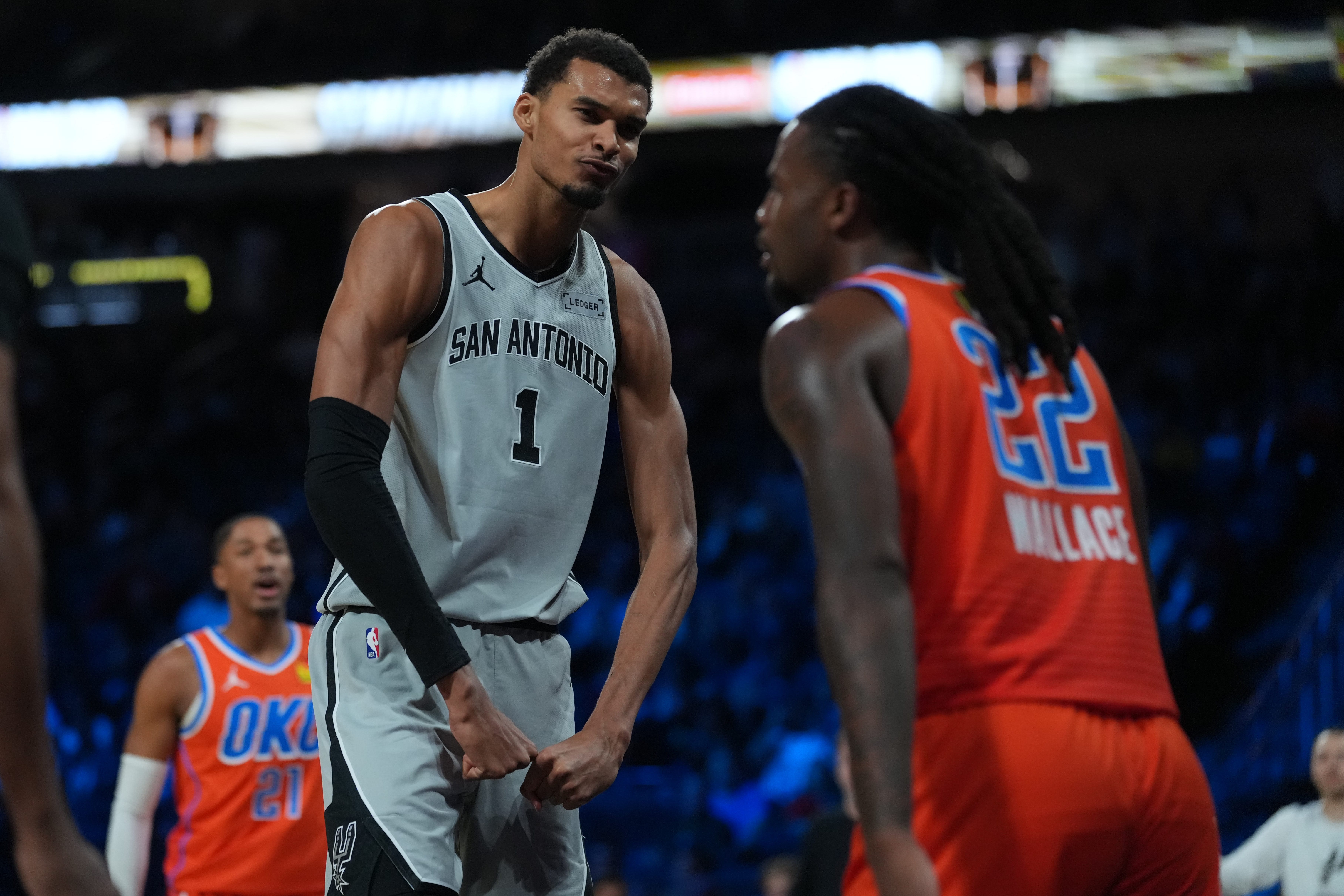
Here is our future face of the league, in all his caricature-smug scowling glory. This seems to be the chorus singing now in a key of relief. The one who is going to make it look effortful and torrid, who can show proof of the strain.
Here is our Atlas.
The myth of Atlas, like them all, has been applied over time to how it best suits. A Titan thrown out of Olympus after he and his kin lost the war they started against the gods, condemned forever to hold up the world on his back.
All wrong.
Atlas was skilled in mathematics and astronomy, in antiquity he was credited for inventing the first celestial sphere. Early cartographers characterised him as the founder of geography (hence, our “atlas”). The Atlantic Ocean comes from the “Sea of Atlas”, the lost island and city of Atlantis named for him too. Atlas was fascinated by the heavens, how they worked and what pull they had on the earth. Myths that involve the weight of the sky being taken from Atlas and hoisted by another, as with Heracles, are done so not by force but by choice. The symbolism being that Atlas and his knowledge, while weighty, are not a curse to escape from, but a commitment re-established many times over.
I thought of that commitment — to learning, to shared knowledge, to science, to wonder and its expansiveness — when I read the United States’ new National Security Strategy. Not very long, the strategy confirms that the U.S. will shift its diplomatic attention inward; that the country will no longer prop up the entire world order like a beleaguered Atlas. Strange, since the war-mongering, destabilising, colonial interests of expansion expressed by the U.S. are at a decadent, clumsy and cruel fever-pitch at the moment.
