

Exits: Repeat repeat repeat
The Raptors return to the playoffs was filled with familiar repetitions in triumph and loss, but have they processed the lessons of the past? Do any of us?
This past fall, the city of Toronto announced they were going to tear down the Imperial Pub after 81 years. The bar closed in November, no fanfare, no ceremony, cruel and abrupt.
If you never got to experience this bar yourself, I feel for you. Even though there is probably one like it in the place where you live, it was special. On the edge of “Toronto’s Times Square” (a neighbourhood exactly as unpleasant as that name makes it sound), it was a strange, dank portal to another dimension. One thing I liked was that its first and second floors had basically no narrative continuity. Downstairs was dark and humid, with a cramped circular front room and a fishtank hanging over the bar, while upstairs was lit oppressively bright and fluorescent as a church basement, crammed with wood tables and overstuffed leather couches and low, stacked bookshelves on the window side. The only thing that connected one half to the other was the fact that they lived in the same building. Sometimes that’s really all you need.
The Imperial was important to a lot of people for a lot of reasons; for me, it was that I went there nearly every week with my friends after seeing a movie at the Cineplex to talk about what we’d seen, and then our lives. These conversations were so load-bearing in my life that I used them as the scaffolding for a memoir. In there, I wrote: It is a privilege to have your life witnessed like this, with such care and attention. To have the scattered points of you arranged into a line.
Art, of course, does this too, as does the newsletter Basketball Feelings; that’s why we’re here. Someone takes the scattered points and leads you down the path between them. Someone excavates the meaning and holds it up to the light.
Last June, the Raptors announced they were firing Masai Ujiri, and the news made me more upset than I was comfortable articulating. I am on the record as someone who doesn’t always take well to big changes in the franchise; I need, often, to be dragged along. Demar DeRozan had once been my favourite Raptor, the one who recharged my love for the franchise. But even I had eventually been forced to admit the necessity of his trade, even if it hurt my heart.
But the Masai firing felt different to me. Yes, again, money, and yes, again, a reset. But from the second they announced it, I couldn’t help but feel there was something essentially Canadian — in the worst sense — about the way they cut him loose. It was bizarrely close to free agency, with a terse, tight smile of a press release, plus insider gossip that felt nastier, more pointed. They were saying Masai was expensive, but also that he was “larger-than-life,” “like a celebrity.” We were unceremoniously cutting ties with the man who had singlehandedly steered the franchise from Primo Pasta to the chip — a man whose salary was arguably commensurate with the work he’d done — because something about him was rubbing the noxious monopolists who now controlled the franchise the wrong way. I remembered what the Raptors were like before Masai. Didn’t we all? It really, really bothered me. But also, I didn’t really have the time to think about it. I filed it away.
Around when the Raptors fired Masai, I was still married to my partner of ten years, but our marriage was ending. All you need to know for the purposes of this story is that we loved each other but weren’t happy, and though we were working as hard as we could to stay together, it was becoming increasingly clear that what we needed was release. Still, we were leaving it all out on the floor, and had been for months. Every single day, in the kitchen or on the couch or the therapist’s office, we would have one of the hardest and saddest conversations of our whole lives, one where we learned something completely new about ourselves and each other. We were tracing the through line; digging into the thing we’d spent ten years building together and holding its core up to the light. It was revelatory and astonishing, repetitious and grindingly hard, an experience I would neither trade for the world nor wish on my worst enemy.
Those days, most afternoons, I would bike 40 minutes downtown to the palliative care ward where my 98-year-old grandmother was also dying. She had been a preternaturally healthy person for almost all her life, including the portion where she had helped raise me, and her decline, now in its fifth year, had been heavy and hard. At some point that year, her caregiving had become a contact sport — I still dream sometimes about the ten-point turn of getting her into bed. Every day, overwhelmed by sadness and boredom, I watched her breathe and clutch the blankets, coaxed her through meals of thickened juice and painkillers, eavesdropped on the other patients and their families, wrote their stories in my head. Then I’d bike back home.
A whole summer passed in this relentless loop: mortality, privilege, plenitude, loss, ego, anger, grief. Rich, lush field of intimacy; vibrating proximity to the other world; boredom’s near-psychedelic richness; plain fear you can’t extinguish or dismiss. These things were daily, never-ending, and I could not extract any kind of greater meaning from them other than that they happened to everyone, all the time.
That was bothering me too. I was used to making something out of it. In the past, when I taught, I would always tell students that repetition wasn’t just a device you could use to help navigate the reading a poem or a novel. I thought the recognition of it was an essential tool for any artist. If you are noticing the same images or themes or moments over and over again in your own life, I’d say, they may be pointing you towards something worth writing about. Now, I wondered if I had been lacquering the grainy texture of real life with a thick layer of poetic license. Sometimes there is no greater lesson. It all just keeps happening, over and over.
You wait so long to find out what happens, and then you do. At the end of the summer, all at once, my grandmother died, and my marriage was over, and suddenly I was on the other side. An apartment dropped into my lap, and by the time the regular NBA season began, I was watching the Raptors’ opener on my new TV while allen-keying together a dinner table from Facebook Marketplace.
I wanted to feel happy to be watching the Raptors again. In a time when so much in my life felt untethered and weightless, I wanted to feel anchored by the familiarity of the franchise I had followed, in various capacities, since I was a child. I wanted to feel linked to the broader through line they indicated, plugged in and grounded by something greater than just my own life. But it was an away game in Atlanta, and I felt unmoved. They won by 20 points that night, but I didn’t even know until the next day; around halftime, I had switched to something else.
The last time I went to the Imperial Pub was on a Friday in fall, a few weeks after the NBA season’s beginning, on a date with a stranger. When I got there it was full. I found him in the back room, watching a packed audience swaying back and forth to a live jazz band. We milled around for a while, waiting for a seat at the bar. There were old people and young people and unhoused people from around the neighbourhood; there were students and regulars and couples coming in from the movies, from sports games. There was the low-lit fishtank and the sticky bar.
He told me he’d only lived in Toronto for a few years; during the pandemic, amid an emergency, he’d sought asylum here. I asked about the differences between Toronto and his hometown, and he said he was struck and saddened by how little we seemed to value places like the bar we were in right now — neighbourhood institutions with real, meaningful history. In the city where he grew up, they built monuments to stray animals, travelled for hours just to see another neighbourhood’s famous street vendor. People did this naturally, unprompted; it was just what made sense. After all, these were the things that made life worth living, that made a city worth living in. Waving his hand around the bar, he said: A place like this is a tree. It takes decades to grow roots. You can’t just cut this down and expect something else will replace it right away.
When I used to write about the Raptors more, I found myself coming back to the same handful of themes on repeat: haunting, echo, memory. The uncanny way the city’s institutions mirrored its infrastructure; the way the people in charge of Toronto seemed averse to preserving the things that make it special. Again and again, writing about the team and how they made me feel, I found myself arriving at the same conclusion: Change is inevitable, yes, but you need to protect the things that matter and mourn them when they go. If you refuse to tangle with the difficulty of transition, to give yourself over to the confusion and frustration and sadness — and, yes, relief — that attend a major loss, it will leach into your life in other ways. A person, or a place, or a franchise, that refuses to mark its losses with the respect they deserve is haunted, hosed, doomed to do nothing but repeat repeat repeat.
The year kept moving. Life bloomed, receded, bloomed. Things were astonishing, incomprehensible; I walked the dog with my ex, talked to my grandmother every day, fell in love. I was proud of how I faced most of the things I did not want to face.
Except the Raptors. I was still miffed about the Masai thing, and also maybe afraid to learn I’d lost my connection to them entirely. Or maybe I felt too raw to tolerate the disappointment of watching them lose, too vulnerable and thin-skinned not to care about an unpleasant year. Whatever it was, I paid the least direct attention to their regular season that I had in many years. I glanced at box scores and tweets, but almost every time I tuned in to a game I’d bail before the end. Their season felt depressing and grindy. There wasn’t a new, gathering energy to get swept up in; just a totally average year, with little spikes of excitement at sporadic, disconnected intervals. They won against teams they were better than and lost against the ones who were better than them. They had moments of inspiration and long stretches of tedium. I found things to fill the hole that was left in my consciousness. Every morning, instead of their highlights, I made coffee with the NBA Top 10 in the background, letting it soothe me the way a lullaby soothes a child. In idle moments I’d Google “wemby highlights” and let myself be carried. Maybe this was just how I watched basketball now.
For a long time, I did not think the Raptors would make the playoffs. When they did, Katie asked me to write this piece. In one sense, that’s kind of the only thing you need to know about their vibe this year: that it made complete, intuitive sense to plan the season’s obituary while they were still fighting to keep it alive. I said yes, and then I worried. This format begs for structure, some kind of closure. I wondered what I was even going to say. Did I even like my favourite team anymore?
The answer, of course, was waiting for me in the game itself. The first few games of the series I had to force myself to watch with a second screen to distract me, avoiding eye contact, feeling nothing but a dull pang when they lost. But around Game 3, the score was close, and the thing started to lift off the ground, and for the first time in over a year I felt it: the flicker of sentiment I associate particularly with this team, with my lifelong experience of loving them in different ways. A glimmer of true hope, not attached to any broader logical structure but the moment that contains it. Like the first day of warm spring weather in March, when it doesn’t matter that you know there is more cold ahead. In that moment, there’s enough hope that you can actually inhabit the present, anchored to the moment and unattached to the stretch of time that came before or lies ahead.
I kept feeling that way for the next three games — through the ups and downs, the weird offensive hiccups and the gnarly physicality of the defense. In moments of pleasurable or frustrating closeness, I remembered what it felt like to love the Raptors: when they take a turn for the worse it feels inevitable, and when they manage to flip the switch and give you something beautiful, you feel like you are gasping fresh air after years spent underground. Each time, good or bad, you feel certain that this is the way it’s always been, and this is how it’ll be forever. A feeling as ahistorical as it is rich with history.
By the time Game 6 hit OT, I was standing in the doorway that separates my kitchen from my living room, and then I was bent over, white-knuckling the back of my couch. I was yelling so loud I heard someone downstairs laughing at me. I could not help it. My phone buzzed and pinged with texts I was not answering. I couldn’t look, I couldn’t look away. And then the moment. Do I need to even tell you how that felt? The bounce, the sea of fans at Jurassic Park, everyone vibrating. I was plugged in again, tuned to the frequency, completely in.
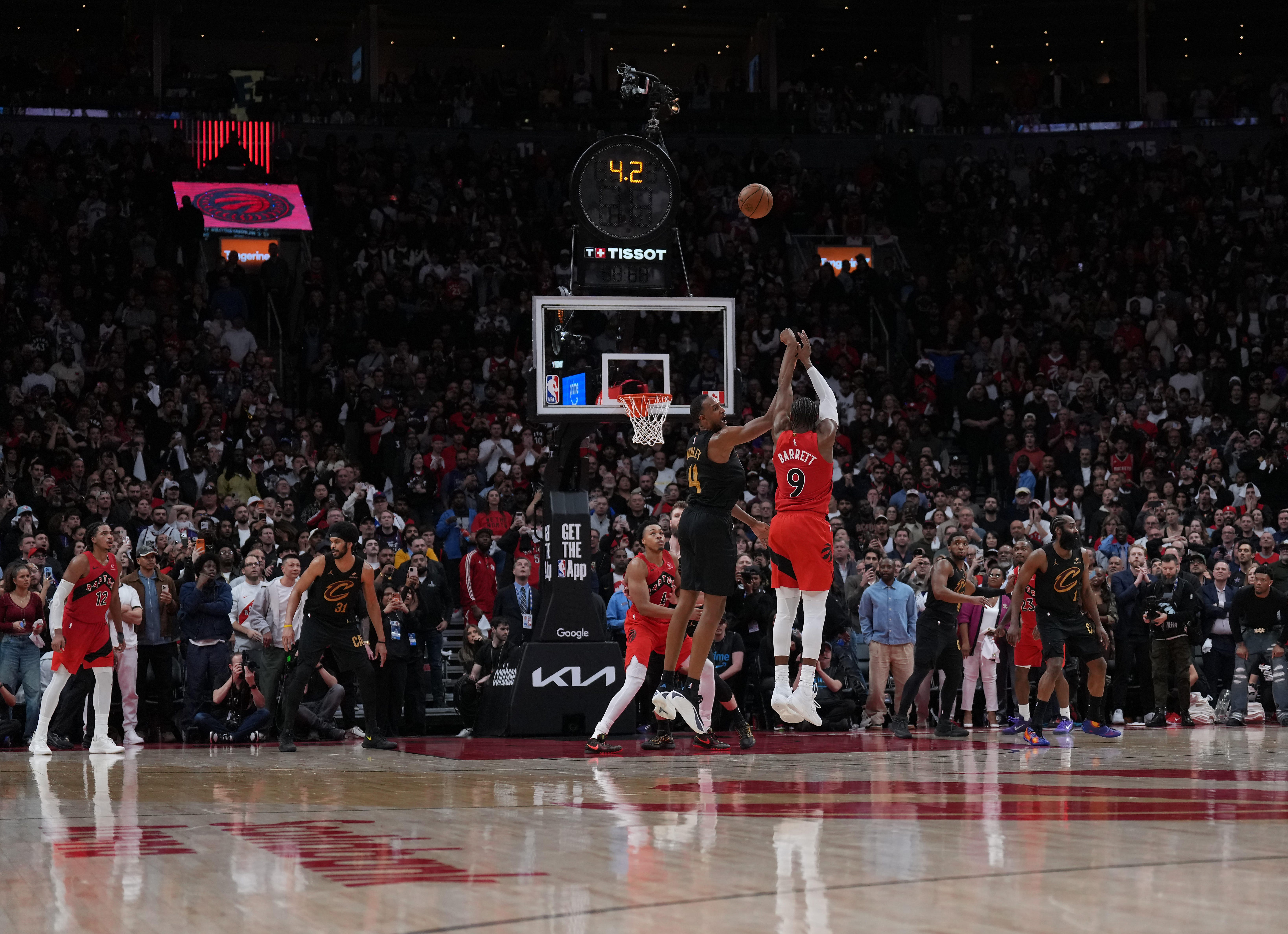
Who can remember what happened after that? Or more accurately, who cares? For as long as I’ve been alive, the Raptors have not even made the playoffs, forget making it past the first round. To get there at all is still a gift. The Raptors have already won a championship in my lifetime — and they did it not long ago, after an endless loop of loss. Maybe they will do it again someday. I hope they can, though I suspect the franchise — once again, like the city it represents — will need to put real stock in valuing its assets and acknowledging its mistakes.
In the meantime, that bounce keeps pulsing in my mind. It was repetition the way a poem uses it; a sign that there is something worth paying attention to here, even if it’s meaningfully different from the last time you met it. A supernatural, uncanny echo; stopped time. It failed to signify some grand resurgence, failed to orient the team in an uncertain, light-grim future. It still probably meant something, and we don’t know what it is yet. Maybe we won’t get to until next year, or at all. Sometimes there is just the feeling, then the feeling, then the feeling, and what connects them is that you have felt them all. No more, no less than that.
 | A guest post by
|
Powerful and beautiful article, Emma! I cannot imagine the pain you've been through over the past year. Your article hit my heart.
"A place like this is a tree. It takes decades to grow roots. You can’t just cut this down and expect something else will replace it right away."
That is so true. While I've never been to the Imperial Pub, I agree that it is irreplaceable. I don't know how to put it in words, but beloved places where there is community, like the Imperial Pub, longtime restaurants, indie bookstores, etc. are irreplaceable and invaluable. They hold so much heart. It's really sad when they close.
"I hope they can, though I suspect the franchise — once again, like the city it represents — will need to put real stock in valuing its assets and acknowledging its mistakes."
And
"he said he was struck and saddened by how little we seemed to value places like the bar we were in right now — neighbourhood institutions with real, meaningful history."
Very well said and spot on, Emma. It breaks my heart how such places are undervalued and taken for granted, especially those in power.
Your description of the emotions and feelings you felt as you watched the Raptors in the playoffs are so powerful, so evocative.
This hit my heart especially hard:
"In moments of pleasurable or frustrating closeness, I remembered what it felt like to love the Raptors: when they take a turn for the worse it feels inevitable, and when they manage to flip the switch and give you something beautiful, you feel like you are gasping fresh air after years spent underground. Each time, good or bad, you feel certain that this is the way it’s always been, and this is how it’ll be forever. A feeling as ahistorical as it is rich with history."
So beautifully said. I'm a Kings fan, but this resonated with me too because I remember the feelings I felt when the Kings reached the playoffs in 2022 (after a historically long playoff drought). They felt similar to the feelings you described. And, similar to how you feel about Raptors' management, I've felt frustration at how they've been managed poorly and not learning (or even truly acknowledging) their mistakes either.
"For a long time, I did not think the Raptors would make the playoffs. When they did, Katie asked me to write this piece."
I'm glad she did! Your writing is wonderful! :)
I wish you all the best with your novel forthcoming in 2028! I will check out "Best Young Woman Job Book" too :).
Great article again!
aaaaa the imperial!!