

Exits: Pulling at the blood like tides
Dillon Brooks' nature, Nova Scotia vs. the desert, and the difference between coveting and deep, rote familiarity.
Coveted, that’s how Mat Ishbia framed the Suns desire for Dillon Brooks.
“Him and Jalen Green were two people that we coveted,” Ishbia said on Phoenix sports radio this week, “Jalen for his immense youth, athleticism and upside. Dillon for his grit, his toughness, his leadership and his all-around winner mentality.”
“Immense youth” is bizarre poetry in itself, Blakean even, but let’s stay with Brooks.
What does it mean, to be coveted? There’s a surface-level connotation to it, an at-a-glance apetite. To be so deeply desired that people are ready, even eager, to forgive your shortcomings and trespasses. And it tracks, in his exit interview Brooks said he didn’t feel the full support of the Suns fanbase until after his late-March DUI. He said it with a bit of a self-referential smirk, a nod to the fact of his fallibility, perhaps. Possible to make light of it now, at the end of the season and because the consequences of that DUI were isolated only to him.
But that is the pattern with Brooks, a pattern he’s self-aware enough to recognise. That he has certain hard-coded habits he needs to bend, to wield more responsibly, and that those habits exist in a warring spectrum of push-pull. That he can be a villain, be the bad guy, but that he doesn’t want to be seen as one-dimensional. That to be labeled a villain — only — is a shortfall of character, that he has been hurt by the characterisation in the past.
“I wanna keep going. I probably only got— I want 10 more years in this, but the life expectancy of a basketball player’s very small,” Brooks said in the same interview. “I don’t want to take it for granted, or ease up. ‘Cause that’s the most human nature thing, to have a great year like this and ease up.”
Brooks’ nature has been pegged as volatile, erratic, difficult to control, but watching him for years now in the NBA and in his summertime runs with Team Canada, his nature is actually quite seasonal. That is, disciplined. Rhythmic. The times his jabs, psychological or physical, have felt particularly pointed they’ve been rooted in a rueful pride. I think of his baiting of LeBron James, a role model who refused to see Brooks, so Brooks turned himself into the kind of person James truly hates to see coming — a person who has no regard for the calibre, or considerable breadth, of James’ work. A person who treated him as regular.
In this, and Brooks’ other seasonal targets, we see the explicitly tender, most exposed part of his nature responding. In other contexts we might call that honest.
In the same exit availability Brooks was asked where his career-best shooting season came from. A quiet career-best, muted for the Suns getting swept, but one his friend, reigning MVP, and Team Canada teammate Shai Gilgeous-Alexander touched on in his Game 4 postgame presser, after his team did the sweeping.
“It’s impressive to redefine yourself this late into a career. Very impressive. For myself, it was my second year I got to redefine who I was as a basketball player,” Gilgeous-Alexander said, and a lot there to unpack on its face. “It just goes to show the work he puts in, he’s a worker. He’s always in the gym. Being around him, you know that.”
A follow-up came later, about Brooks’ character. That Brooks took the time after the Suns loss to congratulate everyone on the Thunder.
“He’s great competitor — a great guy,” Gilgeous-Alexander said, the “great guy” emphatic, each word staccato. “No matter what people say about him. All that villain stuff doesn’t phase me, I know exactly who Dillon is.”
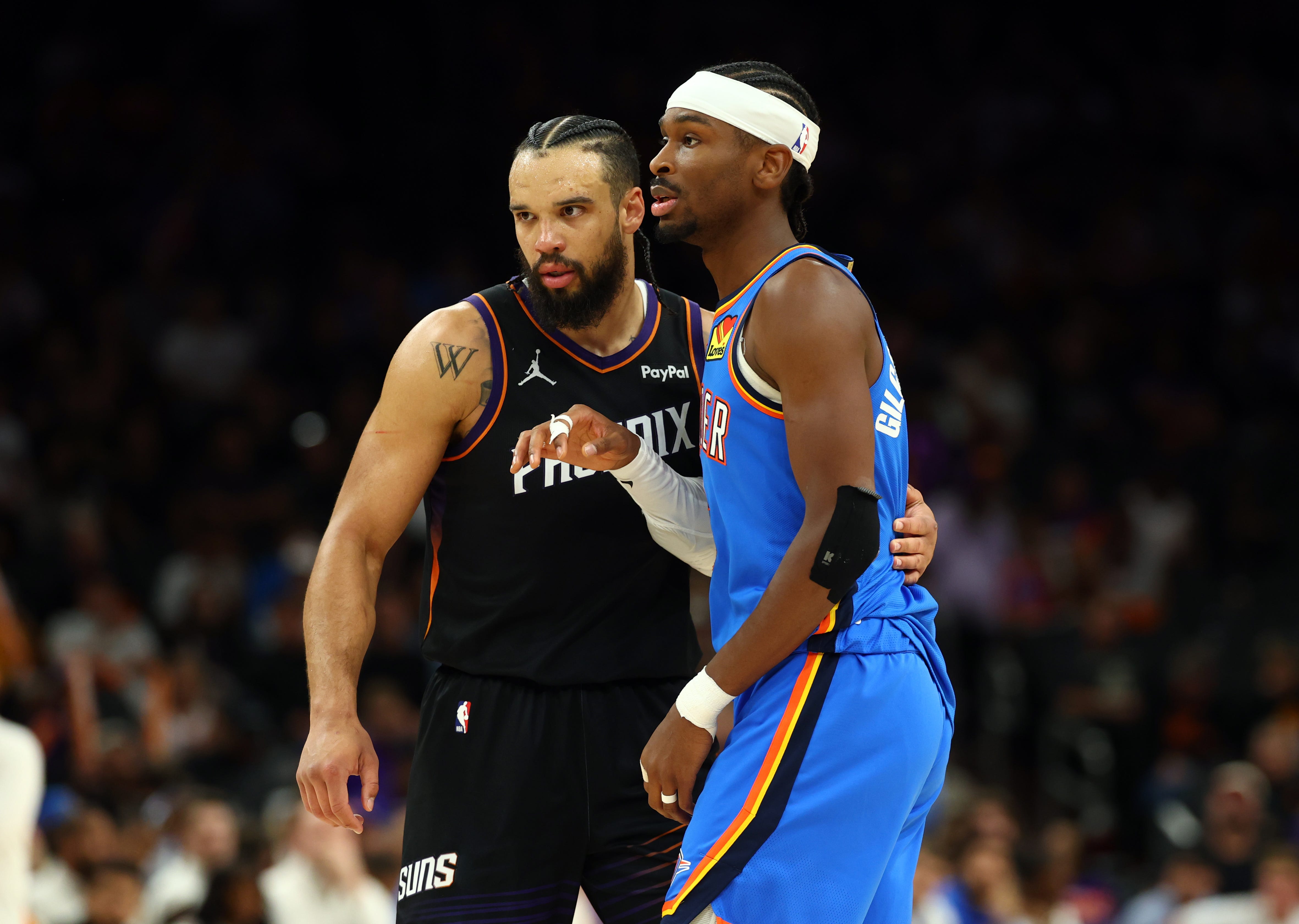
There’s a hint of Gilgeous-Alexander’s sly smile then, the sort of glimpse that goes past the podium, before the looks, like his luminous plum coat and specific material tastes, that brings to mind scrimmages together but more than that, all the downtime. The training, the commutes, the bumping into each other as teenagers and kids, the character that can only be gauged over many monotonous years.
That sort of respect and understanding of a person’s character, the patterns and parameters of their nature, only comes from repetition. From time. It can mean a dulling — and maybe that’s part of it for Gilgeous-Alexander too, why Brooks can’t phase him on court — a familiarity that borders on boredom, but it’s also being able to trace someone’s bones. Their roots.
It’s the opposite of what it is to covet. To want the flash of a person as they are just then, right then, the culmination of so much time. Coveting comes from one sense — the eyes, and their limited scope. Neither is wrong, really, in a basketball sense. You could say it’s a team owner’s job to covet, and to spend money in generous response to that impulse. But I feel myself leaning into the rote days behind what Gilgeous-Alexander hints at, their pattern and rhythm. The dull gift of being stuck in the slipstream of time alongside somebody.
In East Preston, Nova Scotia, where Brooks’ paternal family comes from, there’s a two lane garter snake of a road called Brooks Drive. It winds through the scrub, the bayberry bushes with their stubby, waxy leaves, the stalks of feathery white meadowsweet flowers, pink St.John’s-wort poking up from the blacktop’s cracked shoulder, clumps of marsh marigold and wild purple iris. Occasionally, taller stands of trees will rise: trembling aspen, scraggly white pine, black cherry. But this is low, salt marsh land, ground like a sieve for the Atlantic, just a 10 minute drive away.
Brooks Drive will get you to the East Preston recreation centre (a long and low brick building, strip fluorescent lighting over the scuffed indoor basketball court) and the Baptist church (single-storey white clapboard, gravel lot) but mostly it will run you along lazy curling rivers and past shallow, grassy lakes. In the winters the land loses all definition, flat and low and brown, but in the summer it turns every gradient of green you can picture with low mists and morning fog that makes it nearly impossible to pick one place to let your eyes settle.
East Preston was founded by Black Loyalists, former slaves and refugees from the American Revolutionary War who were relocated by the Crown. East Preston was just Preston then, the North and East monikers combined into a community that stretched from Porter’s Lake, just north of Lawrencetown, over to Dartmouth. The boundaries have shrunk since, with Halifax now absorbing the community’s western edge. I’m not 100% sure Brooks Drive was named after Dillon Brooks’ family but with the history sunk there like sediment, deep and rich in slow, shifting layers, I’ll make an informed guess.
Brooks wrote recently about his summers spent in Nova Scotia, out in the countryside, out in East Preston. How he and his cousins would come inside green from days spent wrestling in the grass and scrub. What you wouldn’t know if you’ve not been to the Canadian Maritimes is that it takes no time at all to get out of the cities. To be in the thick of a sweet, placid nowhere.
When I first left Ontario I moved to Halifax, and the first time I left Halifax, on a road trip down the South Shore, I was startled by how quickly the coast came rearing up. Piled into a friend’s car we were doing donuts on a wide strip of empty beach less than 10 minutes into the drive, flashing clouds of mottled, tiny and trilling piping plovers trailing us to peck up anything the tires kicked up. The Maritimes are deceptive in that you think you’re well-tucked into their forested, green cores, only to make a turn and find the view in front of you suddenly sheared away, replaced with nothing but a wide, flashing plane of blue. Living blue. The Atlantic never stops churning.
One of my favourite stories about the shiftiness of land out there is that when Halifax built its airport the proposed location was surveyed way out, 35 kilometres inland from the city and the ocean. That far in and the developers found themselves finally free of the coastal fog, fog that settles into a milky wall and can stick around for days. The thick pines were cleared for the runways, the modest terminal building, the control tower and like clockwork, the fog rolled in. It was the trees keeping the fog at bay. Gone and the fog flocked like so many gulls in ferry wake.
In the same piece Brooks writes about what he refers to as “the dark arts” of shit talking. The psychology beyond shit talk, when he gets into opponents heads by whispering single words to them during the brief, shuffling silence of a free throw. The name of their mum, a school they never got recruited for, tiny pin-prick points of vulnerability to pierce them with. Brooks isn’t some malevolent seer, able to see deep into a person’s secret and individual nature. He is, however, adept at understanding the through-line of soft spots we all share, probing them — family, ego, belonging — until one stings. Once he does that the doubt settles, thick as fog.
It takes a great deal of intuition, to become so skilled at something that it makes people think of you as one-dimensional.
The best thing about being in Halifax, in Nova Scotia, was proximity to water. It’s why I picked a college at random, I was romanticising the ocean. It turned out not to be trivial at all, because the ocean became the texture and background of the years I spent there. How in the extremes of Maritime weather, the warm rain and freezing sleet often in the same day, there’d be a tinge of salt; or cresting the top of Citadel Hill on my bike to get to class or the city stables I rode at, I’d look back and see the harbour steady at my shoulder, giant cruise ships, commuter ferries, little sailboats dotting the deceptively calm surface. How easy it was to bike to the warm, Atlantic-fed lakes around the city and spend an afternoon reading, or hop a fence by Dalhousie’s marine biology campus to sunbathe on the wide concrete slab of their boat launch. Waking in the night to fog horns, tone so deep they thrummed through you, falling back to sleep in the blanket of their pulse.
I wonder how Brooks feels, living in the desert. Memphis is landlocked but the Mississippi flows through like those East Preston rivers, just 10 times as wide; and Houston itself is settled in swamp, air thick with green humidity. Of course, he can get to whatever water he wants in a matter of hours, but it’s a different feeling, not having water looming.
What does Brooks covet? He wrote about Nova Scotia for the first time, at least the only time I’d read or heard him mention his ties to it, after his inaugural season in Phoenix. Eight (almost) dry months in the desert. A nudge, prompt, or caress, maybe, to his deeper nature. Pulling at the blood like tides.
"luminous plum coat" and "immense youth" are on deadass opposite sides of the poetry spectrum.
i really love your work so so much 🙏
Awesome article, Katie :) I love the audio clip at the top of the page. I feel the same way. I enjoy getting lost in your articles, especially with the vivid details and the emotions that you evoke through your writing. It's so immersive and great.
I haven't been able to keep up much with NBA basketball but I try to read up and watch some games here and there. I did hear about Brooks and his reputation. I heard about his feud with LeBron and I remember feeling annoyed by what I had read and seen.
But you do a great job in going deeper and well below the surface level. Human beings are incredibly complex. It's easy to be judgmental and to simplify, to see someone as one-dimensional. But, the older I get and the more I learn about people, the more I see how complex people are and how so many factors shape who someone is and the layers we all have.
"“He’s great competitor — a great guy,” Gilgeous-Alexander said, the “great guy” emphatic, each word staccato. “No matter what people say about him. All that villain stuff doesn’t phase me, I know exactly who Dillon is.”"
:) I love this quote from Shai Gilgeous-Alexander :). To spend much time with someone, you can get to know them well. And I can see how he's gotten to know Brooks very well and understand him (and much more so than fans). You've captured it well here:
"Coveting comes from one sense — the eyes, and their limited scope. Neither is wrong, really, in a basketball sense. You could say it’s a team owner’s job to covet, and to spend money in generous response to that impulse. But I feel myself leaning into the rote days behind what Gilgeous-Alexander hints at, their pattern and rhythm. The dull gift of being stuck in the slipstream of time alongside somebody."
I also love your vivid descriptions of East Preston. I feel like I can picture it in my mind's eye. I also appreciate the history you shared of it and Brooks' connection to, and roots in the community.
"Piled into a friend’s car we were doing donuts on a wide strip of empty beach less than 10 minutes into the drive, flashing clouds of mottled, tiny and trilling piping plovers trailing us to peck up anything the tires kicked up. The Maritimes are deceptive in that you think you’re well-tucked into their forested, green cores, only to make a turn and find the view in front of you suddenly sheared away, replaced with nothing but a wide, flashing plane of blue. Living blue. The Atlantic never stops churning. " This is so beautiful. I'd love to visit :).
" Brooks isn’t some malevolent seer, able to see deep into a person’s secret and individual nature. He is, however, adept at understanding the through-line of soft spots we all share, probing them — family, ego, belonging — until one stings. Once he does that the doubt settles, thick as fog.
It takes a great deal of intuition, to become so skilled at something that it makes people think of you as one-dimensional. "
That's an excellent point. That definitely takes a lot of understanding of psychology and humanity, and, as you wrote, much intuition.
This also reminds me of how different trash talkers are seen. Some are seen quite positively (like Michael Jordan and Larry Bird and Kevin Garnett). Others, like Brooks, are seen as one-dimensional.
Yet, as you showed, he's definitely not one-diemsional. I need to read his article as well.
Great article, Katie. Hope you have a great day!