

Exits: Precursors and parades
The origins and pitfalls of triumph, the question of age, and the Spurs loving their own spectacle.
In my feed, with the European heatwave content, are videos of canal Saint-Martin in Paris. In the clips strong, shining bodies jump from bridges over the canal into the murky green water below. Some dangle from the steel platforms, their fingers gripping the edge with arms tensed and legs slowly bicycling the air, waiting for a gap to drop into. Others leap from the same ledges out as far as they can, hoping to clear the people treading underneath.
Most of the videos are taken at a bridge called Passerelle Richerand, where Avenue Richerand and the Rue de Marseille intersect with the canal. I recognise it for two distinct diamond cut-outs, one half painted red and the other white, mounted at either end of the bridge. That bridge, plus the Passerelle Alibert and the Passerelle Bichat, about a block away in either direction, aren’t the only bridges that span the aboveground portion of the canal, but they are the only two that boast any height. The others are traffic bridges, stout and cement, street-level.
What sticks out to me, beyond how many people I know in Paris at the moment, is how crowded these bridges are. Not for their promise of proximity to relief: the motor bridges, even the cement ledges of the canals, offer quicker access to the cool plunge of water in a city that is broiling. They’re crowded because even in crisis, beyond seeking relief, people want a bit of a thrill. Some levity in their escape. To leap or let go and feel their pulse ratchet for a few seconds, to shout their triumphs before they clamp their mouths shut against the questionably clean water rushing up to them.
Beyond the infrastructure crucial to their deliverance, they want some fun.
In Victor Wembanyama’s last year of basketball before he declared for the NBA Draft, he had offers from Real Madrid, Barcelona, Paris Basket, Australia’s NBL and the NBA’s G League for their now defunct Ignite team, among others. Wembanyama chose to play instead for Metropolitans 92, a Paris team part of the LNB Élite — the highest level of the French basketball system.
Bouna Ndiaye, Wembanyama’s agent, said at the time that he wanted Wembanyama to stay grounded in his preparation for the NBA. That in order to develop the young phenom’s body for the long, hoped-for career there, “everything has to be built the proper way.” Wembanyama, then 18, had his own doctor, orthopedist, and weight trainer, and the Metropolitans brought on a former head coach for France’s national team to help develop him in addition to their own coaching staff.
Wembanyama’s mind, as Ndiaye saw it, was ready for the next level. It was his body that had to be methodically prepared. He wasn’t wrong, there had never been an athlete quite like Wembanyama, with his size, strength and mobility all in one. Athletes who mirrored him in stature might not have had his bounce or quickness, or they were more — how to put this kindly — willowy, not so physically strong.
It was a meticulous, necessary preparation, not only considering the average NBA career is still five seasons, but because of his aforementioned combination of physical and competitive attributes. Wembanyama was intense, even then, and his physical abilities could’ve proved a powder keg to his competitive nature. Explosive, yes, but of a finite quality. You don’t get to blow something up twice.
The canal Saint-Martin was ordered built by Napoleon Bonaparte in 1802 and took 23 years to complete. It was largely funded by a new tax on wine. Gaspard de Chabrol, prefect of Paris at the time, proposed building the canal to bring fresh water to the growing city and to combat diseases like cholera. It was also used for transport. Barges hauled food, building materials, and once, the Éléphant de la Bastille, a colossal elephant statue dreamed up by Napoleon to replace the fallen Bastille fortress.
The canal stretches 4.5 kilometres, with 2 kilometres now running underground — covered over in the mid-19th century to create broad, public boulevards. Every decade or so the canal is drained and dredged, with past finds including artillery shells from World War I, gold coins, a human skull, 56 cars and innumerable bike share bicycles. The waterway’s 20 some-odd species of fish are relocated for the cleaning.
Picture the 18-year-old Wembanyama, playing for Metropolitans at the behest of his agent and in service to his body and hoped-for long and successful career arc, but also playing for them because they were closest to home.
Wembanyama grew up in Le Chesnay, a small municipality to the west of Paris most famous for being the site of Napoleon’s last battle, after his defeat at Waterloo and subsequent retreat. The village is picturesque to a North American eye in that the buildings are clustered together in bright European blocks that are a mix of village homes, newer low rise apartment buildings, small shopping centres broken up by rows of tidy hedges, lots of trees, and traffic roundabouts, but all of it is decidedly suburban. It’s also low. The tallest building is the vaulting single tower of the Saint-Antoine-de-Padoue church.
I wonder what it felt like to Wembanyma to walk or bike around the sidewalks of Le Chesnay, from home to school and back, passing a Pizza Hut and neo-Gothic church. His own height climbing in unruly bursts while the town around him stayed short; his perspective surging over the rooftops by the time he was 15. His ambition, too.
We all outgrow the places we’re from, wanting to know what’s beyond them. Wembanyama’s version was more literal than most.
Most professional sports warp our perception of age.
The NBA Draft happened earlier this week and in it, Yaxel Lendeborg, who’s 24, went 11th to the Warriors. In the second round John Tonje, another 24-year-old, went to the Jazz. They were the oldest players in the draft. Most draftees are between 19 and 21, the youngest this year was Cameron Boozer, still 18. He was picked 3rd. Immediately after the draft Warriors GM Mike Dunleavy Jr. fielded questions about Lendeborg’s age, told media he wasn’t worried “because he’s not 38.”
With age, the NBA has very few sweet spots. If players don’t hit their stride by their third year in the league (sometimes sophomore) the rumbles of them being a “bust” begin. Generally, and not considering conditions like the competitive stage of the team they’re on, the development capacities (coaches with patience, trainers with a plan, teammates to learn good habits from) of that team, the competitive ladder of the league, which positions and play-styles are on trend — the list goes on — the sweet spot is between the 3rd and 7th season of a player’s career. Maybe stretching to 8th.
For reference, here are the 2016 NBA Draft results — Ben Simmons went 1st overall, Jaylen Brown 3rd, and Pascal Siakam 27th (Simmons and Brown were both 19 when they were drafted, Siakam was 22). To look at that list is to feel simultaneously aged and haunted. There is no place a decade feels more counted, down to the minute, than the NBA.
All to say another term associated with age in the NBA — mature — is ambiguous from the beginning. Mature in comparison to what? For a new draftee, interviewed moments after being drafted, they might be called mature because they remembered to look at the person asking them questions, took a beat before they answered, and gave a response with a personal detail. Maturity can look like curiosity, confidence, consideration — traits we think of in relation to time passing, developing over time. Maturity can also be a rookie keeping their locker clean.
Maturity in the physical sense is an entirely other qualifier, and usually it lines up with that aforementioned, pretty singular “sweet spot” in a player’s career.
Much was made of Wembanyama’s maturity all season, most of it in relation to how he coped with carrying a team a year or two ahead of its competitive trajectory. His physical maturity, the impressive result of everything being “built the proper way” as his agent stressed and many people laboured over. His mental maturity, showcased with his impromptu chess matches in the park and time spent at a monastery last summer. His emotional maturity, too. All of it so celebrated, I think, because it seemed like he (and we along with him) had figured out a way to hasten maturation along with the expedited aging process of the league. To breeze past the volatile ups-and-downs that come with the accelerationist bent of hyper-speed competition while being young. To skip, perhaps, the messy part.
In the 1960s, with pretty much all of Paris’ freight traffic being overland, the canal was nearly filled in and paved over with a highway. It was budget constraints that stopped the project from going ahead, the city couldn’t afford it. It wasn’t until 1993 that the canal, along with a few others in the city, were designated historic sites.
Wembanyama, Dylan Harper, Stephon Castle, Carter Bryant, Julian Champagnie, Devin Vassell — they’re all so young. Of the Spurs 22 man roster, just six are over the age of 30, and only one over 35 (Kelly Olynyk turned 35 on April 19th, the first day of San Antonio’s postseason). Their youth and its associated inexperience did not become a detriment until they began losing consistently, which took until the NBA Finals. In the Conference Finals, when they dropped two in a row against the Thunder, it was still an anomaly.
The stakelessness of inexperience is a true thing. Of a person, or in this case a team, overachieving or achieving differently than is the prototypic way. Not knowing limits because they haven’t yet been delivered by pain or loss and underscored further by doubt. When there are limits, but they aren’t yours yet. Instead they drift, float out past where they can touch you. The suspension of disbelief.
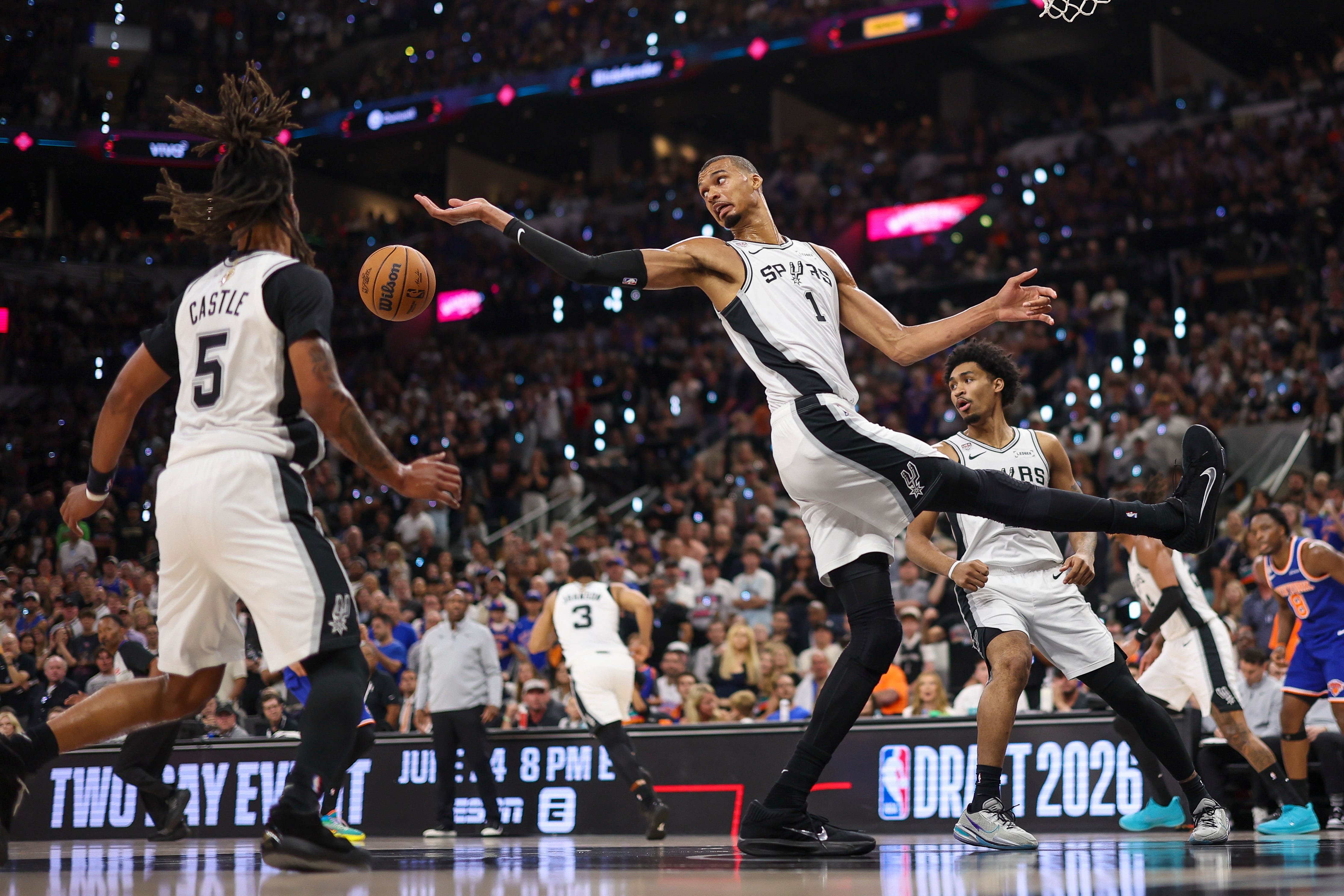
But stakelessness can’t last. Whether the limits find you or you impose them on yourself by achieving the thing you didn’t know you weren’t supposed to, lines are drawn. It’s impossible to say, in retrospect, how long the Spurs stakelessness might have lasted but in terms of a Finals matchup, they couldn‘t have asked for one worse.
The Knicks pragmatism, their shrewd, unfussed way of working a basketball game down to its base components brought the breathless, dreamy, impulsive quality of San Antonio’s playoff run to a dead stop. There were times the Knicks were like the adults flipping the lights on in the Spurs theatre of make-believe, their larger-than-life shadow puppets thrown up on the wall suddenly vanished. There were other times they were the stone-faced collections officer there to get their due, nothing personal.
Up until that point every opponent had, at least a little, played along. Some, like the Wolves, seemed to outright marvel at how far the Spurs had come, the way they blitzed and played beyond themselves. Others, like the Thunder, grew taciturn at their inability to enforce some limits. The Knicks were just going to work.
The Spurs reverted to their inexperience, the youthful qualities of frustration, impatience, poor communication under pressure and trying to either physically muscle the game back or shoot their way ahead, because they are a young team. Not because they had fundamentally forgotten their identity — they don’t really have one, not yet. Wembanyama reverted to the bullying, physical limitations he could impose on other players with his body: the jabbing elbow at eye level, how little effort it takes to torque and fold another person in half, erratic lunges around the paint. There is physical mastery and psychic mastery, the very best learn to use them in tandem.
When Bouna Ndiaye talked about slowly building Wembanyama up, he meant into his career. Not that they would hit a point and the work would be finished, the building done. Think of the everyday maintenance of being a person, how at times so meticulous and incredibly dull. Besides, for Wembanyama, that was only four years ago.
The word triumph, from the Old French triumphe, came from Roman antiquity. Triumphs were military parades, part spectacle and part propaganda to reinforce Rome’s conquering might and superiority over other nations. The processions, giant parades that took over the city, became so extravagant they were eventually only reserved for emperors and could last for days.
Napoleon borrowed a lot from the Romans, including their triumphs. His Arc de Triomphe de l'Étoile and du Carrousel, the Vendôme Column, redesigning the Church of Saint Mary Magdalene in a Neoclassical style. The Éléphant de la Bastille he’d imagined cast in bronze only stayed a statue made from plaster, eventually crumbling and with so many holes it became infested with rats and torn down. If demure by comparison his civil projects, like wide streets fit for parades, bridges named after his battles, and practical canals, are the most used and by that metric, the most successful.
Dropping from the Passerelle Richerand into the canal Saint-Martin, I doubt anyone is thinking of its origins as part of a civil engineering triomphe set in motion by Napoleon, completed four years after he died, exiled far away on Saint Helena. Likely, they are anticipating the cold brace a split-second away. But hanging from the ledge, or psyching oneself up to jump or to let go, the whooping leap out into the air, maybe a backflip — we still love our processionals as bookends. Precursors and parades.
The Spurs took the origins of triumph to heart, the pomp and verve. So many times in their postgames after lost games players, or coach Mitch Johnson, would say they were relying too much on their talents. At first, I wasn’t squaring what they meant but now I understand: their spectacle. It could take them to the edge, but it was never going to carry them beyond. To the cool relief at the very end, or the quiet submersion and surreal suspension of the body stilled, the last victory won.
It made me think about how impatient we are with young teams. We want them to be exciting and fully formed at the same time. Maybe this wasn’t really a failure for the Spurs, just the part they probably had to go through before becoming something more solid.
basketball does warp age. at 50, I always have to remind myself how much older I am than say Carmello Anthony, Mike Connelly, or LeBron James. In Portland, some of us refer to it as "basketball years," similar to dog years. Every year, players seem to age 3 years, so players who are 23 seem 26, 32 year olds seem 35, etc.