

Two thousand years ago in Alexandria, the Physiologus, a catalogue of fantastic and mythological beings, described one called the myrmecoleon:
“Its father has the form of a lion, and its mother that of an ant. Its father eats flesh, but its mother grains. If then they engender the ant-lion, they engender a thing of two natures, such that it cannot eat flesh because of the nature of its mother, nor grains because of the nature of its father. It perishes, therefore, because it has no nutriment.”
Thirteen months ago in Indianapolis, James Dolan wanted to fire Tom Thibodeau. Didn’t seem the best time to rock the boat. The Knicks were coming off consecutive seasons winning 50-plus games and a playoff series; the only other Knick coaches to do so were Red Holzman and Pat Riley. The owner had promised the fans to stop meddling when he hired Phil Jackson. Maybe he even believed it.
A lotta people didn’t think Thibs should be fired. Most people, really, including a majority of Knick fans, Jalen Brunson and Leon Rose. But not all animals are equal. When Dolan’s desires conflict with the world around him, he’s less of a salmon swimming against the current and more a megalodon completely re-directing it. The Knicks’ season ended on a Saturday. Tuesday, Thibs was gone.
James Dolan is a walking contradiction. You may have known him when he was young: the kind of rich kid who threw giant pool parties where 80% of the people there weren’t their friends. They just wanted to swim. Money can’t buy love, but it usually knows a guy who knows a guy who can rustle up a reasonable facsimile thereof. There are worse fates in this world than quid pro quo.
Money means power, power means isolation and pretty soon, you get yourself paranoid. The people Dolan thinks really oughta be on their feet in Madison Square Garden chanting “JA-MES DO-LAN!” *clap* *clap* *clap clap clap* are the same people whose love he craves. The people he spoke to when he first held the Larry O’Brien Trophy, pumping his fist and yelling, “Hey, New York! I’m sorry it took so long!” He wants to be loved.
Loved by people like the 60-year-old Knicks fan who emailed Dolan in 2015 begging him to sell the Knicks in the midst of seven straight losing seasons, who Dolan emailed back to call an alcoholic and tell him to root for the Nets. The people directly impacted by an election where House Representative Max Rose told TMZ — in as light and joshing a manner as one can — that Dolan should sell the Knicks, after which Dolan called on his fellow fatcat friends to donate money to the opposing candidate. They did. He won.
The people who, a month ago, stood in the sun for hours and hours and hours and hours before NYC’s first NBA Finals game in 27 years, thrown for all sorts of logistical loops so some other unliked rich kid could flank Dolan in a bulletproof suite, looking down over people they act like they’ve no need for yet clearly also can’t live without. People who came night after year after decade, when the Knicks were an abomination, hoping Toby Knight or Kenny Walker or Michael Sweetney might be who Brunson turned out to be. The people priced out of the Mecca soon as the team’s any good.
After the mayor and NYPD decided safety applied to the general public, too, and kept certain safety precautions in place for Game 4, Dolan called them “party-poopers.” That night, shortly after the most miraculous win in franchise history pulled them within one win of the title, a 17-year-old was beaten into a coma outside the Garden.
Three months ago in Atlanta, the Knicks were down 2-1 to the Hawks. Unless they won at least three of four games, their best chance at a title since 1994 would go poof in the first round. Doubts that now look quaint had some teeth in ‘em then. Plus Dolan went on NY sports radio in December, an event rare as the Big Bang, and said the Knicks “should get to the Finals, and we should win the Finals.” If they got bumped off early, heads would roll and bodies would soon be in motion. Whispers would grow louder. Mike Brown? Too nice. Jalen Brunson? Too short. Karl-Anthony Towns? Too much. OG Anunoby? Too brittle. Mikal Bridges? Too soft. Josh Hart? Too erratic. Mitchell Robinson? Too limited.
The myrmecoleon is an oddity among oddities, a creature whose definition requires its un-doing. Some binaries are false. How many sides does a coin have, jostling in your pocket? Two. Spinning on a table? How do you count the sides on a sphere?
Mike Brown probably isn’t the best basketball coach on Earth. He didn’t need to be. He didn’t even need to be the best Mike Brown he’s ever been; the one in Sacramento a few years ago might’ve been. The Knicks needed Brown to be the best coach for this group at this point in their journey. That meant putting aspects of the self aside. Finding his way as coach while his players were finding theirs as a unit. Sometimes it meant not fixing what wasn’t broken, like early in the season when he resurrected some of Thibodeau’s discarded defensive principles. Brown had to be Mike Brown, not be Mike Brown, and also add a dash of Thibs here and there.
Mitchell Robinson is impossible. Impossible to keep off the offensive glass. Jordan-esque, in that everybody in the building knows what he’s gonna do, everyone on the other team has been practicing for it and strategizing about it, and it doesn’t even matter. Impossible to imagine someone shooting 29% from the foul line in the playoffs closing out the biggest games of the season. And ultimately impossible to keep — Robinson signed a three-year deal with Boston this week.
Josh Hart is a physiological contrariety, both the heart of the team and its appendix. When times are good he’s chemical X, a rich, mysterious substance who makes everyone’s life better in plural and uniquely personal ways. When times get tough, Hart’s inability to consistently knock down 3s gets the blame first, and itchy fingers wanna remove him from the starting lineup. The last two games of the Finals, he made 5 of his 10 three-point tries. How does a shooter who can’t make a shot start making them? By continuing to do something he can’t but knows he can. By reconciling both selves.
How can Mikal Bridges be “soft” when he never missed a game in college, or the NBA? The idea that Bridges ironman run had become a detriment, that he didn’t play as aggressively as he should because he cares too much about the streak, was fermenting if not metastasizing in some minds after the Knicks dropped two to the Hawks. Bridges shot just 3-of-10 in Game 2 against Atlanta, collecting all of one rebound, then missed his only three shots in Game 4, going scoreless while again grabbing one lonely board. Then, the same player went a month without missing a shot. “Strong” and “soft” aren’t antonyms.
When the Knicks signed OG Anunoby the summer after trading for him, the numbers were large — he signed the biggest contract in franchise history. But it was his dwindling number of games played over his last few years in Toronto that gave pause. This was someone who’d never played more than 74 games in a season, fewer than 50 each of the two years prior. The greatest ability is availability? Nah-uh. It’s being available, 6-foot-8, with high hopes, hops and an open lane to the cup.
Karl-Anthony Towns doesn’t live or act or sound or play like some think he should. What elegant symmetry, then, that the decision that sparked the Knicks ascension unto godhood was giving KAT the ball and letting him be himself. Turns out that self’s a 7-foot two-way point center more interested in diming dudes up than knocking threes down, and plenty good at either. For two months, the congenitally foul-prone Towns defended brilliantly, switching effectively while protecting the paint, all with nary a reach-in or bite on a pump fake to be found.
The Knicks won 15 of the next 16 games by a record margin of victory after centering their offense around their center. For more than a decade, KAT kerfluffled fans and front offices. Is it irony, then, that clarity came only after giving the wheel to the source of that confusion?
Jalen Brunson is small, and not fast. No hops. Civilian wingspan. Victor Wembanyama is mountainous, yet fluid. The hops are a bit gratuitous when you’re 7-foot-5, but they’re there. His wingspan is measured in acreage. Wembanyama is a demi-god. Brunson is merely a man. One who didn’t run from his flaws, but sharpened them into weapons.
Small means a low center of gravity, quicker stops and starts, shiftiness. Brunson’s turned his poor vertical into an evolutionary advantage: in an ecosystem where everyone can and does hop and fly and zip around all the time, headfakes, stutter-steps and step-throughs are the little man’s utility belt. 45 points in the Finals clincher? Maybe Brunson is Batman.
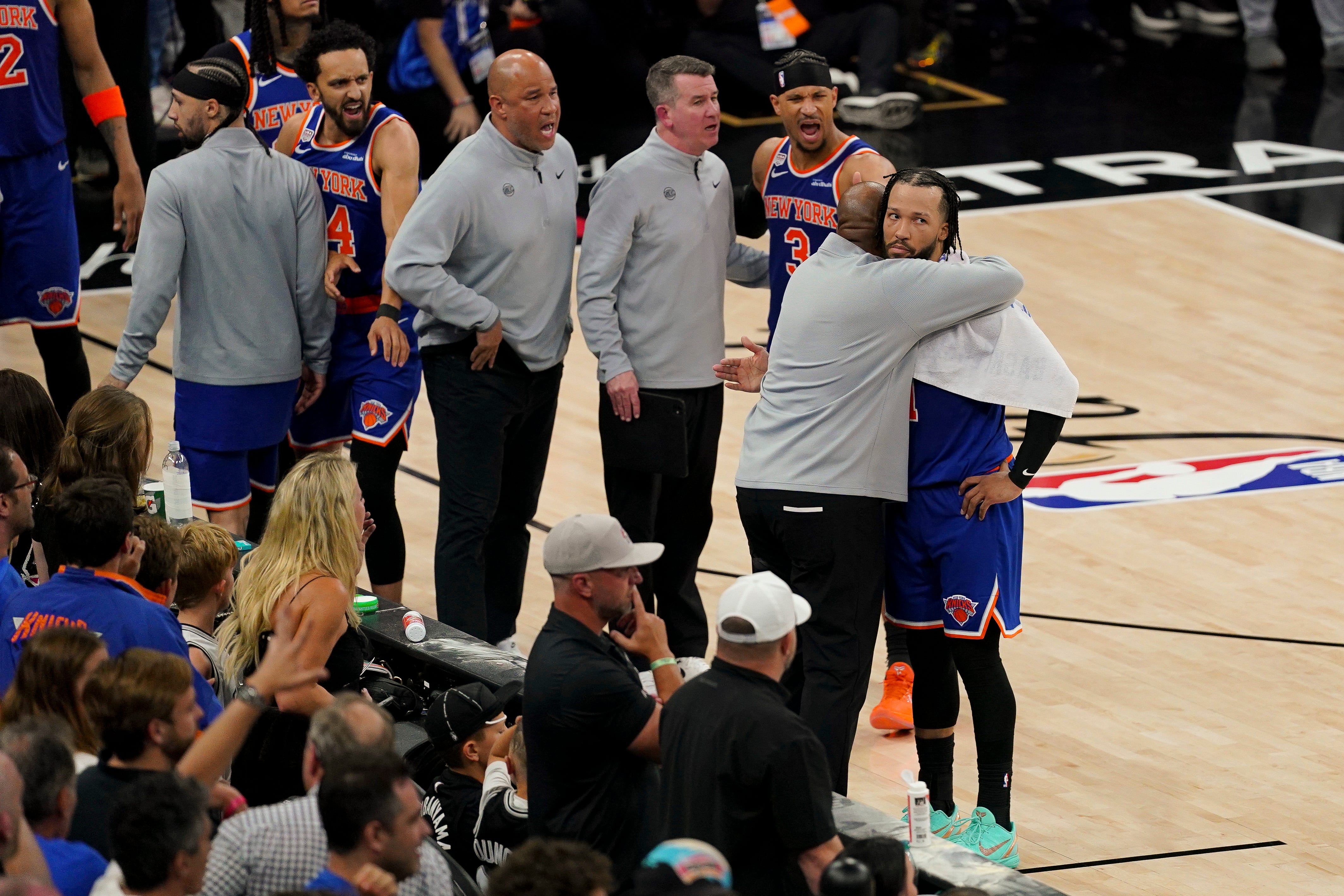
He can’t alter his wingspan. You don’t need to when you lead the league in charges drawn. Brunson doesn’t have the physical tools to stop people, so he evolved to become an elite stopper and turnover-maker by making his physique the tool, turning a weakness into a strength. The god left the battle telling his followers he should’ve won. The man departed as Finals MVP.
A lifetime living with PTSD means keeping things at a distance is so engrained it’s not second nature: it’s first, second, fifth. Sometimes that’s helpful. Sometimes it isn’t. If it runs amok, I isolate and disconnect and maybe don’t even recognize it.
When there aren’t words for something you experience, metaphor’s a natural mother tongue. I’ve covered the Knicks for 13 years. For the first seven, they were atrocious. It was heaven. How do you keep interested writing about loss after loss after loss for a team that at best will win 25 games? And don’t have a first-round pick? Or cap space? Or talent? How do you keep readers reading about a team that goes 17-65 twice in five years? That has five lottery picks in six years combine for one All-Star selection as Knicks? Four of whom don’t make it to their rookie extension? How much is there to say about a team with no hope? I don’t know. I have learned there are a million ways to reflect what’s left unsaid.
When the Knicks were losing, the feelings around the team and the fans were familiar, the pain analogous. Precedent is prophylactic when you hurt enough. Distance kept me comfortable when I was alone, dovetailed nicely with my writing life.
With a little over two minutes in Game 5 of the Finals and the Knicks up one, I burst into tears. I wasn’t sad, and they weren’t tears of joy; the outcome was nowhere near settled. What was this feeling? This was something new. Finding no clarity within, I looked for a parallel without.
The Knicks were winning the game. They were winning the championship. That wasn’t a snowball in hell or a dark horse or a betting favorite. It wasn’t a thought, it was, new and boundless and ineffable, like their play all postseason. There was no time for distance, no space to contain the emotion, no context to compare it against.
In “Averroes’ Search,” Jorge Luis Borges tells the story of a philosopher who tries to answer a seemingly impossible question. At the very end he thinks of the answer, after which he and the entire universe instantly cease to exist. Borges said his goal with the story was “to narrate the process of failure, the process of defeat.”
In the final moments before the impossible happened, Wembanyama missed a three. Anunoby grabbed the rebound. The clock reached zero. Since then I’ve written a couple dozen pages of notes and over 10,000 words on what just happened. I still can’t say what I’m feeling. In a good way.
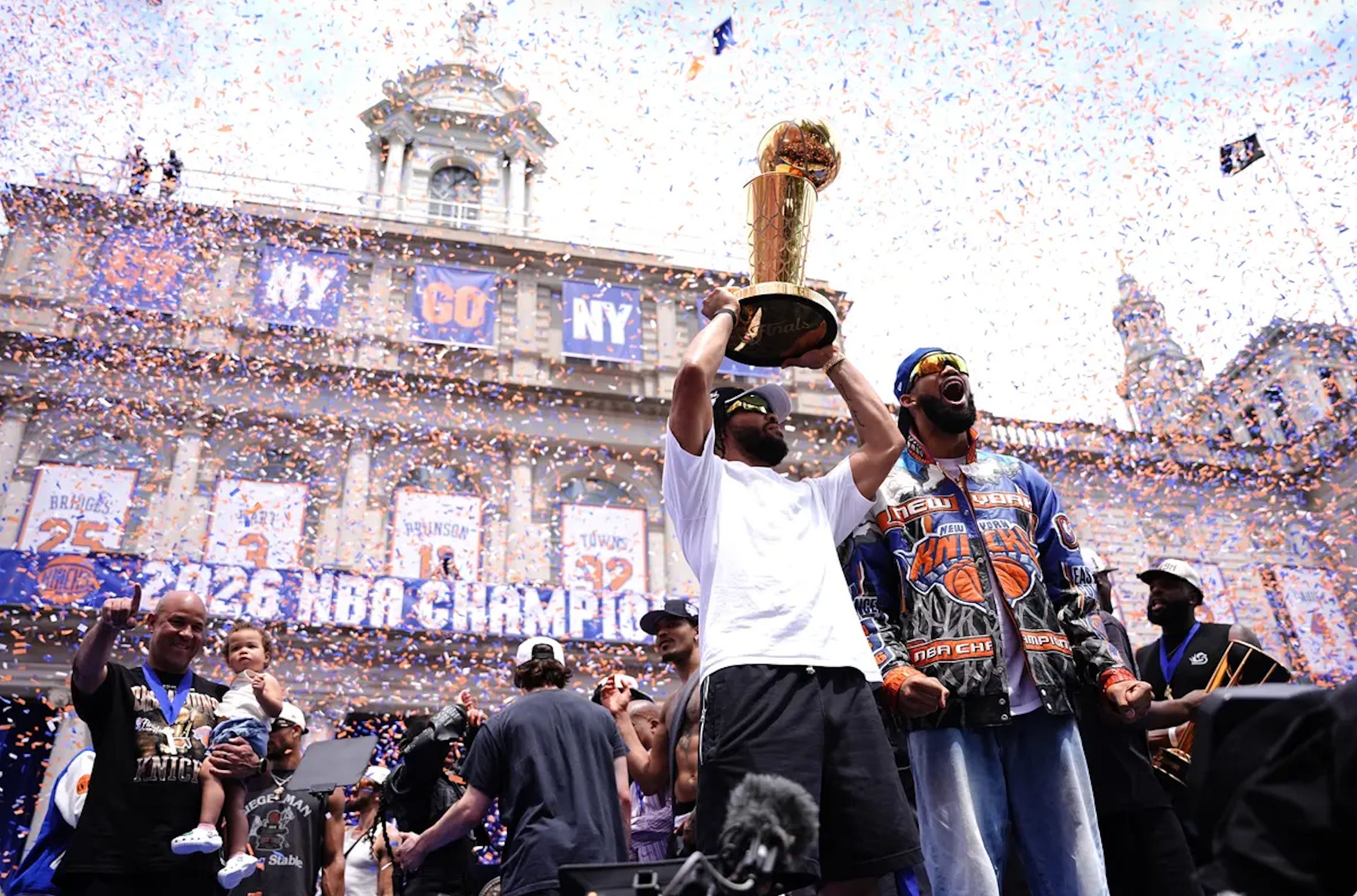
One thing that sucks about PTSD is while it’s an illness, something we treat and work to recover from, getting better often makes things worse, at least initially. It’s common for a positive breakthrough to be followed by a sudden, steep crash that spirals into a conviction one has failed. No.
When you heal, you stop relying on defense mechanisms that you needed at some point but have outgrown. You lay down your armor, only then realizing how heavy it is, how much it’d hurt to walk around in. The next time you’re tested, the defense you’re used to relying on is gone. You’re newly vulnerable, likely to get hurt. It takes time and reps before you get used to what being healthy feels like.
When the Knicks won Game 1 in San Antonio, something in me tightened, some spiral of anxiety. After they won Game 2, it was ten times worse. Game 3, the only Finals game they lost, was the only game I felt any kind of peace after. Even after the Hand of OG win in Game 4, all the Spurs had to do was win Game 5 at home. Imagine the pressure on the Knicks then, knowing Game 6 at home would either end with a celebration for the ages or a flight back to Texas for Game 7. Everything pointed to them closing the series out, but for some people blue skies are red flags.
The Knicks help me connect with people while feeling safe. One day at a time, I try to get used to it. The Knicks are NBA champs. One day at a time, I try to get used to it. Somewhere under the sky, a lion and an ant are making it work. One day at a time.

Great writeup and really appreciate the pivot to reflecting on PTSD. While it can be a bit too serious, in a way, since it's "sports," for fans of long suffering franchises (I grew up a Bengals fan since the early 90s,as well as a Reds and Pistons fan - I know of losing), it is very, very real.
Beautiful. I can relate to the heightened anxiety as the victory got closer.
I believed in this team from the start of the playoffs because they’re a team full of playoff risers, with collective playoff experience, a two way bench, and the best closer in the NBA.
But as the team made progress toward that goal and the smell of it started permeating me like fresh baking bread, a counterweight took hold…
“What if, after getting this close, they blow it?
Even after that last Anunoby free throw putting them up by 4, as Fox was streaking down the court….
“What if he hits a 3, the Spurs steal the inbound and they hit a miracle shot, then they somehow win game 6 in the garden and Brunson gets hurt?”
In hindsight, the Knicks had it under control the whole time, with 2 points of doubt that they quickly vanquished.
Sure didn’t feel that way though!