

Exits: All talk
How fast Shai Gilgeous-Alexander and OKC as villains were forgotten, and whether NBA discourse is our modern form of the oral epic.
In The Iliad, in all epic poetry, there’s a fate worse than death. Not ridicule, or a wound to pride or name; not maiming or any particularly gruesome or violent bodily end, the worst outcome for a life is it being forgotten.
Achilles almost, almost, breaks with tradition when he first refuses the Achaean commanders come to fetch him to fight the Trojans, telling them,
My mother Thetis tells me that there are two ways in which I may meet my end. If I stay here and fight, I shall not return alive but my name will live for ever: whereas if I go home my name will die, but it will be long ere death shall take me.
At this point in the story Achilles leans toward the latter fate that his mom foresaw for him: dying old with a name that will eventually fade from history. He isn’t particularly bothered by the prospect, even as the commanders beg and plead and promise him riches Achilles sticks to his conviction. Wealth can be plundered, horses and cattle stolen or traded away, he says, “but a man’s life breath cannot come back again… once it slips through a man’s clenched teeth.” The guy’s got the truth of it sorted out.
I’ve never been convinced, or particularly compelled by, the perspective of Shai Gilgeous-Alexander as villain. I think the way he plays, the distinct gravitational pulls of his body — to performance, conviction (“selling it”), weak points in the defensive angles of an opponent, the ball — capitalise on an uncanny ability to be a split-second ahead, to point out what then seems obvious. I think people find it annoying, to be shown what they believe to be flawless or strong and in one sinuous sequence have that belief broken. To have a person do it in a way that looks so easy, unhurried, and to have the reaction of the person who has pulled the wool from their eyes be none at all or maybe, a smirk.
But annoyance doesn’t add up to villainy. What it does show is that we are, mostly, spoiled. We want an athlete like Gilgeous-Alexander, after a while, to take the bait. To accept the pre-constructed role we’ve fixed to so many before him, players who make things look so easy as to make rooting against them difficult. There is no obvious hitch in their game to latch onto, no loose thread to worry, the eye has to work a little harder in sequences without a major snag to tell us where to look.
What it also shows is we tend to believe what we hear. Especially when we begin to hear it all the time.
In the end, it isn’t the Achaean commanders or King Agamemnon that convince Achilles to fight, nor is it the promise of eternal glory or the lure of an immortalised name. What draws Achilles into the fray and ultimately, his death, is the killing of his lifelong companion, Patroclus.
At face value, The Iliad is considered a war epic. People think of the Trojan Horse, the sack and subsequent fall of Troy (none of which take place in the story), or they think of Achilles picking off most of the Trojan army, maybe the gods’ wrath and interventions on either side of the opposing armies. But The Iliad, when it is not about waiting, is about a loss so enormous that its resulting grief threatens the mortal and divine world.
People get hung up on the opening lines,
Rage — Goddess, sing the rage of Peleus’ son Achilles
murderous, doomed, that cost the Achaeans countless losses,
hurling down to the House of Death so many sturdy souls,
great fighters' souls, but made their bodies carrion,
feasts for the dogs and birds,
and the will of Zeus was moving toward its end.
specifically, all that rage, and believe Achilles came to it on his own. That his bloodlust, or spoiling for war, didn’t exist in relation to anything else. He was a great warrior, and warriors fight.
The Iliad is a love story. Whether romantic or platonic, a heady mix of the two, or a way of relating we have no comparable reference for in our contemporary culture, the rage it opens with is in reaction to loss. Not the loss of honour, stature, a single fight or any particular battle, but personal loss. Achilles feels the loss of Patroclus so deeply that he shakes the floor of the sea with his sobs, lays with Patroclus’ corpse, and asks for their ashes to be mixed together when he dies. His rage is so white hot that eventually it’s Zeus and Zeus only, father of all the gods, that has to step in when the fighting becomes too much, with all the gods getting involved on both sides.
There are plenty of other themes in the story — pride, fate, mortal impermanence, politics — but glory, to me, isn’t one. Before Patroclus puts on Achilles armour, rushes the gates of Troy, and is killed by Hector, there was a solid 10 years of sitting around. Achilles may have refused to fight knowing that killing just one man would seal his fate, but there is some level of petulance, indulgence definitely, in the way Homer tells him. What is memorable in the story and why it’s survived so long, through so many centuries of just oral recounting until it was eventually written down, then centuries on after that, are the interpersonal dynamics. The petty intrigues of the gods, the frustration between the Mycenaeans and Achilles, the oscillating assurance and panic of the Trojans (a real, “We’re good, are we good?”), and the relationship at the core between Patroclus and Achilles. Zeroing in on the machinations and mess. Homer, plainly, knew how to hook an audience.
Kleos, an oft-cited theme in the story and a Greek word typically translated to “renown”, is derived from the word kluein, which simply means “hear”. That makes the most sense to me. Rather than glory, the story is about remembrance. In order to be carried forward, epics had to be memorised, and to be memorised they had to be spoken. The concept of having your memory rewritten, or snuffed out due to lack of glory, didn’t exist the same way it’s framed now. In its original form, Achilles wasn’t written down, nothing of the story was. He and the rest of it had to be spoken. They had to be talking about you for you to exist.
Is NBA discourse the modern form that most closely resembles the oral epic?
When the Spurs beat the Thunder in what were seven gruelling, gutsy, exquisite games between them, the talk so quickly shifted over to the next series. It kind of felt like something created on an Etch A Sketch, drawn up and shaken off, a faint imprint where it had all happened. Talk was what gave the series strength, the retellings of each game down to the quarter. Every game was alive, still, until the next one rolled around (every game the best one until the next one rolled around, too).
And then it was over, there was nothing more to talk about.
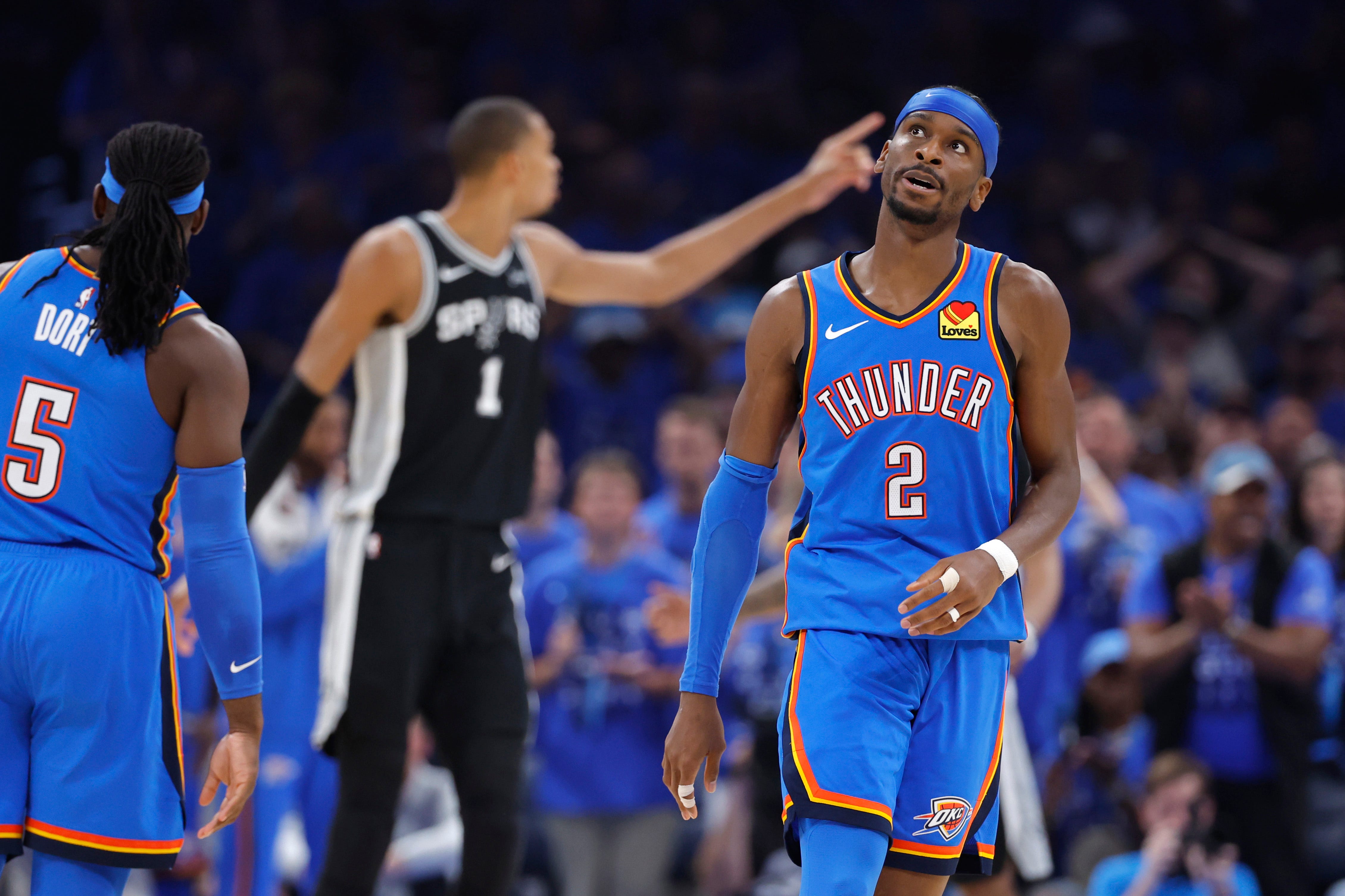
What I heard (and read) mostly had to do with what the Thunder would do with their summer. How would they draft and were they going to bring the roster cost down? Was Lu Dort getting sent to the Lakers? Were they prepared to go all-in on Isaiah Hartenstein? What was essentially the postscript of a season the team was still feeling in their bodies, in aching muscles, bruised and broken bones, became the pressing story. Secreted information (sources close to, insiders say) spoken in short bursts as the basketball faded from memory. The basketball that days earlier had everyone too wound up to sleep and chattering all through the off-day between one game and the next, stirring memory to sudden visualisation.
The Thunder were forgotten as the villains, too. Shai Gilgeous-Alexander — in name, in memory — ceased to conjure up the kind of vitriol that came with just the mention of his initials. There was a new villain, and a new team of darlings to rapidly turn against. At first I wondered if that was the worst fate an NBA team, an athlete, could face: not losing, but being forgotten. Having your name cease being the one at the tip of every fan’s tongue, whether they loved or loathed you.
Wasn’t that a kind of contemporary erasure, akin to an epic poem jumbled and broken-telephoned to time until nothing coherent was left? To not have your name on the back of a jersey be one furrowed at by someone following behind, trying to place you? To not even be a guy remembered when Remembering Some Guys?
But then, like Homer asks the Muse to sing of Achilles, I watched a clip of Max Kellerman saying if Shai Gilgeous-Alexander had been replaced with Jalen Brunson, the Thunder would’ve beaten the Spurs. The result this time was my rage, but there was his name, not gone anywhere, capable of conjuring and perplexing, capable of dominion in conversation that need not concern him at all.
In Greek mythology, they had muses. They were the embodiments and patrons of speech, each with their own specialty like science, philosophy, history, music, etc. They were the ones getting names into the world.
If they need to be talking about you for you to exist, well the ancient Greeks only had nine muses, our modern NBA discourse has about 1,000 to spare. We’re all talk. So sing, Max Kellerman.
This is brilliant, Katie :). I enjoy learning more about Greek Mythology from you. And I'm hoping to read The Odyssey this summer (and plan to read more due to inspiration from your articles).
"We want an athlete like Gilgeous-Alexander, after a while, to take the bait. To accept the pre-constructed role we’ve fixed to so many before him, players who make things look so easy as to make rooting against them difficult. There is no obvious hitch in their game to latch onto, no loose thread to worry, the eye has to work a little harder in sequences without a major snag to tell us where to look.
What it also shows is we tend to believe what we hear. Especially when we begin to hear it all the time."
That's very true. I admit that I haven't been a big fan of SGA. He's a great player, but I haven't always been a fan of his style. But I think at least part of that is driven by what I've heard of him being someone who is a foul baiter. I think I ended up believing it because I heard it often. But there have been other players who have flopped a lot, such as Vlade Divac. What he's doing isn't unprecedented and he is a very skillful player.
You make a great point. The focus was on the Spurs. A huge spotlight shined on Wemby. And no one talked about OKC afterwards. It was an exciting and great series. But I doubt many are talking about it today. Many more are focused on Brunson (and some, I guess, would be focused on what Wemby will do over the offseason to build his game to).
It's interesting how fast attention can shift and move away. And I like how you connected it to the story of Achilles. What grabs the headlines today may be forgotten tomorrow. And the narratives of SGA being a foul-baiter, etc. won't likely come back until after the summer.
And now, I want to read The Iliad :).
Kudos again. Nice work, Katie :)
Beautifully written