

Exits: A wash of potential
The Pistons were the team of quiet control, did that rigidity backfire? And, life in the sparse paintings of David Milne.
If you go to high school in Canada, you will learn about the Group of Seven. Even if you only have a rudimentary arts program at your school, you will learn about the Group of Seven.
You might not be able to list them all, but there will be times when their names come to you unbidden. More likely you’ll drive by a street or school named after one of them. There’s an A.Y. Jackson secondary school in Toronto, another in Ottawa; a Lawren Harris park in Toronto and a Lismer Hall at a west end Toronto high school, after Arthur Lismer.
The name everyone knows and remembers is Tom Thomson, though he wasn’t ever officially part of the group. He preceded them, was pals with them, influenced them, but died three years before the group formally got underway (his mysterious death, probably, the only thing that piqued interest when also learning about him in high school).
In the way of foisted on culture you likely weren’t interested in them, and wouldn’t find their work all that compelling, until you found it again for yourself later in life. For one, they painted scenery taken largely for granted. It was the tertiary stuff of car trips, the sparse world that whizzed by between cities, or between city to more remote destination. It was bland rocks, unkempt trees, snow covered woods. There were no people, no animals, there was only horizon, maybe a mountain.
I remember having physical reactions to Group of Seven paintings on museum trips as a kid and teenager. My limbs would get heavy, my eyelids would droop, I would start to yawn. It’s funny to think now that the paintings triggered the same drowsy feeling in me as a long car trip, that those guys got it so right my brain and body didn’t know the difference. Seeing the muted greens and browns of fall, the austere white, pale purple and blues of winter scenes, even the living greens of spring and summer, each rendered so perfectly on cavas as to seem instantly familiar, my “relax” response was Pavlovian.
I can’t say what finally flipped the switch for me on the group’s work. What caused it to shift from backdrop, as in glancing scenery, to wrenching focus. Paintings, sometimes on canvases no bigger than a laptop, that require close and peering study for how the clouds seem to lift, or water ripples, or splotches of red, orange and yellow merge to make a tree in fall’s full thrall. They are all deceptive in how seemingly simple, and there is none so deceptive as the paintings of David Milne.
Milne was himself an outlier to the group. Not in the way Thomson was, because Milne came up working alongside the group, passing in the same social circles. Milne, who you’ve probably never heard of, was called one of the three greatest North American painters of his generation by the American titan of art critics, Clement Greenberg (Greenberg was the first to champion a relatively unknown Jackson Pollock).
Milne’s work is sparse, his main influences were impressionist painters, especially Claude Monet, but Milne took the dreamy, colour infused and light-laden sensibility of impressionist painting and tailored it to an austere finish. With him there are no watery pastel dreamscapes, no scenery you can practically breathe in. Colour, when it comes, is either in rationed accent or an entire palette and still, restrained. There is no one else who painted like Milne and, up close with his canvases, that unfamiliarity pulses through.
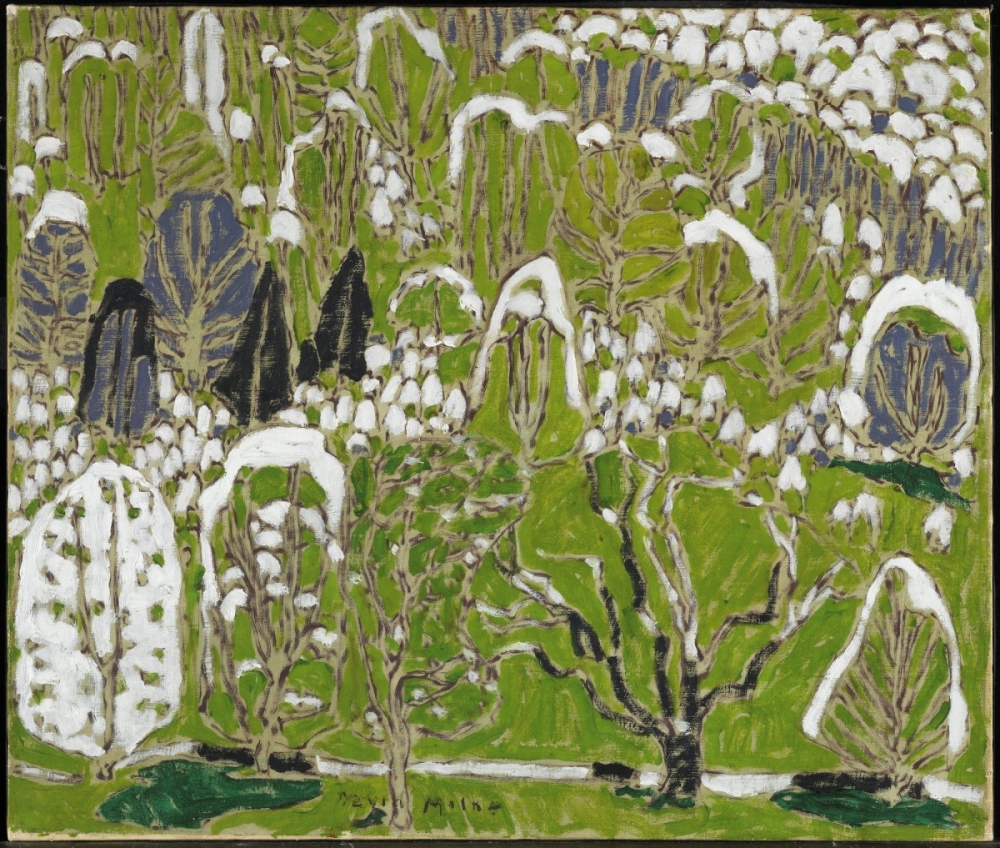
The brain likes references, comparisons to draw from. Safe tethers we can trace back from what we’re seeing or experiencing as new. When I stood in front of Back of Clarke’s House this past January, on a trip Greg and I took to McMichael Gallery on a -30°C day, I didn’t understand how I was supposed to even look at the painting.
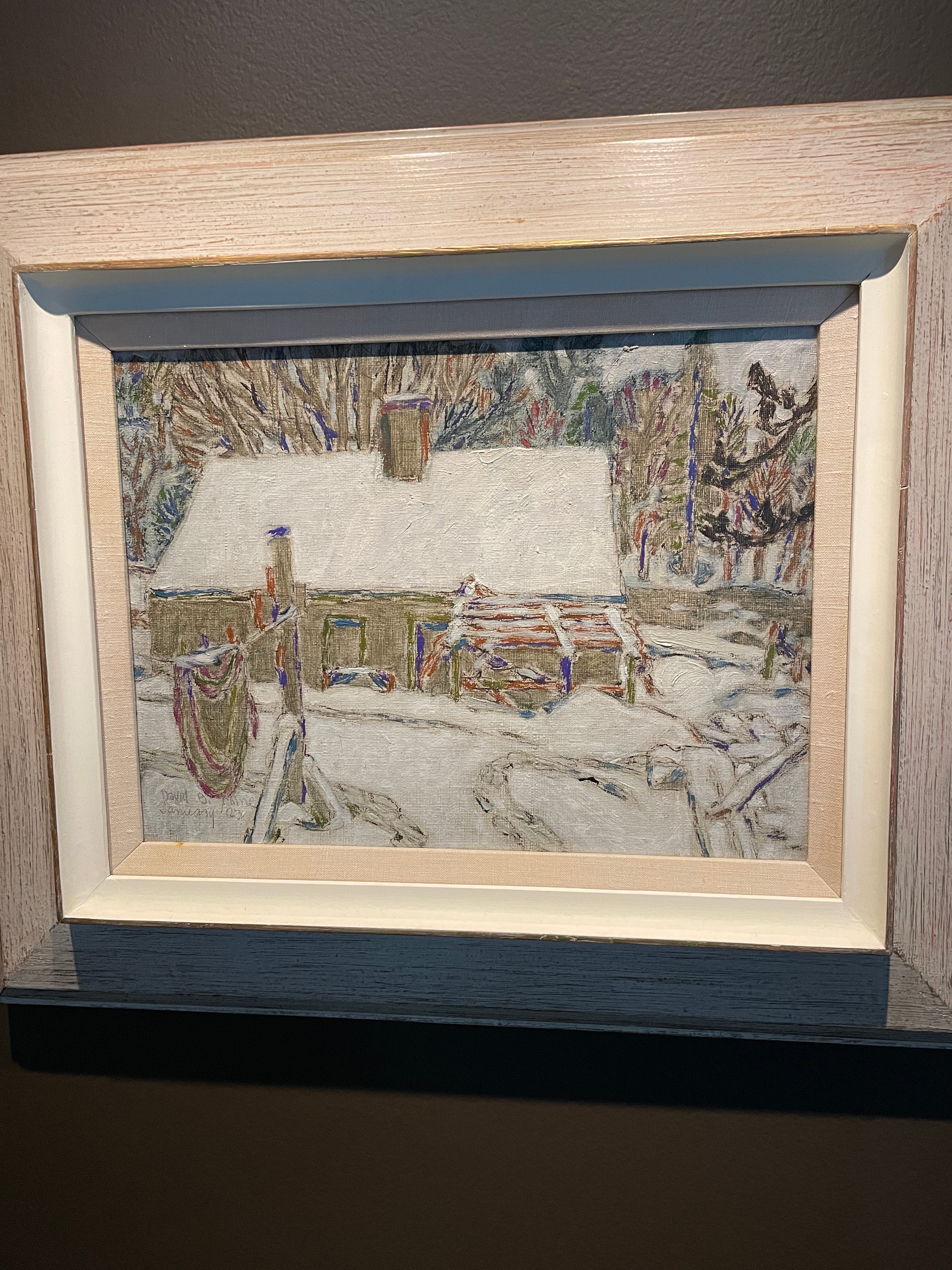
It’s small — 12” x 15” — like much of Milne’s work, but each hair of every brush stroke is discernible. Some hairs of said brush still there under a thin layer of paint. At first, the colours, like the lines, seem rough. Guessed at. It also, how do I put this, felt dry. Like it imposed on me no richness, no lushness, seemed to narrow my cells to parched focus. A bit like a dry sauna, I found myself breathing through the first minute or so, determined to either normalize or settle into whatever new state the work offered.
All of Milne’s work is like this. There is nothing particularly easy about looking at it, which is, you could argue, the point of visual art. He will occasionally offer reprieve, usually in his interior scenes, but close study is always required.
If you consider Detroit too closely, in the tangle and culmination of their season, there is only confusion.
Why did a team that looked so confident, so in control all season, suddenly come apart when pressed? Why did a team that looked as if the will to win was always there, quietly humming below the surface, suddenly seem to lose their engine when it came time to really rev it to full potential?
It wasn’t despondency. We’ve seen that these playoffs but not with the Pistons. There was clear confusion when the Magic stretched them to five games, winning the first, then third and forth. It was like we could glimpse behind the eyes of Cade Cunningham, Jalen Duren, see the brief blink of blankness as they were faced with a possibility they couldn’t adjust for because they hadn’t planned for it. Because it was never supposed to happen.
Detroit went on to win three straight and secure the series but the fact of those wins felt only like relief, not like proof stored and converted into momentum. Perhaps they were tired. Perhaps they were getting their postseason legs under them. After all they’d only made it to the first round a year ago, and it only took the Knicks six games to finish them.
When the semifinals started there was a feeling like a clean slate, but feigned. Like a canvas gessoed over, the darker marks of effort still visible under light. Everyone wanted to believe the real Detroit was here now, ready to push past the Cavs, a team less desperate than the Magic had been.
For two games, yes. The Pistons offence looked like itself — muscly dunks, light floaters, snug threes from the corner pocket. Still, flashes of that old vacancy. Missteps in transition, getting snagged in obvious screens, Cunningham and Duren looking at each other to check who was going to lead. Up by 10 felt flimsy, jumpy.
Game 3, back in Cleveland. Cunningham still the only player to score 20 points or more in each of his postseason games. Throughout most of the first quarter a scrim of leftover smoke from the Cavs introductions hung in the air, crowd rendered to an impressionistic blur. Clarity, cloudy.
It took about 15 minutes of game time for it to get away from the Pistons. The series, but at that point it seemed like only the game. Detroit chased, Ausar Thompson made good on his own fumbling mistakes, turnovers turned into big blocks at the other end. But Cleveland started to strip away the facade, reveal in broad strokes what the Magic had already hinted at: the quiet control Detroit led with all season wasn’t one gear, but the only one.
In basketball, like art, there’a a fear of losing control. Of doing too much. What is the vision? is a phrase used in art crits and in team building. To stick close to the vision is the goal, to pair down to the core meaning or make up. Excess can be gaudy, frivolous, expensive. Excess can ruin the work.
But the cooler side, for both, can’t be the only side. Good art often starts with mess; messy attempts made before what turns out to be the last one or else an environment where materials merge, paint stains, time blurs and the result is better for it. Basketball is the same. Knuckle down too tight and the game, sensitive and slippery, mercurial and reactive, will flee. Reading the energy of a game is the first part, learning to follow it, preempt it, react and respond, the part that takes years. It’s only the guise of control that the very best have. Shedding the fear of losing control is only possible when you admit you have none to begin with.
Pistons coach J.B. Bickerstaff was asked after his team was eliminated whether he was disappointed with them. He was adamant. He said disappointment wasn’t a word he’d ever associate with his group. To hear the word “disappointment” is to immediately think of its forerunner, expectation. Hearing Bickerstaff, I felt caught out. There is nothing wrong with expectation as a handy outline, something to keep a loose hold on, but I’d placed rigid, exceptional expectations on Detroit precisely because they appeared so measured, self-contained and disciplined. That there was no danger of them ever losing control.
Detroit is a team that’s so often (and so antiquatedly) associated with a history of roughness, or flying off the handle, and within that lies the notion that the franchise lacks the gravitas required to get especially far. It’s hard, and unfair because of that history, to then say what a team like Detroit needs is to loosen up. It’s a double standard, even a funhouse mirror of double standards, on display. Bickerstaff saying disappointment has never been a word or feeling he’s fixed to this team means, at least, that internally the Pistons have more freedom than we’ve, as observers and critics, given them credit for. The message to me: relax.
It’s Milne’s water scenes that offer the biggest reward for close and lingering inspection.
His Bishop’s Pond series, or Brown Hillside Reflected. Each toys with the horizon, placing it slightly north or south of centre. In them, there’s a jumble of forest. Trees clumped together so densely the shoreline is mostly dark shadow to suggest the dearth of light through canopy, or else have been blanched of tonality, turned ghostly. The eye struggles on shore for a while, furrowing around what should be the trunks of trees, trying to pierce through for a firm sense of the landscape beyond. It’s only when your vision finally tires, relaxes and slips down to the watery inversion below, that you see the subject clearly rendered for the first time.
There, some relief. In the play of reflection on water, and the impression of water — cool, calm, soft — the shape of the work is revealed. Whether deeper, vibrant hues, or order to the jumble of “real life” in its echo. In Brown Hillside Reflected, especially, I have an easier time with the entire painting when I limit my gaze only to the rendered reflection.
In the spectral version of the hill, the flat, clean impression, it’s possible to take the whole of the horizon on. The vision is simplified. There is the base and the summit, there are the largest of the trees along the way, now comforting markers. In very little, technically, there comes a wash of potential, quiet promise.