

Exits: A light hostage situation
The Trail Blazers were back in the playoffs after seven seasons, but what does having a new owner who treats the team like a bottom line mean for Portland's way forward?
Welcome back to ‘Exits’, an NBA playoff series in its 6th year running.
Each entry, rather than focusing on “what went wrong” for each team, is instead a snapshot, a mourning, a hopeful vault forward, a vent session or something else entirely; where writers from in and outside of basketball unspool their thoughts and of course, feelings. Hope you enjoy.
Imagine it worked. All of it. You started a business, say, a way to provide the less fortunate with cars they wouldn’t otherwise have access to, and it worked.
No, not in the sense that you solved transportation challenges for countless Americans at a grand scale. But it worked. Your subprime lending company was acquired. You have $700 million and the type of swollen confidence that has you devising plans to triple that figure.
It kept working. Downtown office buildings, racquetball for the fleece vest-clad class, and a now ubiquitous “What If Chilli’s Was a Driving Range?” concept. Then the big one, a most poisonous proof of concept for a certain class of Rich Guy. It worked: Transforming a sad sack hockey team in a moderate sized southern capital into a perpetual money printing machine.
It keeps working. It always works, you see. You’re the common thread. When you show up and crunch the numbers and make the cold calculated decisions that others didn’t see or wouldn’t push, it works. The proof is in decades of making money. Lots of money. A bunch of different ways. It all works.
Now imagine these people, most of whom you don’t know or plan to know or care about, imagine these people are hollering that you’re doing it wrong.
Why would you listen?
Tom Dundon bought the Portland Trail Blazers because he could. Because he made enough money through predatory car loans and Top Golf and Pickleball and the Carolina Hurricanes that when an NBA team tucked away in the Pacific Northwest was available for purchase, he was on the short list of billionaires (perceived billionaires?) to call. He bought the team because it’s the next charm on the bracelet. It will work.
A month into the Dundon era, making it work looks like a tragicomic level of cost cutting. Booting employees from their hotel rooms in the morning because late check out costs money, leaving developmental players at home because traveling costs money, low-balling coaching candidates because expertise costs money.
The Trail Blazers, finally relevant after a half decade in the desert, are playing the most meaningful games of the season. On the court they are as compelling as they’ve been in years, with reasonable hope that this is the early stage of the next era of competent Blazers hoops.
Off the court, the new man in charge is reducing anything and everything to a line item on a spreadsheet.
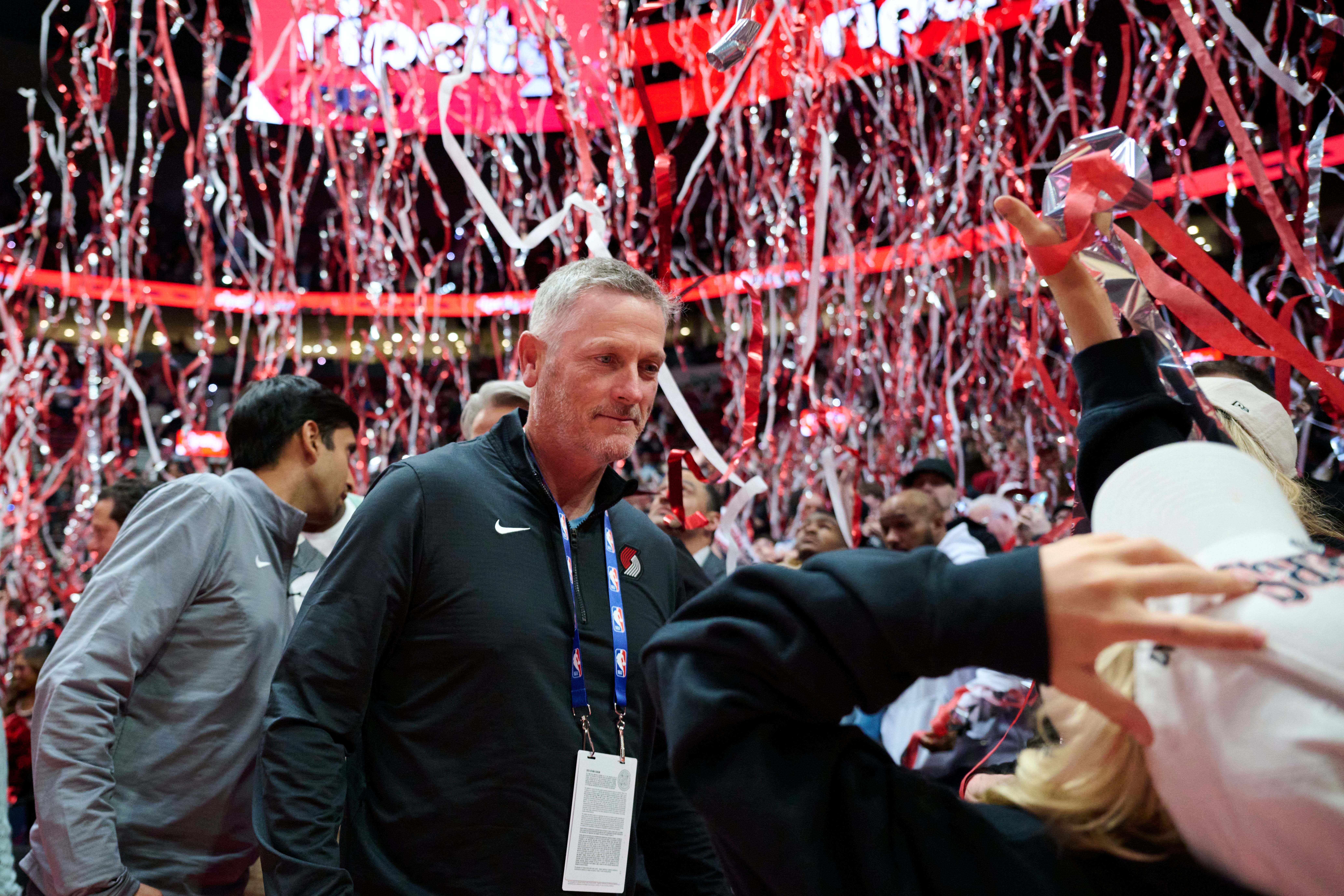
Those inside the Moda Center over the weekend were not greeted with customary free playoff T-shirts. Instead, they got towels; draped on the chairs and immediately forgotten. But you don’t walk into the arena for the shirts sponsored by a local grocer or credit union, you go to feel the collective joy and angst of playoff basketball in a full building seven years in waiting. It was community catharsis, the release of pent up emotions both joyous and peeved.
The worst part about rooting for this team in this moment is not that Victor Wembayama has returned to thwart postseason dreams. It’s that you might get caught in a situation hoping that Tom Dundon makes it work. While the owner is slashing ancillary spending and cutting every corner to save small thousands of a billionaire entity, you’re stuck hoping that the team excels in spite of him. And that’s the catch. If the team wins while nickel and diming every off the court expenditure, then Tommy D made it work. Rooting for the Trail Blazers success, however you might do it, is inescapably tied to Dundon’s success. Should the Blazers succeed on a shoestring budget, it’s simply more proof that The Plan Works.
The Trail Blazers will make more money. They’ll hit their KPIs, go green on the spreadsheets, and prove to be a worthy investment vehicle to spin off into whatever entity is next in the conquest of soulless success.
Fans are caught in a light hostage situation, authentically supporting something that Dundon frankly doesn’t care to grasp is the last line of defiance. Passive indifference won’t change things and larger scale boycotts aren’t realistic. If you let him take away the thing you love, he will still make it work for him, just without you.
The dude is rich and in charge. And cheap — in a way he seems to cherish, perhaps even celebrate. Everyone who has been able to get close to him suggests he isn’t moved by public opinion. He shows up. It works.
In the NBA world, Dundon is notable for his budget conscious approach. But more broadly, his first month running the Blazers is symptomatic of the entire billionaire investment class to which he (kinda) belongs. It’s a club filled with folks demanding credit for their shrewd acumen when they are more often parachuting in to destroy an entity to which they have no connection, powered only by greed and lust for profit. The bottom line is more sacred than any human investment or any understanding of what makes something special. These are vultures building condos on your block, snatching up local hospitals, and acquiring your newspapers. Dundon spread his wings and landed in Portland, perched comfortably from a vantage point where he can run the Trail Blazers with the same cold, calculated approach that built a car loan empire.
Tom Dundon is not out of touch. He is untouchable. Rooting for the Blazers in spite of him seems like the only viable path. He’ll make it work without you. The challenge is for you to make it work without him.
 | A guest post by
|
Can't get enough of this opening!!!! Also feeling similar budget conscious pains in Toronto :')
Re: the last paragraph, Hell yeah!