

Engine, ballast
The push/pull of want, The Believer's Sports Issue, and how athletes are shrinking the sports media landscape.
On a call with Howard and Bobby, I’m running a fever and my camera is off but it’s the longest conversation I’ve had in days. We’re talking logistics, L.A., All-Star schedules. When I say which days I’d fly in and out, I picture an alternate version of myself, capable of being up and walking around, packing a suitcase, boarding a plane.
The vision, like the plans we’re making, are for a desired outcome. The things we want. Normally, not being so sick, I wouldn’t think of, wouldn’t see, that stretch of wishful no man’s land between the hoped-for outcome and its enactment.
If being physically unwell offers any silver lining then it’s an appreciation for the ease of life we were living a day before, suddenly gone. From the very small errand to the elaborate plan, when you’re well the gap between thought and action can seem automatically navigable. The steps roll unconsciously into action. An ablest impulse, to be sure, but an impulse — which is why it can take the impulse being short-circuited to clock its function.
Propped up in bed and muting frequently to cough, making plans for southern California in February, I see very clearly the liminal space between plan and action. It stretches like a wilderness. All the things that have to be done to do something, as well as all the things that could go wrong.
A miracle, I think, simultaneously sweating and freezing, that what we want to happen ever does at all.
Something I’ve told my students, or young writers and hopeful media people who reach out for advice, is that you have to balance a healthy grip on reality with a delusional sense of grandeur. Even the most basic elements of this work — pitching, asking for interviews, jamming your body into a scrum, gathering breath for a question, putting your work into the world — constitute little acts of hope, over and over again.
You hope that your pitch lands, the interview happens, the work is well received; you hope that what you are saying, ultimately, is worthwhile, interesting enough to be read or watched, important. Inherent in that hope is the necessary delusion that the work will of course be all those things.
You balance this with the grip on reality of what’s possible now versus later, where your work fits, where it didn’t if you’re rejected, what’s for you, what’s not, and what you can do compared to what you want.
One is the engine, the other the ballast. Too much of the first and you burn out on fumes, lean heavy on the second and you’ll never get anywhere.
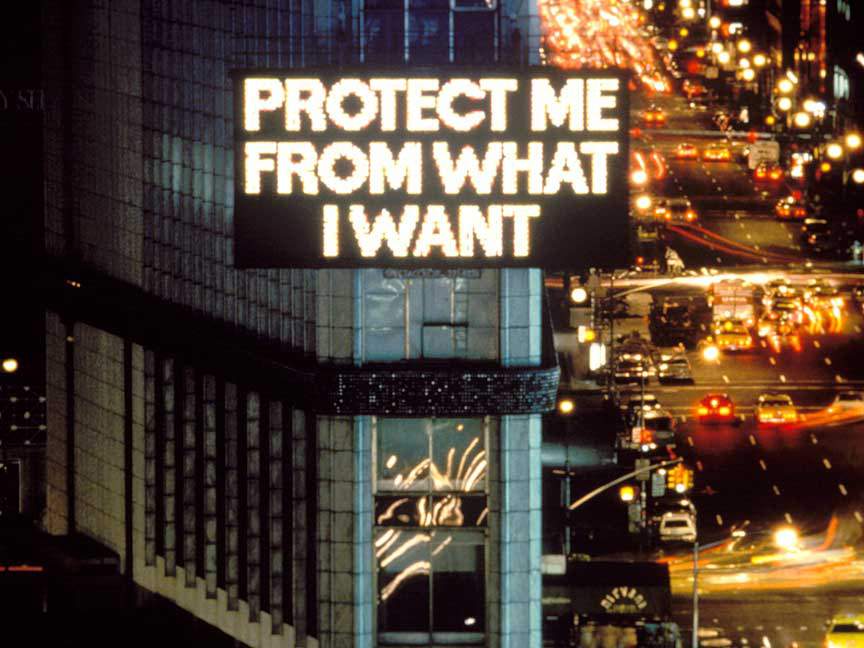
In March 1982, the artist Jenny Holzer was part of an ongoing public art series called Messages to the Public. The series ran from 1982-1990 and showcased the work of many artists over a giant LED billboard displayed in Times Square.
Holzer, a text-based artist, pulled her month-long contribution from her then (and still) ongoing Truisms series.
They included:
ABUSE OF POWER COMES AS NO SURPRISE
PRIVATE PROPERTY CREATED CRIME
YOUR OLDEST FEARS ARE THE WORST ONES
and,
The first rejection came after the interview had been agreed on by the agent and the date set by the athlete. The athlete said actually, they didn’t want to do any media before training camp. We were meant to talk about their book club.
The second rejection came after the team thought the topic — collecting art and how the person’s taste and markers for what they liked had changed with time and exposure — sounded interesting for the athlete, offered a different avenue and audience, and sent the request along. I got a contact for the athlete’s agent and tried there, too.
The third came after a different team similarly liked another angle (favourite books) and ran it by the athlete, but then ghosted away the short deadline window I had left after the first two rejections, all those weeks of back-and-forth accumulating into months.
A summer and fall, essentially, of chasing. Well, of research and prep, pitching and introductions, scheduling, waiting, re-scheduling; starting again.
The Believer’s new issue, their first ever Sports Issue, is beautiful and important. After inviting me to interview an NBA player for it, I went through the aforementioned rollercoaster to make it happen.
Three times I had something set, had picked a person based on my editor’s criteria of an NBA athlete with an interest in art or literature (the last bucket was politics, but given how the first two went that bridge wouldn’t have been any more successful). Three times the something turned to nothing, leaving me with lost weeks and fewer options.
It’s been a uniquely sad professional first for me to see stories from the issue begin to release digitally this past week — some by friends, all very good — with those three false-starts in mind. I’ve been turned down for interviews many times, had athletes cancel them or ghost; had to kill stories after working hard on them for weeks, months. Those losses you salvage best you can before moving on, roll the experience into your professional resiliency. Build the muscle.
This feeling is different. It’s not one I’ve had before and strikes me as discouragingly unique and likely to get more common to the digital media space, and the NBA media landscape within it.
Players — not all, but a lot — are increasingly and intensely concerned with controlling their narrative. Also, with getting paid for it. Influencer culture has emphasised the belief that if there’s something interesting, worthwhile, or novel about you (even if there isn’t) then you have to be the one to make other people see it. For athletes, this has translated into the sense that if they’re not the ones explicitly telling fans who they are, preferably on a podcast, fans won’t know.
I recognise the impulse. I’s the cringe, embarrassing cousin of storytelling that insists a name must equal a brand, and an athlete’s brand be fully formed before their career is. But storytelling seeks to serve impulses beyond entertainment, seeks connection, empathy, growth, comfort and truth, while solely self-aggrandising narrative seeks… much less.
It feels worrying that the impression of traditional storytelling done by media, an impression shared by some fans as much as a growing number of athletes, is that it leaves too much room for interpretation. That it’s too broad or fails to explicitly tell the audience what to think and how to feel. Never mind that interpretation is the most important part of reading any story.
Trust — for the fan, the broader audience, for media — has gone out the window. I’m not naive, I knew it would be a stretch to get an NBA player to talk about a hobby outside of basketball, especially when players are maligned just for having them. Stories like this one I wrote about Donovan Mitchell’s lifelong passion for drumming come via delicate dance with a brand — access in exchange for promotion. You get 15 minutes, half an hour with an athlete, you can ask them about their season, their game, their growth, but at some point you also have to ask about the product, the commercial, the partnership. There are overbearing brands and there are thoughtful fits. This is just the reality of the NBA media landscape, where you’re not going to get, for example, Donovan Mitchell relaxed in the sun in his own house and ready to chat if you’re not of a certain stature, or with a very big outlet. Likely both. These circles were already small and post-Covid, have drawn even tighter.
For The Believer interview, I had a hunch I hoped would be proven wrong that in this current media climate, with the added devaluation or outright attack on books, art, and culture underway, it would be hard to get an NBA athlete to engage about those things. Hard but not impossible. The hunch was right.
It’s depressing that reading, or enjoying and engaging with art, has become a lightning rod. In general. More depressing that I could sense the need to couch each (how are they beneficial to an athlete’s game versus how are they pleasurable, period), the way one would with a personal ask or a subject considered divisive.
What makes The Believer’s Sports Issue so important is that it opens up a largely new audience for the athletes featured in a storied and tactile (a full-colour, print magazine) format. It puts their stories first because they’re either being written by writers with deep understanding and love of the subject matter, or interviewed by them. It treats the athletes with space, with slow builds and time for the reader to luxuriate and learn, pairs their stories with the visual support of original accompanying art. All of it wholly unique in the current media, certainly sports media, space.
This was the same reasoning I pitched to the basketball players who ultimately turned me down.
Irony or hubris, want or need, engine, ballast, all of the above.
Wolves head assistant coach Micah Nori is a gift. Familiar to Minnesota fans for his in-game interviews and the twangy idioms he drops therein (gems like “He makes everybody comfortable, he’s like popcorn during Saturday night movies” and “Like a woodpecker in a petrified forest, nothing was falling for us”), Nori’s been with the Wolves, under head coach Chris Finch, since 2021. He took over early in Minnesota’s matchup against OKC this week when Finch — who went storming onto the court barely six minutes into the first quarter to confront a ref for the lack of a foul call — was ejected with a technical foul.
I enjoy coaches who are disarming, who seem to have a flair for the quality. There aren’t too many. Nori is one and not because of those teasing idioms, but for his plain-faced sincerity.
In his postgame — first of this season, second overall as a result of Finch getting ejected, and 15th acting as Wolves head coach — Nori answered media questions in a way that was referential without being niche, self-effacing and intimate without losing authority, and precisely detailed without wading into the weeds. He gave examples from the stat sheet but also memory, which felt photographic and warm.
On the scrappiness the Wolves showed in their win against the Thunder, and whether that old team hallmark is coming back: “You guys are gonna think I’m full of crap, but Finchy got into ‘em the other day during the film session… and I think they didn’t want another butt-chewin’ tomorrow,” but also “winning the possession game,” “crashing the glass,” and “second chance points.”
On Anthony Edwards impacting the game other than by scoring: “Rudy [Gobert] gets hit, I’m not saying they’re fouling him, but he takes up two guys. So we’re always on our smalls to go in and rebound, and the one thing, Ant sometimes struggles to box out. So we’re like if you ain’t gonna box out, go get the ball. And tonight he went and got 12 of ‘em.”
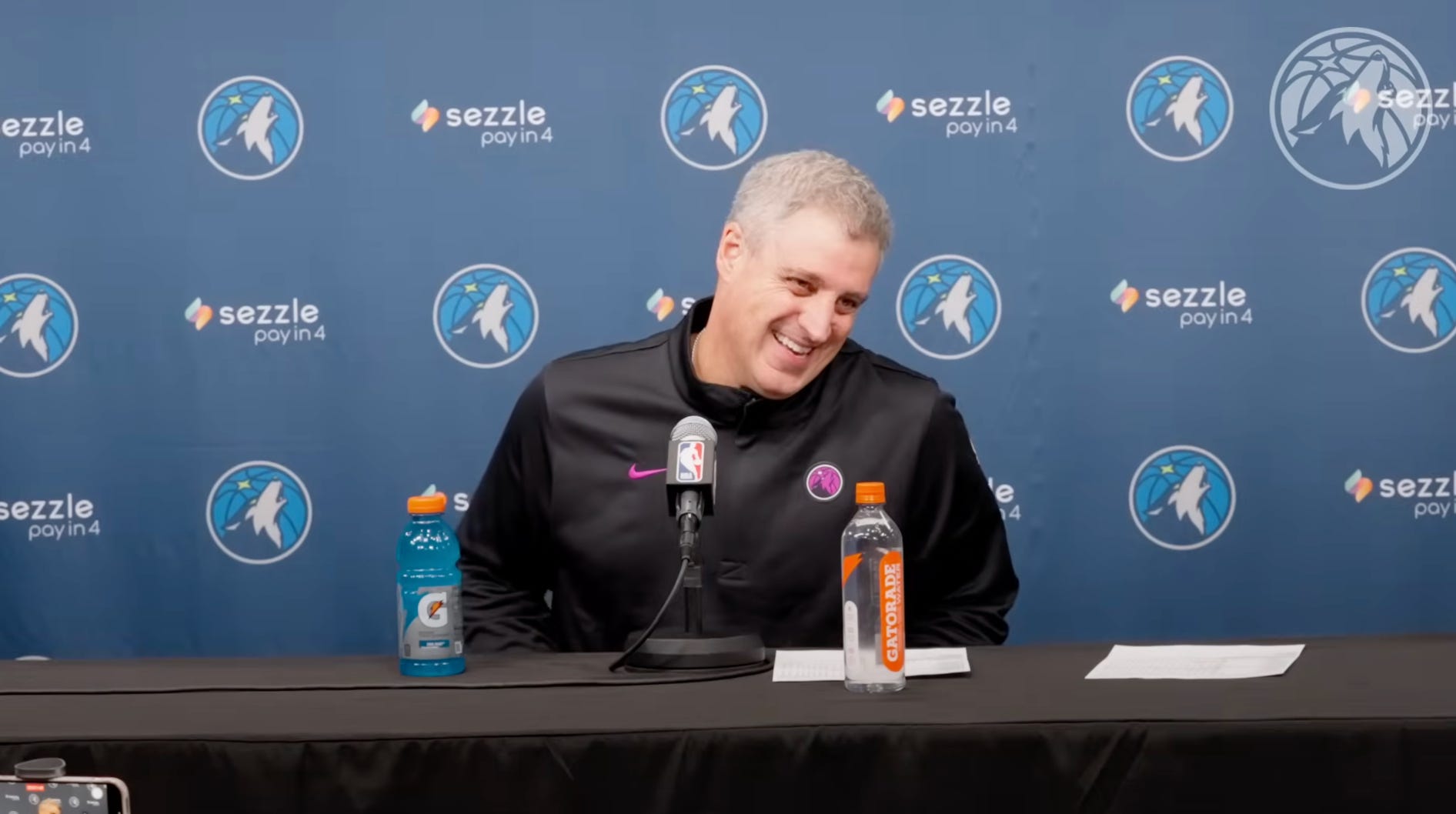
On Finch getting kicked out: “I know Coach Finch did not want to get kicked out right there, but that really got us going. And he’s talking about, first quarter, we started slow. We didn’t think he’d have to take it to that extreme to get us goin’, but it really did.”
(Later, as a follow-up, someone asked Nori tongue-in-cheekily whether he was sure Finch didn’t want to get kicked out of the game. He leaned forward over the table and shook his head like you would at a school kid, “He did not want to get kicked out,” he said, then offered a smiling, almost shy back-pedal, “I don’t think.”)
In the end Finch got what he wanted, even if the monkey’s paw of that want had him watching the win from an arena tunnel instead of coaching it forth on the floor. Hard to say if the Wolves would’ve battled it out the way they did if Finch didn’t get booted. We wouldn’t have had Nori take over, and his subsequent bus stop chat of a postgame, if Finch hadn’t been in a bad mood for two days and let the Thunder be the straw that stirred him over. And it all happened on Prince night.
Proof that what you get can, sometimes, be better than what you wanted.
Tied up in the sting of professional rejection is the want I’m not naming. The big, desirous wish for the challenge, the byline, the beautiful end result. The impulse to downplay want, or to appear that I’m above it, is strong.
It’s difficult to parse want, harder to name it. There are certain groups of people, marginalised mostly, for whom want has been socialised to feel foreign. Enforced by overarching power structures, want becomes a slippery thing to name. Becomes greed, not need, especially if the want is directed at the aspirational (big goals, betterment, enrichment beyond the monetary), even if want is directed at the very basic (food, housing, the ability to live in a fulfilling and dignified way).
To want becomes an act of open revolt, radical. To hold it in both hands and name it plainly, directly — say it out loud to yourself, I want, I want, I want — is instructive, galvanising. Not just forcing the future to meet you, but being hopeful, brave and sincere enough to want one.
“interpretation is the most important part” 🙌🙌🙌
I broadcast high school sports, but I also (in exchange) get to teach an "intro to media" class. Part of the mission of the class, at least in my opinion, is to instill an understanding of good media etiquette in a generation who are growing up without any of that. Maybe it's as simple as them learning to not say "this movie sucks" just because they don't like it and don't know how to form a subjective opinion. Sometimes it's bigger, helping them understand the responsibility there is to tell truth over telling "narrative" or "brand".
Anyway, it's hard being a media/journalism fan in this age, but your writing is always refreshing. It inspires us down here in the small, grassroots spaces. We appreciate your efforts.