

At the funeral most of the eulogies mentioned ice.
When we talked about ice
When we made the ice
When we built up the ice
The ice in question sitting empty and quiet below the panoramic viewing windows. The sheet stretching down the length of the temperature controlled hangar, pristine, rocks lined neatly up and brooms snapped snugly into racks, as the clubhouse room everyone was crowded in grew warmer.
I thought about how our hobbies and the communities we find in them can come to define us, but I mostly thought, during those speeches, how much ice symbolized. It was time spent together, in this case long hours perfecting something I had only just learned is temperamental as it is polarizing. It was the idle hours of conversation that went alongside laying ice and all the life that spilled off of it. It was frustration, failure, starting over; it was attention to detail, mastery and craft. It was friendship, family, a place of belonging. It was fierce competition, friendly rivalries, vulnerability, happiness, love, now loss.
It was easier to talk about these things through ice, and when the voices grew strained or choked off with grief, with ice as the thing to brace against.
Every injury in the NBA is cruel, but some feel particularly bitter, if not altogether spiteful. I’ve been thinking about injuries because of the recent rash of them, and because of Louisa’s Feeling of the Year entry for sadness:
Everything I say about an N.B.A. player is said with a silent caveat: when healthy. As long as no one steps on his foot in the paint and causes his knee to buckle. As long as the constant demands of cutting don’t cost him his calves. As long as he gets enough rest to recover from the bludgeoning of setting screens. Every sentence has a hope and prayer as its subtext: please.
Louisa sent her snippet over to me the morning of December 30th, less than 12 hours after Nikola Jokic had his foot stepped on in the paint. Watching, you could see the pain race up the length of his leg; see his knee pop forward with the force of it. There was no update yet about the extent of the injury.
Louisa’s timing, well I’d expect nothing less. The injury’s timing, rotten.
Jokic’s been having a best of career season so far — though this has been the case for him throughout the last two, if not more, seasons — leading the league in rebounds and assists, and shooting 43.5% from three. His ability to perennially improve his numbers while also enhancing the more numinous qualities that make him a threat and a wonder borne from a stubborn, plodding progress. Jokic is also the rare athlete for whom improvement seems incessant, humming in the background like habit or curse. Another word for that: craft.
“It’s like a quest for efficiency and consistency,” Nuggets coach David Adelman said of Jokic, before the game against Miami, “and I think that’s whether he admits it or not, he sees it as a craft.”
With every injury that’s televised or taken in a public forum, the common and correct response is a collectively held breath let out slowly, tapering to a whispered plea — like Louisa wrote — of please. Beyond their direct affect on the person who’s just suffered one, the particularly cruel thing about injuries in the context of sport is that for those tense few seconds to minutes that follow a person crumpling in pain we’re assured a rare, unified compassion.
Anyone, everyone, watching and witnessing feels the same thing. It doesn’t last very long but that physical bracing and bated breath unites us better than winning, losing, or any other outcome could, because there’s nothing divisive about it. You see a person’s face flash with pain, see fear flood their features for what the pain might mean, and you hold your breath. As if adding any extra strain, whether in a hushed arena or psychically from home, could make it worse.
Augury — the prophetic divining of the future through means of natural signs — began as a Greco-Roman practice of determining whether the gods approved of a plan. While augury eventually expanded to include everything from reading animal entrails to observing the patterns of thunder and lightning, it began with birds.
Auspicium is Latin for bird-watching. We know it best for its derivative, auspicious, which has built-in context for referring to good signs, but in its origins “taking the auspices” was augury for going to work. Plenty of ancient civilizations looked to birds for omens and messages from their gods, but the Romans, in their knack, formalized the practice. They brought in tools, like the curved staff augurs carried called a lituus, and uniforms, togas with different banding and colours depending on the setting — religious or military, mostly. Augurs also invented their own (loose) math, marking invisible coordinates in the sky they called a templum. Each auspice taken was always facing south and always on Roman land (if not, the land would be consecrated first).
Initially, augurs were only granted the role if they came from the wealthy, early ruling class of Rome. Decisions about which wars to wage, who to elect, and laws to adopt not considered relevant to the general public. Eventually a law passed that upped the official augur count from four to nine, with five required to be plebeians — regular people. The change meant that the average Roman citizen, people not from the ruling class, got a direct line to the gods and more importantly, could for the first time weigh in and critique auspices made by patricians, the higher class.
I think it’s charming that an ancient practice, once so central to the decisions and aspirations of one of the most successful and influential civilizations on earth, has been reduced to a quaint hobby. To be a bird watcher implies a solitary spectrum ranging from kooky to outright dull, the pleasure of spotting a particularly rare bird not really a common one, not any longer.
Massive flocks of starlings, called murmurations, still migrate through Rome every winter. Twisting, coiling, cascading through the skies in the evenings, in dense configurations made up of hundreds of thousands of tiny individual bodies, the shapes they cast are of towering tornadoes, figures of animals, even human faces if you squint. Lately, I’ve been watching the displays secondhand, through videos shared by someone I’ve had the pleasure of working with at the NBPA who was home in Rome for the holidays.
Masses of liquid black moving against florid sunset hues, the displays are dramatic enough to wrench people’s fickle attention, once again, to the skies. To pause and train their gaze, their phones, up to follow the formations as they morph, mass, evaporate. For a few moments to only breathe with the movements, to loosen the whole body as these waves of birds wash over them. To wonder what it means, maybe, but to quit bracing.
Kevin Durant has the specifically cruel familiarity with what it is to take another person’s entire weight, at velocity, on the leg. Twice he’s suffered a sprained ligament in the knee, one from Bruce Brown getting knocked backwards into it (left knee), the other from Jimmy Butler falling against it (right knee). He missed 21 games with the first, 20 from the second.
"One thing I don't want to see with Nikola is like, they started calling me 'injury prone' after that,” Durant said on New Year’s Day. “Hopefully they don't start with him because it's one of those freak injuries that you can't really control.”
The body has all sorts of ways of protecting itself — chemical defences, built immunity, tears — but it never accounted for the foreign body of a 225 lb professional athlete, mostly muscle, landing right on it. Though we, in the way we classify “injury prone”, definitely should.
How much of prediction is bracing?
I think of this as I see horoscopes for Year of the Horse, as my algorithm picks up on me pausing on videos for a split second too long and starts to feed me more: Western and Eastern astrology, tarot, planetary transits. No matter the outcome or tenor of delivery, the gist is the same — prepare yourself, be ready.
If I know I’m inclined to have a year of big change, shakeups in my relationships and work, does that better prepare me for them? And isn’t that true of every year, when we really get down to it?
Horoscopes, going way back (Babylonian, in fact), were a way to get a handle on the seasons for harvesting, fishing, sowing, managing irrigation — all very practical. Later, with the Greeks, constellations got folded in, and the gods with them, but the basis was largely scientific. Mid- and during the dark ages, when the scientific basis for Greek astrology was lost because of condemnation by the English church, contemporary Western sun signs started to be tied to parts of the human body. By the High Renaissance, doctors across Europe were required by law to calculate planetary positions before performing medical procedures. Not great. Still, the practice was prognostic.
Like scaffolding for the sky, horoscopes became a way for people to feel they were reinforcing against celestial forces. Making preparations for the unknown.
The cadence we give to horoscopes at the start of a new year is greater, I think, because we want to get it right. And to get it right in the face of forces beyond our control.
History tells us we’ve been making our humble, personal predictions against the backdrop of war and natural disaster, against ages and civilizations seemingly upended, from the start. Recency awareness — it isn’t bias — tells us that geopolitical catastrophes, like the abduction of Nicolas Maduro, the leader of a sovereign country in that sovereign country by a foreign, imperial power; the admission of that invading foreign power that it’s indeed an act of aggression for resources, for oil, and a small taste of what’s to come on a global scale, is brute power replacing law in a way that feels, for all our history, unique to this moment.
But history also shows we know how to go beyond idle prediction, beyond a kind of chronic bracing — into action. That when our small, individual efforts are joined they make for resistance, for movements that topple administrations of savage, crude strength, their shoddy instruments of cruelty and isolation.
That we can tear the scaffolding down.
Quickly, very quickly, the tenor of Jokic’s injury shifted to a different sort of bracing. The plea was still there but the please of it turned tangible, turned to what many fans and media tend to lean on when feeling threatens to overwhelm: numbers.
Even before it was announced by the Nuggets in the evening hours of December 30th that Jokic’s injury was a hyperextension of the knee, and not much worse as is always the fear with that particular quadrant of the leg, the worry had gone from his health to award consideration. That if Jokic was going to miss four weeks or more of competition recovering, then he’d potentially be out 17 games — 17 the magic number for Jokic to still hit the qualifying, 65 game minimum for MVP and All-NBA award contention.
I understand the perceived concreteness of numbers, the sense that steeling oneself with them might stave off the worst, but the worst in this case went from the competitive feat of Jokic himself — running, reaping — and losing all that kinetic action, to reward. To our perception of feat. And it went faster than I can ever recall.
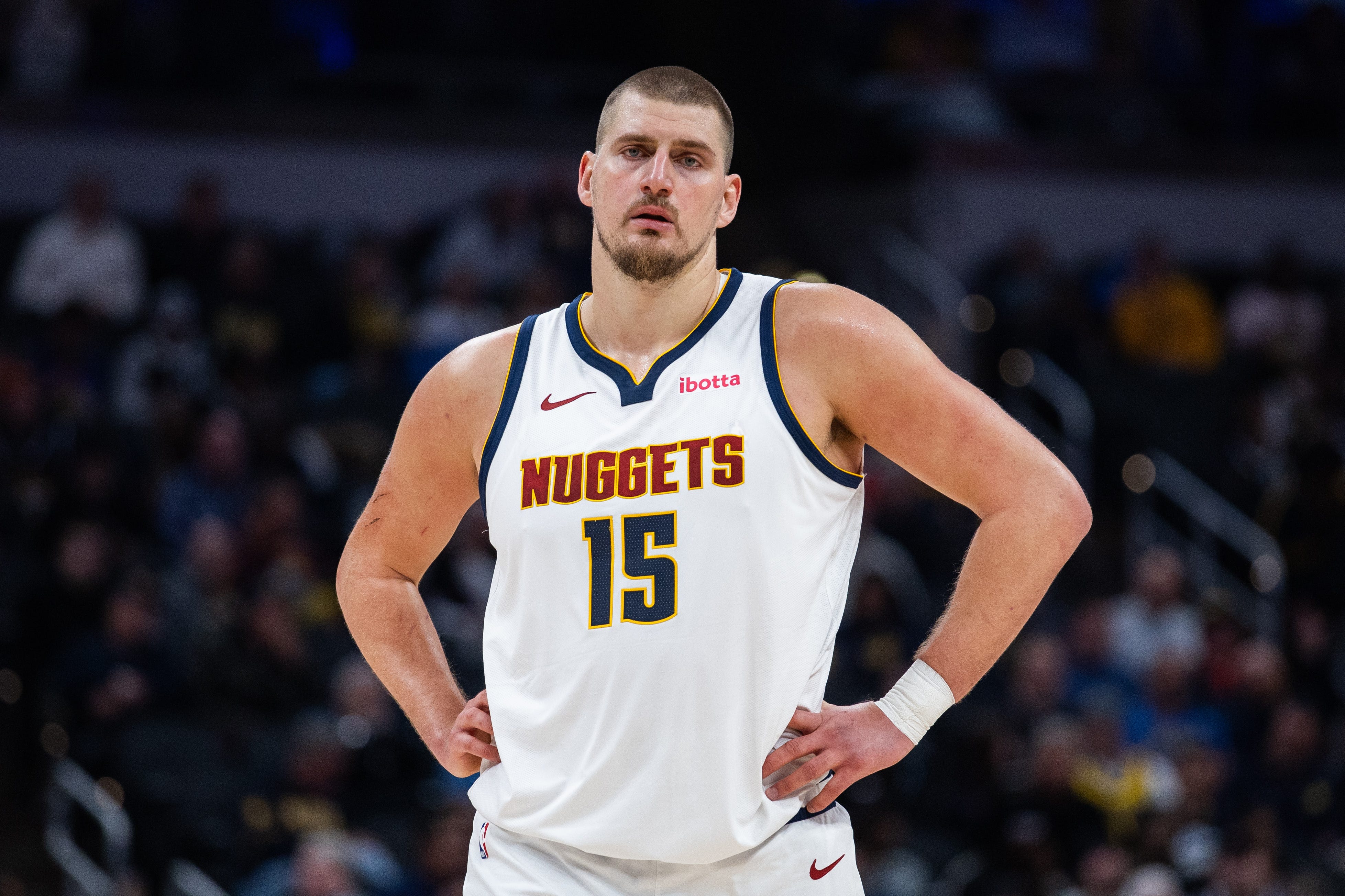
What is really lost if it takes Jokic more than 17 games to recover? Do we lose all his capability, his compulsion to tinker with the notion of his craft so closely that it reshapes the very game he plays and by extension, little by little, the way everyone else plays it too? Those changes are already in motion. Rippling out in torn up and redrawn defensive schemes by opposing coaching staffs, in the way offences train, in how players fine-tune their very bodies, condition their legs to better cut, pivot, and run; to get out of the riptide of an elemental force like Jokic.
The fear of what’s lost is the ability to neatly assign an award to this effort and skill, these confoundingly unique capabilities. To package it all up in a way that confirms Jokic without much deep thought or reflection.
Much like our collectively held breath, or hope like a glowing thread shot through all of us when an athlete goes down, when we witness and murmur please, please as plea for protection, the time that follows — no matter how long the recovery — is a window to the same shared recognition. The impulse is to slam the window shut, turn inward and make our predictions, but we’ll never appreciate an athlete so much as when faced with the threat that we’ll go without them.
Instead of pithy predictions, bracing for what might not happen, why not cast off the auspices and sit, really take in, the formidability of what is.