

A swooning confessional
Victor Wembanyama's hard fall in Game 2, and the two-way mirror granted to us in the NBA's close-up vulnerabilities.
If a tree falls in the forest are the first words that come to mind but no, they can’t be right. This is a person, a person who nearly every other person in that arena, some 18,400 of them, have their eyes trained on, have forgotten the seductive pull of their phones to watch in real, vibrant time.
That line in full — If a tree falls in the forest and no one is around to hear it, does it make a sound? — is often misattributed to George Berkeley, an Irish bishop and founder of immaterialism, or subjective idealism. Berkeley never really made a great case for the theory, one borrowed from Mahāyāna Buddhism, but the gist was that to be was to be perceived; that things existed if they were seen and understood in the same way (“The Existence of an Idea consists in being perceived,” A Treatise Concerning the Principles of Human Knowledge).
Think how fast Berkeley, or any monist thinker, would’ve had their head spun watching pro basketball. And the fabric of their intellectual and spiritual worlds torn asunder watching Victor Wembanyama.
Or maybe Berkeley would have considered it an ecstatic truth, sitting in an arena alongside tens of thousands of other people so eager to perceive; and perceive one specific person. Who watched him fall, hard, to the hardwood just minutes into the second quarter of Game 2. Fall hard and stay down. Thousands of people who all wrestled with Berkeley’s key concept, that they saw Wembanyama quite clearly, his outline stark against the shining court, but could perceive no movement. What they could perceive — flurries of fear, anxiety gripping their chest, seized breath, sudden and nauseous dismay — felt too real but were of course intangible. Imagine though, Berkeley trying to argue that to them in the moment?
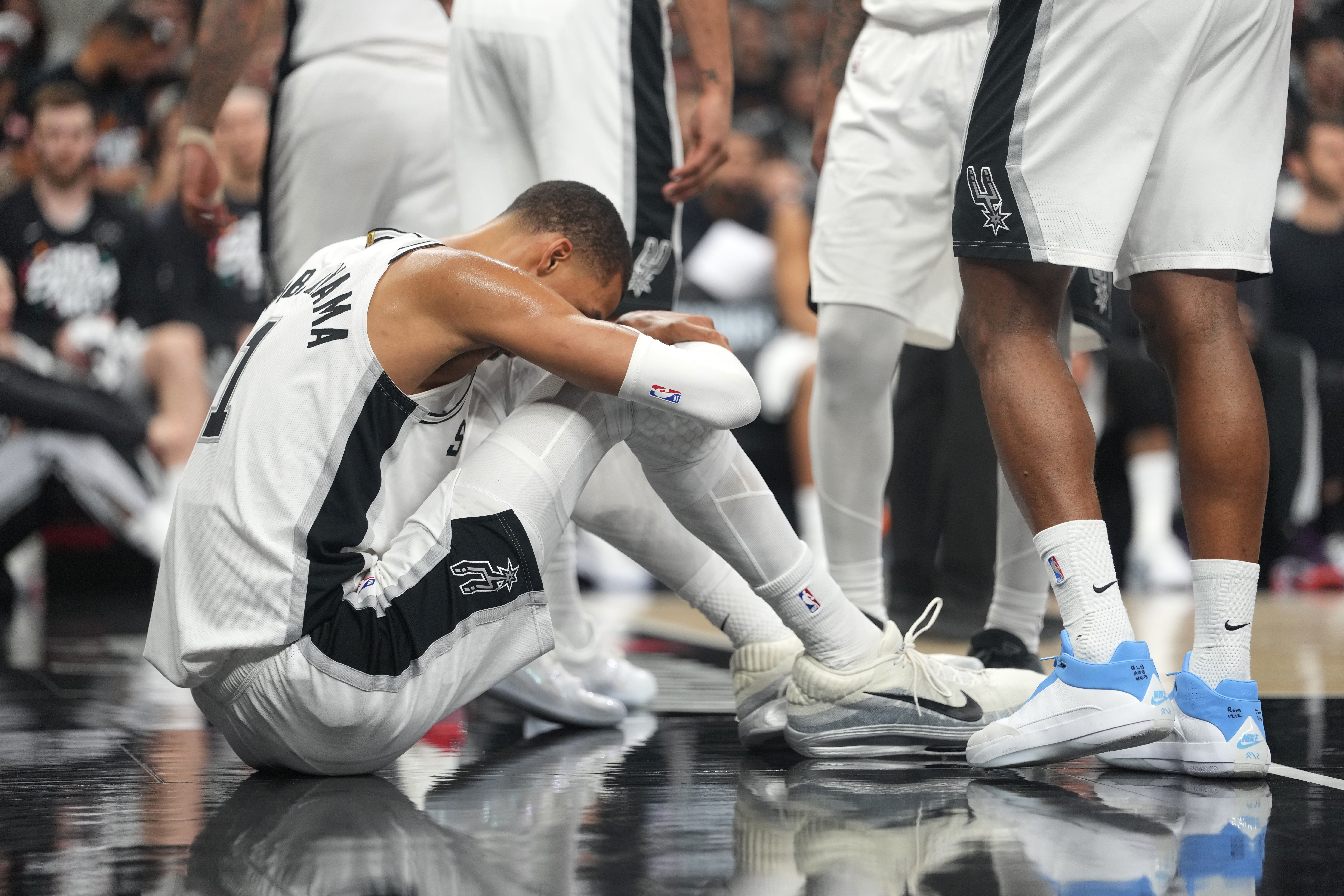
There’s a few brief seconds, once Wembanyama’s body has slid to a slow stop, that he appears to flicker from consciousness. His jaw unclenches, brows relax; his head softens against his right hand with its fingers splayed out on the floor. His forehead rolls against the supporting right hand and his mouth opens slightly, his shoulders sink a little more liquidly down. It’s the face of a person who has just slipped from sentience, dropped their guard into sleep or another gone state. It’s nearly imperceptible but the change in his features, his body, flashes a glimpse to a much younger Wembanyama — and he already is young.
Watching, I felt an intense wave of vulnerability for him. Like you would watching a child sleep. The perception of that bare sliver of a moment replayed over and over as the broadcast was fed other angles and finally stuck on the main replay, filmed from the perspective of the camera person whose feet Wembanyama toppled at.
Replay is one of the strangest components in basketball. Replay in general and replay of injury, certainly. The ability to stop and revel in time — I do it often. Studying footwork, where and how the body moves. Zeroing out to parse the people around whoever is central and how they react, hinge on the action of that central axis, then zooming back in to trace up to the person’s face, fixate on their features, follow where their eyes go. Whether it’s ever possible to pick up on intention watching this way, I’m not sure, but I’m sure that’s why I’m watching. To discover the exact split second a decision is made, to see the brain fire.
Replay of injury, and I’ve written about it, when I’m feeling generous I think of it as a way for us to process grief in small glimpses. To see a person’s pain and mete out our own response, decide how we’re going to feel as we watch what’s happened again, now from another angle. It’s an anaesthetising way to grapple with the unknowable full spectrum of emotion the person we’re watching, in brutal slow motion, is experiencing.
When I’m feeling less generous I think of it as blunting. As a way to neatly package injury into something that happens “in-game” by showing it from so many angles, within the bounds of a basketball court. That way when the person is removed from the floor, by their own power or at the hands of other people, we cease to think of all the time now unfolding in front of them — of how they are even going to grapple with the concept of all of that time — that they must manage on their own. Road to recovery is a quant euphemism when really, it is a wilderness.
Wembanyama travelled with the Spurs to Portland. He’s in concussion protocol, which was clear to anyone who watched his fall and how he took the brunt of the impact with his chin, and then watched him jar awake and roll over, attempt to stand up only to groan and sit with his head hanging. When he brought his knees up to his chest and held a hand to his eyes, rubbing them gently, willing his vision steady as the crowd began to chant his name, I felt — maybe not for the first time but drawn in a different, sharp relief — how vulnerable a game this is.
Bodies, bare limbs, in motion, tangled and in flux; it’s what makes basketball so captivating to watch. Faces and expressions exposed, defeat and triumph flashing in every possession — in playoff basketball at least. The shakiness shot through Wembanyama as he tried to feel his way back into his body, his usual stolidness, stripped away. It’s confessional, this level of perception into another person, their body showing us what they don’t yet know. Wembanyama’s right then is swooning, but even under full faculties we’re handed revelations.
As he gained his feet — not letting any of his teammates help him up, choosing instead to stand under his own power and jog to the tunnel and out — my mind kept flashing back to that short, secreted glimpse of peace slipping over his face. How transportive, one shifting second and a person’s features relax, the decades drop away. An awareness of a life, of life, untenable, precarious, precious, too huge, so small, balancing at every second on a breath.
I refuse to watch the moment of Kyrie’s ACL injury. Great writing as always!
Gorgeous piece. So evocative of the moment, yet tender to the concerns for Victor, for the players in that moment, in all those moments, and the crowd as well as they ( observe, and care and emote.