

A deluge of blue
Whether NBA players have an obligation to speak up after tragedy, and how we lose our urgency in forced isolation.
The ideal subject of totalitarian rule is not the convinced Nazi or the convinced Communist, but people for whom the distinction between fact and fiction (i.e. the reality of experience) and the distinction between true and false (i.e. the standards of thought) no longer exist.
— The Origins of Totalitarianism, Hannah Arendt
When I look out my window/What do you think I see/And when I look in my window/So many different people to be/It's strange/Sure it's strange/You've got to pick up every stitch/You've got to pick up every stitch/The rabbits running in the ditch/Oh no, must be the season of the witch
— “Season of the Witch”, Donovan
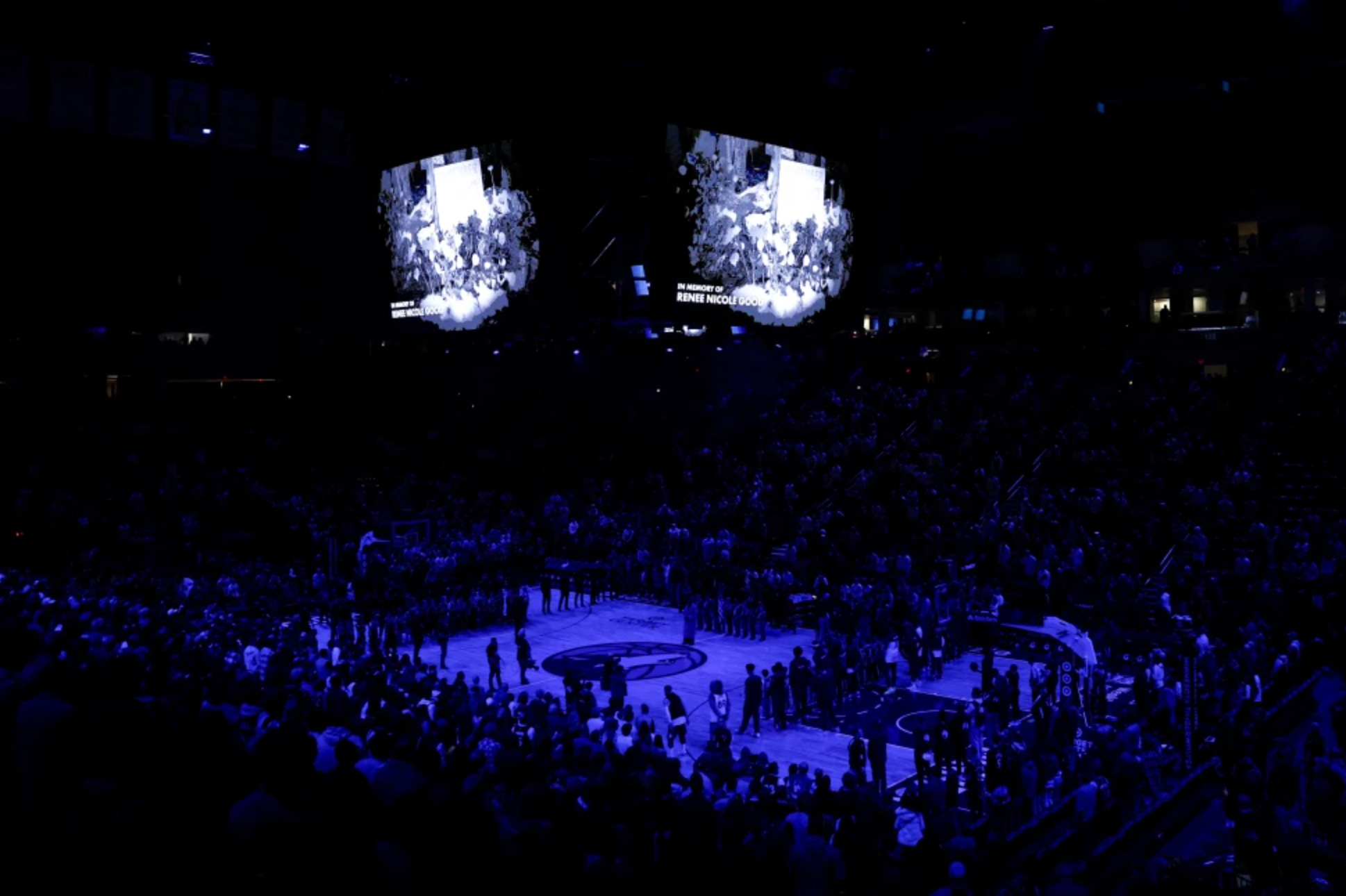
It’s so blue, the arena. The court glows, lambent, so do the clothes of the people rising from their seats. The tone of the lighting, its frequency, difficult for the human eye to hold on to. Outlines thrum, bodies blur together. The lower bowl looks underwater.
Above, the video board shows a black and white photo of a makeshift memorial. Dozens of white roses stuck stem by stem into a bank of snow around the trunk of a tree. “In memory of Renee Nicole Good” at the bottom right corner of the screen.
There are a few videos circulating of the moment of silence the Timberwolves held before their game Thursday night. The deep voice of the in-arena announcer is measured, reading from a prepared statement, but the weight they give to Renee. Nicole. Good. Each name punctuated by its own breath, distinct. Distinct too is a single voice ringing through the subsequent silence, after about five seconds, shouting “GO HOME ICE” to rising cheers.
Before the moment of silence, Wolves head coach Chris Finch began his pregame media availability with a statement he wasn’t reading, but felt rote in the cadence of public American eulogy.
“As we all know, our community has suffered yet another unspeakable tragedy. We want to just convey our condolences and heartfelt wishes and prayers and thoughts to the families and loved ones and all of those that are greatly affected by what happened yesterday,” he said. His body slightly hunched at the shoulders, both hands under the table and eyes fixed firmly in the middle ground.
Finch also said that he’d had individual talks with players about what happened, but that it wasn’t “about our guys and how they're reacting. It's about how our guys can be supportive and understanding of what's happening.”
I don’t know if, by then, the Timberwolves had watched, like many of us, the murder of Renee Nicole Good. Watched a masked ICE agent reach into the rolled down driver’s side window of her car and shoot her in the head three times at point blank range, or if they’d consumed some version of the horror in aggregate. Perhaps they’d driven by vigils or around protests on their way to the arena the afternoon of the 8th — the site of the killing just a 13 minute drive south from Target Center. They would have been briefed about the moment of silence before their game and if that was the first they’d been informed then they’ll surely be aware of the change to the city as they return from Cleveland today, in the ramped-up presence of ICE redirected to Minneapolis and the protests, going strong.
It’s possible to be simultaneously heartened and disappointed, and depressed with what you’re heartened by.
That the Wolves held a moment of silence for Good, that Finch spoke before the game about her killing: both of these were welcome surprises. The moment of silence, and its interruption, felt especially pointed given the U.S. administration’s multi-pronged and lightning quick attempts to blatantly lie about Good’s murder in order to dismiss it. Moreover, given how many organisations and institutions — private and public — we’ve seen fold to their cudgel-subtle artifice more broadly. That the public gesture of silence could be perceived in this moment as anomalous, as anything more than a community in mourning, that’s the grim part.
So is not hearing from any athlete on the team, with the time they had and conversations Finch alluded to about what was going on.
An oft-offered response to wanting athletes to speak up in the wake of tragedy and its social fallout is that it’s indicative of a sad state of affairs. That we are so low on meaningful, or at the very least vocal leadership, that we look to an entity like an NBA franchise for moral translation. The reality is that for many fans the athletes and teams that they root for will be their only window into what’s happening. That is the sad state of affairs, not that an athlete or coach might offer up something off-the-cuff, simple and steadying. That the average person’s engagement with news, political conditions, and the world around them is so depleted, suppressed, or both, but hammering on the bleakness of that fact isn’t going to help much.
Of course, there’s no obligation for a team — the Wolves in this case — and its players to do any of it. What forces necessity is urgency.
When the Timberwolves were at the vanguard of the protests and social justice movement that sparked with the murder of George Floyd in spring 2020 and rose to a fever pitch that summer, the urgency was just as proximal — in distance — as Renee Nicole Good’s murder. For a majority Black team the urgency was also physical, visceral. Covid had also forced athletes into stasis like the rest of us, our collective attentions fixed on the news, on the killing of Breonna Taylor (two days after the 2020 NBA season was suspended), George Floyd, and the ongoing case against Ahmaud Arbery’s killers. There was real reluctance from players to enter the NBA Bubble in July 2020 because many of them were involved in protests; potentially felt for the first time the thrum of urgency that comes with civic action — and renewed agency after isolation — coursing through them. They felt they were leaving a world poised on the precipice of change for another, wholly removed from it in order to exist.
That urgency pulsed in the background of play through the Bubble’s early days, and sparked immediately to life with the shooting of Jacob Blake on August 23, 2020.
I remember how angry Fred VanVleet was on a Zoom call with Toronto media the same day, how much pain was twined with that anger. His voice choked with both. Players held a series of meetings on whether to continue the Bubble or force its end, held their labour out in strikes, voiced their anger and objection in statements that demanded change. It was powerful, and in the grand scheme of the league, short-lived.
Beyond the difference in the American political backdrop from then to now, the isolation wrought by Covid that’s never quite gone away — baked now into much of our day-to-day and formalised (made lucrative) with A.I. — it was the forced closeness of the Bubble that made for urgency. Whether NBA athletes were discussing protest methods or venting their fears to each other, talking about how fucked up things were, those conversations were frequent, focused and immediate. What else was there to talk about, really?
The discomfort of Timberwolves players to talk about the killing of Renee Nicole Good, the rise of ICE, the brutality of this moment — I don’t think it’s because they don’t care. I think it’s because urgency has been so intentionally suppressed in our collective discourse, our habits, reflected back to us by leaders who speak carefully of ongoing global conflicts if they do at all, or else sow chaos to split our collective attention so that urgency for one cause can never find its footing. We see it too in the handwaving away of truth, of what we witness with our own eyes versus what we’re told happened. In this way urgency is delayed by second-guessing. Another way is meeting urgency with fear, calling any person or collective action in response to urgency “radical”, attempting to cut off the very impulse to react.
What happens if martial law is declared in Minneapolis? What is the status quo for basketball, for sports, when it’s revoked for the average citizen? How will it feel for Timberwolves players to take the floor in an arena turned psychic refuge or struck silent, in equal measure? These question don’t feel particularly far off from being answered.
In her book The Origins of Totalitarianism, Hannah Arendt wrote that “what prepares men for totalitarian domination in the non-totalitarian world is the fact that loneliness, once a borderline experience usually suffered in certain marginal social conditions like old age, has become an everyday experience of the evergrowing masses of our century.” We aren’t forcefully shoved into a state of oppression, we’re quietly sequestered. Our urgency blunted by distraction or revoked by fear. In its place, at the price of our connection with one another, comes a singular, autocratic way, “a last support in a world where nobody is reliable and nothing can be relied upon.”
In the underwater blue of the Timberwolves arena, rather than let themselves submerge into solitary despair, fans shouted for each other in the dark. Whoever yelled “GO HOME ICE” was met with a return call of “FUCK ICE” and more cheers. The blue lights thrummed. Blue, in art, is a durable pigment. It’s “considered inert, stable and with good resistance — qualities to emulate in this political moment,” critic Rosie Prata writes in a survey of 50-plus artists and culture workers on their colour pick for 2026.
The soothing omnipresence and emotional expansiveness of blue means it’s what we turn toward when the world around us blazes red from wildfire smoke and MAGA hats. Blue washes away the past, signifying a fresh start. It stands for serenity, loyalty, melancholy, romance and holiness — human qualities that a machine can’t convincingly effectuate.
The in-arena call and responses didn’t impede the mourning that’s happening, again, in Minneapolis. These interruptions — desperate, knee-jerk, relieving — were a reminder that urgency doesn’t wait for the right moment. That urgency is necessarily disruptive, emotional and surprising, a deluge of blue over singular, hammering red. It may be that right now we need the dark, an arena’s cavernous quiet and lull of anonymity for dissidence. Lull because shoulder-to-shoulder with 18-some-odd-thousand, we’re not alone at all.
Neither are we in the streets, together, in winter daylight’s piercing blue; or watching as witnesses wherever we are, under whatever sky that holds us.
Great post, Katie. When I heard that the Timberwolves held a moment of silence for Renee Good, I was glad to hear that. But I also looked up to see whether any members of the team (or other NBA players) commented and didn't see any comments either.
That takes me to what you wrote here:
"That we are so low on meaningful, or at the very least vocal leadership, that we look to an entity like an NBA franchise for moral translation. The reality is that for many fans the athletes and teams that they root for will be their only window into what’s happening. That is the sad state of affairs, not that an athlete or coach might offer up something off-the-cuff, simple and steadying. That the average person’s engagement with news, political conditions, and the world around them is so depleted, suppressed, or both, but hammering on the bleakness of that fact isn’t going to help much."
That is really sad. It's sad how there is little engagement with the news, and how many people are getting the news via sports or social media...It worries me.
I can understand being overwhelmed to the point of disengagement though. I used to spend a lot of time reading both U.S. and international news. But, it took a toll on me. I had to take a break from it all (and it was a lengthy one). Even now, these days, I've been overwhelmed by current events. It weighs so heavily on my heart, and I sometimes feel hopeless.
"I think it’s because urgency has been so intentionally suppressed in our collective discourse, our habits, reflected back to us by leaders who speak carefully of ongoing global conflicts if they do at all, or else sow chaos to split our collective attention so that urgency for one cause can never find its footing. We see it too in the handwaving away of truth, of what we witness with our own eyes versus what we’re told happened. In this way urgency is delayed by second-guessing. Another way is meeting urgency with fear, calling any person or collective action in response to urgency “radical”, attempting to cut off the very impulse to react. "
That is an excellent point. There is SO MUCH happening. So many atrocities. So many horrors. So many headlines. It's so taxing. And, you're right, the truth is handwaved and people are smeared for speaking out. Even the mildest criticism of authoritarianism is slammed. There is a lot of fear, a lot of anxiety and it's only increased in recent years. And the pushback against the atrocities has been...mixed. Sometimes, as you indicated, it's mild and quiet.
"We aren’t forcefully shoved into a state of oppression, we’re quietly sequestered. Our urgency blunted by distraction or revoked by fear." Sadly true. That and I think we've become siloed as a society. The internet has helped us connect with others around the world and there can be a lot to learn, but at the same time (and I think algorithms play a huge role in this), we are left scrolling our phones for hours on end and are fed a lot of information that overwhelms (and there is so much misinformation too). That plus the fear and anxiety that is generated is a horrible combination that has left us overwhelmed.
But, I still have hope.
"Lull because shoulder-to-shoulder with 18-some-odd-thousand, we’re not alone at all."
That's right. We are definitely not alone. And there is community, which is so invaluable. I've been connecting more with friends and have found spaces like libraries, bookstores, etc. to be so invaluable and helpful - especially when it comes to community and helping us feel connected. To keep us from feeling alone. To keep going.
Great post again. Take care, Katie.
Keep writing Katie. Our world needs your analysis and focus, more than ever in these chaotic, dispiriting times.